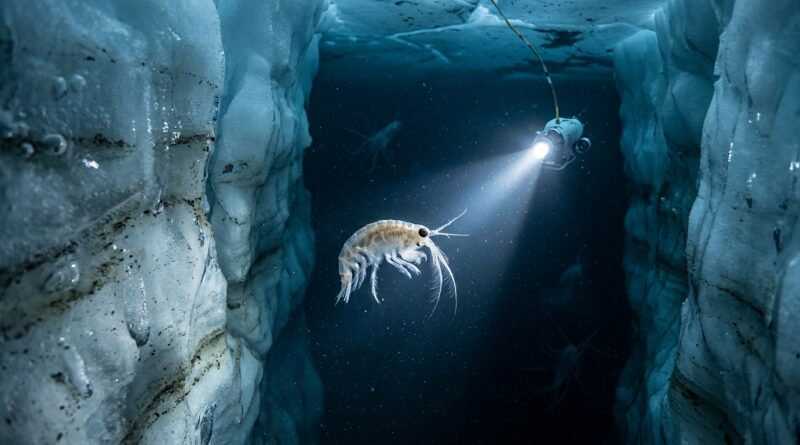
The Tiny Creature Under The Ice: Did Scientists Just Stumble On A ‘Wrong Place, Wrong Planet’ Lifeform?
You can be forgiven for rolling your eyes at this one. We have all seen “impossible creature” stories melt into bad footage, confused headlines, or a researcher saying something careful that turns into clickbait by lunchtime. That is what makes the report of a mysterious shrimp like creature found under ice so gripping. This was not a monster splash or a viral hoax. It was a quiet scientific surprise. Researchers working beneath thick Antarctic ice found a small, shrimp-like animal living in dark water where many people assumed only sparse microbial life would hang on. That does not mean scientists found an alien. It does mean they found a stubborn little rule-breaker in a place that looked too harsh, too sealed off, and too food-poor for this kind of animal life. The real story is better than hype. It shows how often nature keeps one more card up its sleeve.
⚡ In a Hurry? Key Takeaways
- Scientists did not find an alien, but they did find a shrimp-like crustacean living under Antarctic ice in a place many expected to be nearly empty of animal life.
- When you read stories like this, check three things first: the original research source, whether experts say “unexpected” instead of “impossible,” and whether the claim has been repeated by more than one outlet.
- The big value here is not shock. It is that sub-ice life on Earth gives us a real-world test case for possible life in hidden oceans on moons like Europa and Enceladus.
What actually happened?
The short version is simple. Scientists exploring beneath Antarctic ice shelves and sea ice have, in a few cases, found small mobile animals in places that were expected to be extremely difficult habitats. One of the most talked-about examples involved a tiny amphipod, a crustacean that looks shrimp-like to most of us, spotted in water under thick ice.
That matters because the setting is brutal. No sunlight. Very low temperatures. Long isolation. Limited easy food sources. If you picture a lively food web there, you are not crazy, but many older assumptions leaned toward “mostly microbes, not much else.” So when a little scavenger or grazer turns up, it forces scientists to ask a basic question. How is the system being fed?
This is why the phrase mysterious shrimp like creature found under ice caught on. The animal itself is not magical. The location is. Put a common-looking crustacean in a very uncommon place, and suddenly it becomes a clue.
Why people are calling it a “wrong place, wrong planet” lifeform
That phrase is more poetic than scientific, but I get why it sticks. The environment feels off-world. Under solid ice, in darkness, in water cut off from the normal image we have of ocean life, this creature looks like it wandered in from a science fiction storyboard.
Still, “wrong planet” can be misleading. Life on Earth has had a very long time to test every crack, vent, trench, cave, and frozen edge it can find. A better way to say it is this. The creature is a sign that Earth keeps building ecosystems in places humans once wrote off too quickly.
If that idea interests you, it fits nicely with The 400-Year-Old Shark And The Cities Of The Deep: Are ‘Immortal’ Animals Hiding A Secret World Beneath Us?. That piece looks at how the deep sea keeps humbling our neat little categories about what life should do and where it should live.
So is this a real discovery or media inflation?
Mostly real discovery. Some inflation. That is usually how these stories go.
The real part
Scientists have repeatedly shown that sub-ice Antarctic environments are more biologically active and more connected than many non-specialists assume. Small crustaceans, worms, fish, microbes, and suspended organic matter can all be part of that story, depending on the site.
Finding a shrimp-like animal in such a place is not proof of a whole lost kingdom. But it is a genuine data point against the lazy idea that thick ice automatically means sterile emptiness.
The inflated part
Headlines often skip the boring but important details. Was the creature living there full time, or passing through? Was that spot truly isolated, or connected by under-ice water flow? Was there enough drifting food, algae, or organic matter to support a tiny food chain? Those details decide whether the story is “remarkable but explainable” or “something that really shakes old models.”
Most often, the answer lands in the first category. Remarkable, yes. Magic, no.
How could a tiny animal survive under the ice?
This is the fun part, because it sounds strange until you break it into plain English.
1. Water under ice is not always sealed off
Many people imagine a hard-frozen lid over a dead, trapped world. In reality, sub-ice water can still move. Currents can carry oxygen, nutrients, and bits of organic material into places that look isolated from above.
2. Food does not have to come from sunlight right there
Even if the animal lives in darkness, food can drift in from more productive nearby waters. Think of it like crumbs washing into a basement drain. The basement did not make the food, but it still receives it.
3. Some ecosystems run on chemistry as much as light
On Earth, life is not limited to the classic “sunlight hits plants, animals eat plants” setup. Some microbes use chemical energy from minerals and reactions in water and rock. Tiny animals can then feed directly or indirectly on that microbial base.
4. Small bodies need less
A little amphipod does not need much to get by compared with a fish, seal, or whale. Sometimes a place that seems empty to us is still rich enough for miniature life.
Why this matters for alien oceans
This is where the story stops being just a weird Antarctic footnote.
Europa and Enceladus, moons of Jupiter and Saturn, are thought to hide global oceans beneath thick ice. Scientists cannot just pop the hood and look around. So they use Earth’s hard-to-reach environments as test cases. Every time life turns up in cold, dark, isolated water on our own planet, it gives astrobiologists one more reason to take those icy moons seriously.
That does not mean shrimp are swimming under Europa’s ice. It means the list of “conditions that can still support life” keeps getting longer. Darkness alone is not a deal-breaker. Cold alone is not a deal-breaker. Isolation alone is not a deal-breaker. Once you learn that, the solar system feels a lot less empty.
How to read these anomaly stories without getting played
If you like Fortean science but do not want to fall for every flashy post, use this quick filter.
Check the original wording
Scientists often say “unexpected,” “unusual,” or “poorly understood.” News writers love turning that into “impossible” or “rewrites everything.” Those are not the same thing.
Look for the habitat details
The creature may be less mysterious than the environment. Ask what the ice thickness was, how connected the water is, and what food source is proposed.
Separate “unknown species” from “known type in an odd place”
A mysterious shrimp like creature found under ice sounds dramatic. But if it is an amphipod, that means scientists already know the general kind of animal. The mystery is often ecological, not anatomical.
Wait for follow-up work
One sighting is exciting. Repeated observations, samples, and independent teams are what turn a cool oddity into a strong scientific case.
Why mainstream science can seem slow to react
This frustrates a lot of anomaly-minded readers, and honestly, I understand it. You see something weird and want a clear answer now. Science usually answers with paperwork, caveats, and years of checking.
That can look like dismissal. Sometimes it is caution. Sometimes it really is institutional inertia. Both things can be true.
The useful move is to watch how the story changes over time. Does the odd finding quietly vanish because later evidence knocks it down? Or does it get folded into the new normal after enough studies pile up? That process is less cinematic than a giant reveal, but it is how real paradigm shifts usually happen.
What this tiny creature tells us about Earth
It tells us we still underestimate hidden ecosystems. We map the planet, launch satellites, and build models, yet a small crustacean under ice can still tap us on the shoulder and say, “You missed a spot.”
It also reminds us that life is an opportunist. Give it a crack in the system, a little chemical energy, some drifting food, a stable pocket of water, and it will try to make a living there.
That should make us more careful with grand claims about where life cannot exist. “Cannot” has a bad track record in biology.
At a Glance: Comparison
| Feature/Aspect | Details | Verdict |
|---|---|---|
| What was found | A small shrimp-like crustacean, likely an amphipod or similar animal, in dark water beneath Antarctic ice. | Real and scientifically interesting. |
| Why it surprised scientists | The habitat seemed too isolated, cold, and low-energy to support that kind of animal life easily. | A challenge to older assumptions, not proof of the impossible. |
| Bigger meaning | Shows that hidden sub-ice ecosystems may be more complex than expected and gives clues for searching for life in icy alien oceans. | High value for astrobiology and anomaly watchers alike. |
Conclusion
The best part of this story is that it gives us a fresh mystery that is concrete, testable, and weird in the right way. No fuzzy lights. No recycled files. Just a tiny survivor in a place that pushes our idea of habitability. That is gold for the Anomal crowd. Deep sub-ice ecosystems sit right where astrobiology, climate science, and old-school Fortean curiosity meet. So yes, keep the wonder. Just keep your fact filter on too. If mainstream science first shrugs, then studies, then slowly updates its story, that is worth watching. A small misfit under Antarctic ice may not be an alien, but it is exactly the kind of clue that helps us imagine what could be waiting beneath the frozen shells of Europa and Enceladus, and how real anomalies get absorbed, argued over, or brushed aside over time.