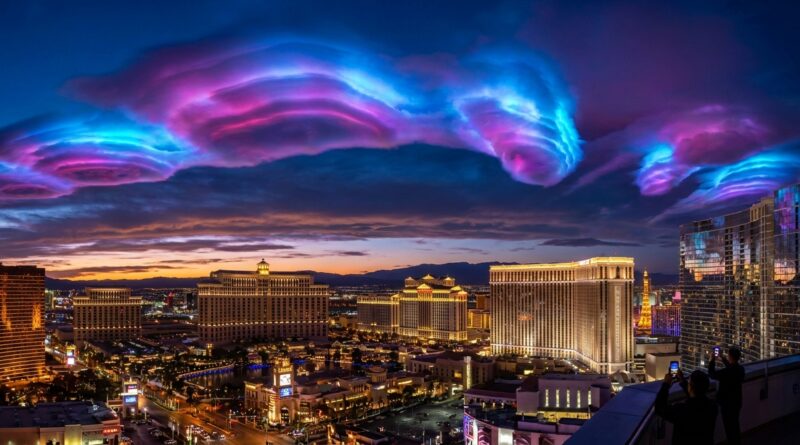
The City That Glowed After Dark: Why Last Night’s ‘Electric Clouds’ Have Las Vegas Asking If The Sky Just Glitched
If you stepped outside in Las Vegas last night and saw clouds glowing like a giant neon sign, you are not being dramatic. It really did look strange. The frustrating part is what happened next. People went online for answers and got the usual mess: “just sunset colors,” “government test,” “AI fake,” “nothing to see here.” None of that helps when your own eyes just watched the sky look like it had been edited.
What likely happened is less sci-fi, but still pretty wild. The most plausible mix is high clouds catching the last angle of sunlight, city light reflecting upward, and phone cameras boosting contrast and saturation so the effect looked even more electric on screen. That does not mean people imagined it. It means a real atmospheric moment got amplified by the way modern cameras and social feeds present it. The good news is you do not need a meteorology degree to check whether a sky mystery is real, exaggerated, or completely miscaptioned. Here is how to think it through without getting lost in clickbait.
⚡ In a Hurry? Key Takeaways
- The mysterious glowing clouds over las vegas sky were most likely a real sunset and cloud-lighting event, not proof the sky “glitched.”
- Check time, direction, weather data, and multiple videos before trusting a viral clip or wild explanation.
- Phone cameras often make bright skies look sharper, brighter, and more unnatural than they looked in person.
Why these clouds looked so unnatural
Las Vegas is already a city built on light. That matters.
When thin or mid-level clouds hang in the sky around sunset, they can catch sunlight from below the horizon while the ground is getting darker. That creates a strong contrast. Your eyes see a darkening city and then, above it, bright cloud edges or glowing patches that seem almost backlit.
In a place like Vegas, there is another ingredient. Tons of artificial light. Hotel facades, giant screens, parking lots, traffic, spotlights, and haze can all bounce light around in ways that make clouds look brighter and stranger than they would over a darker town.
Put those together and you get something that can feel genuinely unreal.
What probably happened last night
1. The sunset angle did the heavy lifting
After sunset, the sun can still light high clouds even when it is no longer visible from the ground. That often creates hot pink, orange, electric blue, or glowing white patches that look disconnected from the rest of the sky.
2. Cloud type matters more than people think
Thin layers of altocumulus, cirrus, or patchy high moisture can act like giant screens. If there were uneven layers, some parts would “switch on” while nearby clouds stayed dull. That mismatch is a big reason people called the effect creepy or fake-looking.
3. Phone cameras made it look even more extreme
This is the part people often miss. Modern phones aggressively process sky photos. They boost dynamic range, sharpen edges, increase local contrast, and sometimes punch up blues and magentas. So the clouds in your camera roll may have looked more electric than the clouds in front of you.
That does not mean the event was fake. It means the image was real, then polished by software in milliseconds.
Why social media made the mystery worse
The internet is great at one thing: taking a weird but explainable event and making it feel like a cover-up.
One person posts a dramatic clip. Another reposts it with a spooky caption. Someone else strips out the location, changes the date, or adds “nobody can explain this.” Pretty soon, normal uncertainty starts to feel suspicious.
That is especially true with sky events. Rockets, satellites, weather balloons, auroras, cloud iridescence, and light pillars all get thrown into the same viral blender.
So if you felt like coverage stopped at “wow, pretty” while commenters jumped straight to “proof something is wrong,” you are not alone. That gap is exactly why these stories spiral.
How to audit a viral sky event yourself
You do not need special tools. Start with a simple checklist.
Check the time
Was the footage taken just before sunset, right after sunset, or deep into the night? Glowing cloud events are much easier to explain near twilight than at 11:30 p.m.
Check the direction
Was the camera pointed west, where the sun had just set? Or was it pointed somewhere that would make sunset lighting less likely? Direction matters a lot.
Look for multiple witnesses
One clip can be edited. Twenty clips from different neighborhoods are more useful. If people across the valley saw roughly the same thing at the same time, it points to a real atmospheric event.
Compare photos to video
Photos often look more intense because phones process them harder. Video can still be processed too, but it sometimes gives a more realistic sense of how fast the glow changed and how broad the effect was.
Check local weather and cloud maps
Cloud cover, humidity, dust, and upper-atmosphere conditions can explain a lot. You are looking for confirmation that there really were the right kinds of clouds present over Las Vegas at the time.
Watch for recycled footage
This happens constantly. A video from Arizona, Dubai, or last year gets reposted as “Las Vegas last night.” If the skyline, weather, or timestamps do not line up, be skeptical.
What it probably was not
Not likely a sky “glitch”
I know. That sounds obvious. But when something looks digitally sharp in real life, people reach for digital language. The sky did not bug out. The mix of light, clouds, and camera processing just hit an unusual sweet spot.
Not automatically AI
AI-generated sky images are everywhere now, which makes real footage harder to trust. But the best clue is consistency. If many independent people captured the same glow from different angles, that is strong evidence the event itself was real.
Not proof of a secret experiment
Could atmospheric tests, launches, or high-altitude activity sometimes create weird visuals? Yes. But those usually leave telltale shapes like spirals, streaks, plumes, or moving luminous trails. “Electric clouds” spread across a twilight sky are far more often explained by weather and lighting than by hidden operations.
Why Las Vegas is the perfect place for this kind of confusion
Vegas is almost built to make normal things look staged.
You have dry air, dust, heat, strong light pollution, massive LED displays, reflective surfaces, and wide open views of the horizon. All of that can make ordinary atmospheric optics feel extra theatrical. In another city, people might have called last night’s scene pretty. In Las Vegas, it looked like the city had somehow projected itself onto the clouds.
What to do next time you see something bizarre overhead
Take one photo, then one short video
Do both. Photos capture detail. Video captures timing and movement.
Note the exact time and direction
Even a quick note in your phone helps. “7:18 p.m., looking west from Summerlin” is much more useful than “crazy sky lol.”
Ask neighbors before the internet
This sounds old-fashioned, but it works. If people in nearby parts of town saw the same thing, you can rule out a lot of nonsense right away.
Save the original file
A reposted screenshot strips context. The original photo or video often keeps metadata like time and device details, which can help later.
Wait an hour before believing anyone
Seriously. Early explanations are often the worst ones. Give it a little time for weather accounts, local photographers, and actual experts to compare notes.
So, were the clouds “real”?
Yes. The weirdness was real. The “electric” feeling was real. What is less likely is the dramatic explanation attached to it.
The best current read is that people saw a genuine atmospheric display that looked extra intense because of twilight lighting, cloud position, city glow, and modern phone image processing. That combination can absolutely produce a sky that looks too bright, too clean, and too vivid to trust at first glance.
And honestly, that is why these moments stick with people. They sit right in the uncomfortable space between ordinary weather and something that feels impossible.
At a Glance: Comparison
| Feature/Aspect | Details | Verdict |
|---|---|---|
| Visual intensity | Strong sunset angles, high clouds, and city light can create sharp, glowing patches | Likely natural, but unusually dramatic |
| Phone footage | HDR, contrast boosts, and color processing can make skies look more “electric” than real life | Useful evidence, but not neutral evidence |
| Exotic explanations | Claims about glitches, experiments, or fake footage spread faster than careful checks | Low confidence without matching data |
Conclusion
If last night’s mysterious glowing clouds over las vegas sky made you stop, stare, and then question your own eyes, that reaction makes sense. This was one of those rare moments where normal weather crossed into something that felt almost digital. The useful takeaway is not just what probably caused this one event. It is knowing how to handle the next one. When a sky scene goes viral and the internet splits between “beautiful” and “obviously fake,” you now have a better filter. Check the time, direction, weather, and how many people saw the same thing. Remember that phone cameras can exaggerate what was already unusual. That simple habit can save you from getting pulled into spammy theories while still respecting that you really did witness something striking. In a world full of launches, satellites, experiments, and endless recycled clips, being able to calmly audit the evidence is a real skill. It helps you feel less gaslit by the feed, and more confident asking for real answers.