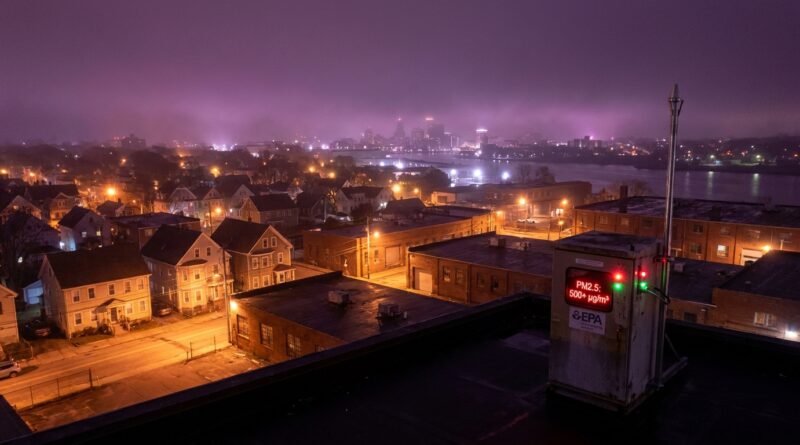
The Night The Air Turned Toxic: Why A Sudden Purple Haze Over Rhode Island Has Scientists Scrambling For Answers
If you woke up to alerts about East Providence suddenly slipping from ordinary air to “very unhealthy,” your confusion is fair. That kind of jump is not the usual bad-air day. Reports pointed to particle pollution soaring to more than sixty times the area’s recent 30-day norm, and that is exactly why people started asking harder questions. Was it wildfire smoke, an industrial release, weird weather, a sensor glitch, or some ugly mix of all four? Right now, the honest answer is frustratingly simple. Scientists do not have a clean explanation yet. What they do have is a real spike, real measurements, and a pattern odd enough to deserve scrutiny. The useful part for the rest of us is this. Events like this are a good reminder that air-quality data is not magic, but it is not random either. If you know what to look for, you can tell the difference between routine pollution noise and something that genuinely looks off.
⚡ In a Hurry? Key Takeaways
- The mysterious air quality spike East Providence saw appears to be real, but the exact cause is still unexplained.
- Check whether a spike shows up across multiple monitors, matches weather conditions, and lasts long enough to rule out a brief sensor hiccup.
- If air quality suddenly enters the unhealthy range, treat it seriously first and solve the mystery second. Go indoors, close windows, and limit exertion.
What actually happened in East Providence?
The short version is that particle pollution, usually tracked as PM2.5, appears to have shot up fast enough to trigger alarm. PM2.5 means tiny particles in the air small enough to get deep into your lungs. They can come from smoke, traffic, industrial activity, construction dust, chemical reactions in the atmosphere, and a few less obvious sources.
What made this episode stand out was not just that the number got high. It was how sharply it broke from the recent baseline. If an area has been sitting at one rough level for weeks and then suddenly jumps to something dramatically worse, that gets attention. It should.
That is where the “purple haze” language starts to matter. Sometimes it is just colorful headline writing. Sometimes people are describing an actual visible cast in the sky caused by light scattering through heavy particles or aerosols. Those two things are not always the same, so it helps to separate the image from the measurements.
Why scientists are not satisfied with the easy answer
When air gets bad, the first guess is often wildfire smoke. That is reasonable. Smoke has been traveling huge distances across North America for years now. But “probably smoke” stops being a satisfying answer when the timing, concentration, local weather, or monitor pattern does not fit neatly.
Researchers usually want to know a few basic things before they settle on a cause:
Did multiple sensors agree?
If one monitor spikes while nearby monitors stay calm, that raises the chance of a local source or a bad reading. If several monitors in neighboring areas jump together, the event is more likely to be regional and real.
Did the weather support it?
Wind direction matters. So does humidity. Temperature inversions matter too. An inversion is when a layer of warm air traps cooler air and pollution near the ground. It can make a city feel like it suddenly got sealed under a lid.
Was there an obvious source nearby?
A port operation, warehouse fire, chemical release, traffic surge, industrial upset, or even large-scale construction can cause a local burst. If no local source lines up with the timing, the mystery gets deeper.
Could it be a measurement problem?
Yes, sometimes. Low-cost sensors can be thrown off by moisture, calibration drift, or placement issues. But when official monitors and surrounding readings support the spike, the “just a glitch” theory gets weaker.
How to read a weird air-quality event like an insider
You do not need a lab coat to think clearly about air data. You just need a simple checklist.
1. Look for the pollutant type
Was the spike tied to PM2.5, ozone, or something else? PM2.5 usually points you toward smoke, combustion, dust, or chemistry in the air. Ozone follows a different pattern and often builds with sunlight and heat.
2. Compare one-day drama to the 30-day baseline
This is where the East Providence event gets interesting. A bad number by itself can be scary, but a bad number that is wildly out of line with the previous month is more useful. It tells you the event broke pattern, not just comfort.
3. Check nearby maps, not just one app
Use official state data if available. Then compare it with broader tools like AirNow or PurpleAir. PurpleAir is useful because it gives you lots of local readings fast, but it also needs context because those sensors can be more sensitive to local quirks.
4. Watch the time curve
Did the pollution climb steadily, hit suddenly, or pulse in short bursts? Smoke drifting in often creates a broader curve. A local source can look spikier. A sensor issue can look abrupt in a way that does not match nearby stations.
5. Check weather and wind history
If the wind was carrying air from a known fire zone or industrial corridor, that is a clue. If the air was stagnant and trapped close to the ground, that is another clue.
What might explain a purple haze with no clear trigger?
Right now, there are a few plausible buckets, and none should be treated like confirmed fact without more evidence.
Wildfire smoke that behaved oddly
This is still the most familiar explanation. Smoke can travel far, mix with moisture, and interact with local conditions in ways that make one area look much worse than the map suggests at first glance.
A local industrial or transportation source
East Providence sits in a region where roads, shipping, fuel handling, and industry all exist in the background. A short-lived release or operational problem could create a concentrated plume, especially if the weather trapped it low.
Atmospheric chemistry
Some pollution is not emitted directly. It forms in the air when gases react. That can produce a spike that feels sudden and hard to pin to one smokestack or fire.
A monitoring artifact mixed with real pollution
Sometimes the answer is messy. A real increase in particles can be exaggerated by humidity or sensor sensitivity, making a bad event look even worse than it was. That does not mean nothing happened. It means measurement and reality may both be part of the story.
What should regular people do during an unexplained air event?
This part is boring but important. You do not need to know the exact cause before protecting yourself.
Go indoors if levels are unhealthy
Close windows and doors. If you have central air, run it with a clean filter. If you have a portable HEPA purifier, use it in the room you spend the most time in.
Skip hard exercise outside
Running, yard work, and long walks all increase how much polluted air you breathe in. If the air is in the unhealthy range, scale back.
Use a good mask if you must be outside
An N95 or KN95 can help with particles. A cloth mask is far less useful for PM2.5.
Pay extra attention if you are vulnerable
Kids, older adults, pregnant people, and anyone with asthma, COPD, or heart issues should take these spikes seriously even if they are short.
Why this story matters beyond one strange night
The phrase mysterious air quality spike East Providence purple haze unexplained pollution sounds dramatic, but the bigger lesson is practical. A lot of environmental headlines train people to either panic or shrug. Neither is great.
The better habit is to ask: what exactly was measured, how unusual was it, did other sensors see it too, and what conditions could explain it? That approach helps you spot nonsense, but it also helps you notice when something truly unusual is happening.
That is why this case is so interesting. It sits in that uncomfortable middle ground where the data looks real, the pattern looks strange, and the easy story may not fully explain it. Those are the cases worth watching.
At a Glance: Comparison
| Feature/Aspect | Details | Verdict |
|---|---|---|
| Sensor evidence | Reported particle levels jumped far above the recent 30-day norm, suggesting a genuine anomaly worth checking. | Likely real, but still needs source confirmation. |
| Most likely explanations | Possible causes include transported smoke, a local industrial or traffic-related plume, trapped pollution from weather, or a mixed measurement effect. | No single theory fully closes the case yet. |
| What residents should do | Follow air-quality alerts, stay indoors when readings are high, use filtration, and avoid heavy outdoor activity. | Treat the health risk first, the mystery second. |
Conclusion
This is the kind of story that rewards calm thinking. A sudden air spike over East Providence is weird enough to deserve attention, but not so mysterious that we have to fill the gaps with nonsense. The value here is in learning how to read the signs. This story lands right at the intersection of weird and useful, a real-world atmospheric anomaly, logged by hard sensors, that behaves just wrong enough to resist simple answers. Covering it now helps the Anomal community sharpen its bullshit detector around environmental scares, learn how to read air-quality data like insiders, and spot genuine outliers hiding in what looks like routine pollution news. In a week full of climate doomscrolling, a single spike that breaks its own pattern is a better use of your attention than another vague panic headline. It reminds us that the air around us is still full of systems we only partly understand, and that careful observation beats easy certainty every time.