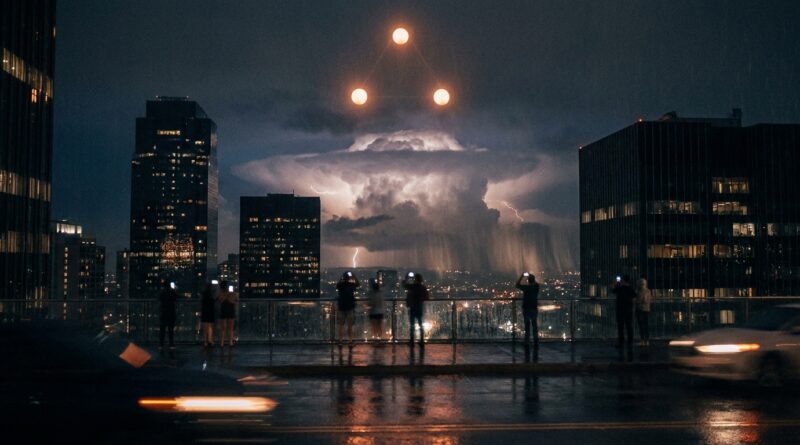
The Lights That Refused To Be Labelled: Why Last Night’s Triple-Orb Sightings Have Both Skeptics And Believers Second-Guessing The Sky
If you watched those three bright lights hanging near last night’s storm line and instantly got told, “It’s drones,” “It’s Starlink,” or “You just filmed planets,” your annoyance is justified. People are tired of sky footage being dismissed before anyone checks the time, weather, direction, or how the lights actually moved. The reason these unexplained triple lights in the sky caught so much attention is simple. They did not neatly behave like the usual suspects. In several clips, the lights appeared fixed for long stretches, kept their spacing, and sat near an active weather boundary where atmospheric distortion can play tricks. That does not automatically make them alien craft. It also does not make every witness gullible. The smart move is to slow down, compare what was seen against known explanations, and only then decide whether this was misidentified sky traffic, a rare optical effect, or a genuinely unresolved sighting.
⚡ In a Hurry? Key Takeaways
- Last night’s three-light sightings do not cleanly match the usual quick answers like Starlink, standard aircraft patterns, or obvious consumer drones.
- Before sharing a clip, note the exact time, compass direction, weather conditions, and whether the lights held position, changed spacing, or vanished into cloud.
- Storm edges can create strange visual effects, so the best evidence is always multiple videos from different locations, not one shaky zoomed-in clip.
Why this sighting got people arguing so fast
The internet has a bad habit with sky videos. Someone posts a clip. Within ten minutes, half the replies say “Starlink,” even when the lights are not in a line. The other half say “drones,” even when the lights appear far beyond where hobby gear would sensibly operate in rough weather.
That is what made these unexplained triple lights in the sky stand out. Not because they were automatically extraordinary, but because the lazy explanations did not fit as neatly as people wanted them to.
Witnesses described three bright orbs near the edge of a storm system. In the clips that spread most widely, the lights seem to hover or drift very slowly. They do not streak across the sky like meteors. They do not move in the tidy train people know from Starlink launches. And they do not show the obvious red-green-white blinking pattern you would expect from many aircraft at night.
What the footage seems to show
1. Three separated lights, not a line
This matters. Starlink is the first thing people reach for because it is familiar now. But Starlink usually appears as a moving chain or a sequence of points following the same path. Three isolated lights holding a rough triangular or offset formation is a different starting point.
2. Long pauses in apparent motion
Several viewers said the lights looked stationary for uncomfortable stretches of time. Be careful here. “Looked stationary” is not the same as “was stationary.” When you are watching distant objects at night, especially without foreground reference points, your eyes can lie to you. But if multiple witnesses in different places report the same pause, that deserves a closer look.
3. A storm edge in the background
This is the big complication. Storm boundaries are famous for making normal lights look weird. Moisture layers, temperature differences, haze, and moving cloud can all distort brightness and apparent position. A perfectly ordinary object can seem to hover, split, shimmer, or jump.
What it probably was not
Probably not Starlink
Starlink satellites usually move steadily and predictably. They do not hover over one patch of sky. They also tend to be seen in a more obvious sequence. Unless the clips were badly cut or heavily cropped, this explanation feels weak.
Probably not a typical plane approach
Aircraft coming toward a viewer can appear almost still for a while. That part is real. Landing lights can also make planes look like glowing white orbs. But three separate lights maintaining that kind of visual spacing near a storm line raises questions. It is possible, just not the cleanest fit unless there was known air traffic stacked along the same approach corridor.
Probably not a casual backyard drone flight
Could drones be involved? Sure. But “drone” has become the new “swamp gas.” It gets tossed at every mystery because it sounds modern and practical. Three drones flying near unstable weather, at enough distance to look like orbs, while holding a convincing formation long enough to fool many observers, is possible. It just needs evidence, not reflex.
What it could have been
Atmospheric distortion of known lights
This is the strongest ordinary explanation. Bright celestial objects low on the horizon, distant aircraft, or even towers can look very strange through unstable air. Add storm moisture and shifting cloud layers, and you get a visual mess. Lights can twinkle hard, blur into larger glowing discs, and seem to move when the clouds are doing the moving.
Aircraft viewed head-on through weather
This remains a serious possibility. Planes on approach can seem fixed in place when they are flying directly toward the observer. If three aircraft were on staggered paths at different distances, a camera phone could flatten that depth and make them look clustered.
A genuine unknown, for now
This is the category people are often afraid to say out loud because they think it sounds dramatic. But “unknown” is a normal label. It does not mean aliens. It means the available video, witness reports, and location data do not yet let us identify the source with confidence.
How to judge unexplained triple lights in the sky without fooling yourself
Start with the boring details
Write down the time. Get the direction. Note whether you were facing west, southeast, or toward a known airport. Check if there was lightning, low cloud, mist, or incoming rain. These details solve more mysteries than dramatic zoom-ins ever do.
Watch for relative movement
Ask one simple question. Did the three lights keep the same spacing the whole time? If yes, that points more toward a structured source, like aircraft, drones, or a linked optical effect. If the spacing changed in odd ways, clouds and perspective may be doing more of the work.
Do not trust digital zoom
Phone zoom is where many sky mysteries go to die. A tiny point of light becomes a pulsing blob with fake edges and apparent texture. That is the camera struggling, not secret engineering. Wide shots with buildings, trees, or rooflines are far more useful than giant zoomed-in glowing circles.
Look for corroboration
The gold standard is multiple witnesses in different spots filming the same event at the same time. If one person sees three lights, that is interesting. If six people across town catch them from different angles, now you can start comparing geometry instead of feelings.
Why skeptics and believers are both rethinking this one
Skeptics are rethinking it because the standard one-word debunks feel thin here. Believers are rethinking it because storm-edge optics are exactly the kind of thing that can create convincing but misleading footage.
That middle ground is where the useful conversation lives. Not blind belief. Not lazy dismissal. Just careful checking.
And honestly, that is healthier for everyone. If every strange sky event gets instantly shoved into a pre-labeled box, people stop reporting what they saw. Then when something truly unusual does happen, the good evidence is missing because witnesses assume they will just be mocked anyway.
What to do the next time you see something like this
Use the 30-second evidence checklist
Here is the practical routine:
First, take one wide video for context. Second, say the time and direction out loud while recording. Third, include a roofline, tree, pole, or horizon reference in frame. Fourth, shoot another short clip 2 to 5 minutes later. Fifth, check local weather radar and flight tracking after, not before.
That last part matters. If you check apps first, you may force the sighting to fit the answer you expect.
Compare before posting claims
It is fine to say, “I don’t know what this is.” In fact, that is the most credible thing you can say. Post the raw clip, the location, the viewing direction, and the weather. Let other people test the easy explanations against the actual evidence.
At a Glance: Comparison
| Feature/Aspect | Details | Verdict |
|---|---|---|
| Starlink match | Starlink usually appears as a moving train or sequence, not three hovering separated lights near a storm edge. | Weak fit |
| Drone explanation | Possible in theory, but weather, distance, and long apparent hovering make “just drones” too easy without proof. | Possible, not confirmed |
| Atmospheric optics | Storm edges can distort brightness, motion, and shape, especially for distant planes or bright horizon objects. | Strong conventional contender |
Conclusion
Last night’s unexplained triple lights in the sky may end up having a plain answer. They may not. What matters is that people stop treating every odd sighting like it has to be solved in under five minutes with the same recycled guesses. There is a growing fatigue around sky mysteries because every viral clip gets buried under the same three lazy explanations within hours. By walking through the triple-light storm-edge sighting step by step, we get better at separating atmospheric tricks from true unknowns in real time. That makes witnesses more credible, discussions more useful, and the whole community less easy to gaslight the next time the sky does something strange.