The Sea Creatures That Built a ‘Dragonball’: Why a Perfect Sphere Hidden 3 Miles Down Has Deep‑Sea Biologists Stumped
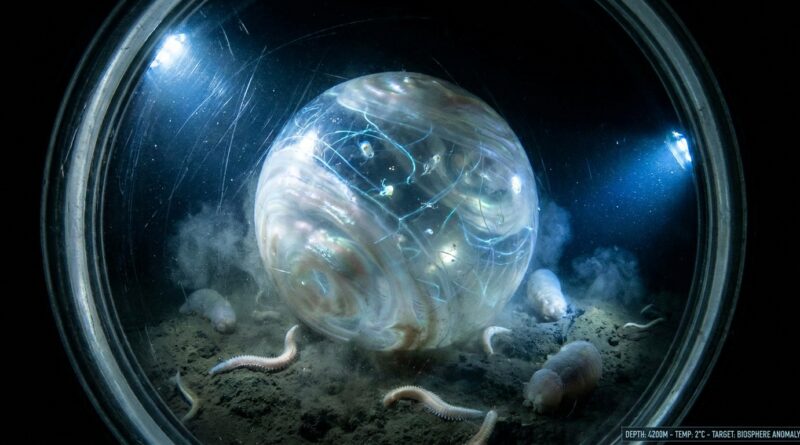
You are not imagining it. A lot of so-called “mysteries” turn out to be blurry footage, old junk, or a headline that promises way more than the science can actually support. That is why this deep-sea story feels different. Researchers found a nearly perfect sphere, nicknamed a “dragonball,” sitting about 3 miles down on the Pacific seafloor, and it was not random trash or camera noise. It was a real biological structure, documented and studied, with one big problem. Scientists still cannot fully explain how soft-bodied sea creatures built something so precise under such crushing pressure. If you have been wondering whether Earth still has true unknowns left, this is a good example that the answer is yes. We have mapped a lot, but the deep ocean still hides things that can surprise even the people who study it for a living.
⚡ In a Hurry? Key Takeaways
- This “deep sea dragonball structure unexplained marine biology” story is real science, not internet hype. A strange spherical seafloor structure was observed and remains only partly explained.
- The best way to read stories like this is to separate what scientists know from what they are still testing. Here, the mystery is genuine because the evidence is solid but the mechanism is not settled.
- There is no sign this is dangerous or supernatural. Its value is that it may change how biologists think about what simple marine animals can build in the deep sea.
What exactly was found?
The nickname “dragonball” comes from the object’s look. It appeared as a striking, almost perfectly round sphere on the deep seafloor, far below sunlight, where pressure is extreme and life often looks more like a science-fiction prop than a familiar animal.
What makes this stand out is not just the shape. The sphere seems to be biological in origin, built or formed by sea creatures rather than by geology alone. That matters, because perfect or near-perfect shapes are hard enough to make in shallow water. Doing it deep in the ocean, with soft-bodied organisms and no obvious rigid blueprint, is the part that has biologists scratching their heads.
Why are scientists calling it puzzling?
Because this is not the usual kind of “puzzling” that falls apart on closer inspection.
Scientists have decent reasons to think the structure is real, biological, and unusual. But they do not yet have a clean answer to the biggest questions:
- Which creature or group of creatures made it?
- How was the sphere assembled so evenly?
- What is the purpose? Shelter, reproduction, feeding, protection, or something else?
- Why build this shape at all in such a harsh environment?
That is an important difference. The uncertainty is not “Did anyone really see it?” The uncertainty is “How, and why, does this exist?”
Why a perfect sphere is such a big deal underwater
A sphere sounds simple until you think about what nature has to do to make one. It is one of the most efficient shapes in physics, but in biology, especially for built structures, getting that level of symmetry can be hard.
Many marine animals make tubes, mats, nests, burrows, mucus houses, egg cases, or protective coverings. Those are common enough. A highly regular sphere, especially one linked to soft-bodied life, is another matter.
Soft-bodied animals do not have hands, tools, or rigid skeletons to measure and lock a shape into place. They rely on body motion, secreted materials, currents, and repeated behavior. So when researchers find a structure that looks engineered, the obvious question is whether these animals can control form more precisely than we thought.
Crushing pressure changes the rules
At around 3 miles deep, pressure is immense. Materials behave differently. Movement is slower. Energy is precious. Building anything elaborate costs something. That is why biologists pay attention when life down there seems to be “spending” effort on structure.
If an animal is creating a sphere under those conditions, the shape likely serves a useful purpose. Nature usually does not waste calories for decoration.
What scientists think may be going on
Right now, the most careful answer is that researchers are working through competing explanations.
Some possibilities include:
1. A reproductive structure
This is one of the strongest ideas whenever marine life builds something unusual. A sphere can protect eggs, embryos, or larvae. It can also create a stable micro-environment in a place where outside conditions are rough and unpredictable.
2. A feeding or filtration aid
Certain sea animals build structures that help manage water flow, trap particles, or gather nutrients. If the dragonball changes how water moves around it, the shape might be practical rather than accidental.
3. A protective casing
Some soft-bodied creatures make coverings from mucus, sediment, or secreted material. A sphere could help defend whatever is inside from predators, disturbance, or sediment buildup.
4. A colony effect
Another possibility is that no single animal “designed” the whole thing. Several organisms, or one colonial organism, may have produced a sphere through many small repeated actions. In nature, complex forms often come from simple behaviors repeated over and over.
Why this is not just another overhyped anomaly
Because the interesting part survives even after you strip away the dramatic language.
You do not need aliens, secret tech, or magical thinking to make this story worth your time. The real hook is more satisfying than that. Scientists saw something unexpected, documented it, and openly admitted they do not yet have the full answer.
That is how good mystery works in science. Not “trust the vibe.” Trust the evidence, then stay honest about the gaps.
What this tells us about how little of Earth we truly know
People often assume Earth is basically finished as a frontier. We have satellites, sonar maps, deep-diving robots, and giant data sets. Surely the surprises are mostly gone.
Not even close.
The deep ocean is still one of the least understood places on the planet. We have broad maps of many areas, but “mapped” does not mean “understood.” It is a bit like having a street map of a city without knowing who lives in each building, what they do there, or what strange things happen behind closed doors.
That is why this dragonball matters beyond its weird shape. It is a reminder that Earth still produces new, testable mysteries. You do not have to look to distant galaxies for the next genuine unknown.
Why the “soft-bodied life” angle matters so much
Soft-bodied marine animals are often underestimated because they do not leave behind big skeletons, shells, or obvious traces. But they can reshape their environment in ways we are still learning to spot.
If this structure really was built by animals with relatively simple bodies, it pushes biologists to rethink what counts as advanced construction behavior. Intelligence is one part of that conversation, but so is something simpler and more common in nature: rules.
A creature does not need to “think” like a human engineer to make something impressive. If it follows a reliable sequence of behaviors, and if local conditions help those behaviors lock into place, remarkable geometry can result.
How to read this kind of story without getting burned
If you are tired of exaggerated mystery headlines, here is the easiest filter to use.
Ask three questions
- Was the object actually observed and documented by researchers?
- Is there a peer-reviewed scientific discussion behind the claim?
- Are the unknowns specific, or is the whole story vague?
This case scores well because the uncertainty is specific. The broad facts are not in dispute. The debate is about origin, function, and mechanism.
Watch for honest language
Good scientists say things like “likely,” “consistent with,” “unclear,” and “we need more data.” That is not weakness. That is the part that makes the story trustworthy.
When a mystery survives careful language, it is usually worth paying attention to.
What happens next?
The next step is not wild speculation. It is better observation.
Researchers will want more examples, more imaging, better samples if they can collect them without destroying the structure, and ideally direct evidence connecting a specific organism to the sphere-building process.
That might mean:
- Repeat sightings in the same region
- Higher-resolution video or close-up robotic surveys
- Chemical analysis of the material
- DNA clues from nearby organisms
- Comparisons with known structures built by gelatinous or colonial marine life
Science often works like this. First comes the surprising observation. Then comes the slower, less flashy part where researchers test every boring explanation before keeping the exciting one.
At a Glance: Comparison
| Feature/Aspect | Details | Verdict |
|---|---|---|
| What it is | A real, nearly spherical deep-sea structure believed to be biological rather than random debris. | Genuinely unusual |
| What scientists know | It was observed on the seafloor at great depth and appears linked to marine life. | Evidence is solid enough to take seriously |
| What remains unexplained | The builder, the method, and the biological purpose of such a precise sphere. | A real open question in marine biology |
Conclusion
The best part of this story is that it gives mystery fans something rare. A fresh anomaly that is real, peer-reviewed, and still unresolved. No recycled UFO loop. No fuzzy image carrying the whole plot. Just a strange deep-sea sphere that forces scientists to admit they still do not fully know what soft-bodied life can build under crushing pressure. That helps the Anomal community today because it shifts the conversation back to evidence. You can follow what researchers know, what they do not know, and why this deep sea dragonball structure unexplained marine biology case matters. Earth still has surprises left. Sometimes the most interesting unknown is not in the sky. It is sitting quietly on the ocean floor, waiting for someone to ask better questions.