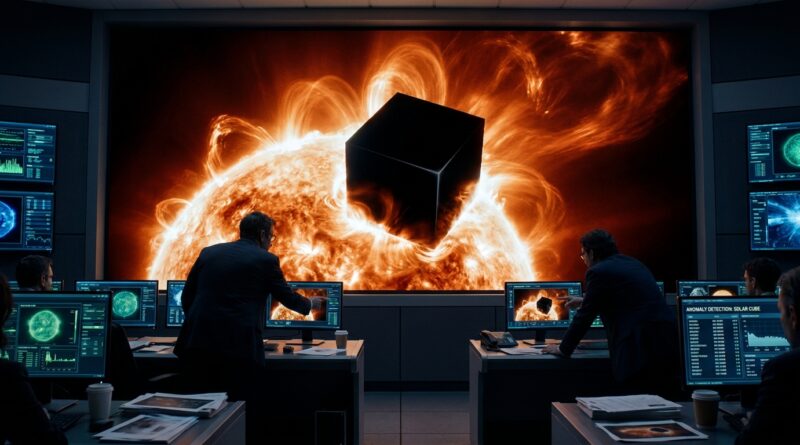
The Cube That Stepped Out of the Sun: Why a ‘Pixel Glitch’ on NASA Feeds Has Anomaly Hunters On Edge
If you have ever watched a wild space clip get shrugged off as “just compression” five minutes after it goes viral, you know the frustration here. The latest stir is a good example. A video pulled from NASA and ESA solar imagery appears to show two things people cannot stop arguing about: a bright, structured object that looks like it is emerging from the Sun, and a stark black cube that seems to blink in and out near the solar edge. That is why this one is getting traction. It is not a shaky phone video from a backyard. It is tied to instruments pointed at the most watched object in our solar system. Still, “most watched” does not mean “easy to read.” Solar observatories use heavy image processing, stacked exposures, occulting disks, and data cleanup. All of that can create shapes that look eerily solid. The real question is not whether the clip is creepy. It is whether the data supports the story people are telling about it.
⚡ In a Hurry? Key Takeaways
- The “mysterious cube emerging from the Sun unexplained solar anomaly” is more likely an imaging or processing artifact than proof of a giant craft.
- Before sharing a viral clip, check the original mission source, compare adjacent frames, and look for known coronagraph artifacts and dropped data.
- NASA solar feeds are fascinating, but they are also easy to misread if you do not know how coronagraph masks, contrast boosts, and missing pixels work.
Why this clip is hitting people differently
Most viral sky mysteries die fast because the source is weak. Bad zoom. No location. No context. This one feels different because it comes from solar observatory imagery, the kind of thing many people assume is clean, scientific, and hard to fake.
That assumption is understandable. It is also where people get tripped up. Space images are data products. They are not simple snapshots the way a vacation photo is. What you are seeing has often been filtered, stitched, colorized, corrected, and compressed so humans can make sense of an environment that is brutally bright and messy.
So yes, the cube looks strange. The “object leaving the Sun” looks strange too. But strange is not the same thing as solid evidence.
What people are actually seeing in the viral footage
The “object emerging from the Sun”
This part of the clip usually shows a bright protrusion or geometric-looking form near the solar limb, the edge of the Sun as seen by the instrument. To viewers, it can look like a giant craft backing out of the solar surface.
In many cases, these shapes come from a mix of solar plasma activity, blown-out highlights, frame interpolation, and contrast stretching. When you push faint structures to make them visible, your brain starts finding hard edges and familiar forms. Humans are very good at this. Too good, sometimes.
The black cube
The cube is the image everyone pauses on. It appears as a dark, tidy block near the Sun, then seems to vanish or shift between frames. That sounds dramatic, but it also matches how missing data, sensor saturation handling, and compositing artifacts can show up in processed coronagraph imagery.
When an image system has to deal with extreme brightness, cosmic ray hits, blocked central light, and changing exposure conditions, weird geometry can happen. Not because there is a cube parked next to the Sun, but because computers are trying to turn difficult measurements into a viewable image.
How solar observatories can create “impossible” shapes
This is the part that matters most if you want a better read on these clips.
1. Coronagraphs hide the Sun on purpose
Many of these viral images come from coronagraph instruments, such as those on SOHO. A coronagraph blocks the blinding central disk so scientists can see the faint corona around it. That means the dark center and the bright outer structures are already the result of a controlled optical trick.
When bright material passes near the edge of that mask, sharp transitions can appear. To a casual viewer, those transitions can look manufactured or object-like.
2. Images are processed for visibility, not for drama-free viewing
Raw solar data is often adjusted heavily. Brightness is stretched. Noise is reduced. Frames may be normalized so one dim event does not disappear next to a much brighter one. Those steps help science. They can also create blocky patches, clipped regions, or abrupt contrast boundaries.
3. Missing or corrupted pixels do not always look random
People expect a glitch to look like static. Often it does not. It can look neat. Square. Even “designed.” That is because digital imaging systems store and process data in grids and blocks. If a chunk fails, saturates, or gets replaced during cleanup, you can end up with a shape that looks much more intentional than it is.
4. Compression can turn fuzzy edges into hard geometry
Once clips get reposted on social platforms, the problem gets worse. Compression adds ringing, edge sharpening, and block artifacts. A soft anomaly can become a crisp-looking cube after enough reposts, screen recordings, and edits.
Does that mean there is nothing unusual here?
Not exactly. It means “unusual” needs better categories.
There are at least three possibilities when a clip like this blows up:
- A real solar event is being misdescribed as an object.
- A genuine image artifact is being mistaken for physical structure.
- A video edit or repost has exaggerated what the original data showed.
All three are common. None require a cover-up. And none should stop people from asking questions.
The healthy middle ground is simple. Stay curious. Stay picky.
How to check a viral NASA solar clip yourself
You do not need a PhD for this. You just need five extra minutes and the right habits.
Go to the original source
Try to find the mission archive or the original frame sequence, not a TikTok repost with spooky music. Look for date stamps, instrument names, and frame numbers. SOHO, SDO, and ESA archives often let you compare neighboring frames.
Check whether the anomaly persists
If a cube is real and physical, it should behave consistently across consecutive frames, viewing modes, and sometimes even across instruments. If it appears in one frame and vanishes in the next with no natural motion, that leans toward artifact.
Compare different wavelengths or instruments
Solar features can look wildly different depending on wavelength. A structure that only appears in one processed stream but nowhere else deserves skepticism.
Look for edge behavior
Artifacts love boundaries. The edge of the occulting disk, the border of a frame, or a region of extreme brightness is where false geometry often shows up.
Be suspicious of perfect shapes
This sounds backward, but in noisy scientific imaging, a perfect square or cube is often less convincing, not more. Nature is messy. Sensors, grids, and software are square.
Why anomaly hunters are still locked onto this one
Because it scratches a very specific itch. People who follow strange-sky stories are tired of low-quality evidence. So when a high-resolution, official-looking source coughs up a shape that seems geometric, it feels like a step up.
And to be fair, it is a step up in one sense. The source material is better than the usual random upload. That makes it worth examining carefully. It does not make the alien-craft claim stronger by default.
The bigger lesson is that better source material also demands better analysis. If you want to take anomalies seriously, you have to be just as willing to test your favorite clip as defend it.
My read on the “mysterious cube emerging from the Sun unexplained solar anomaly” claim
The safest conclusion right now is boring, but useful. The footage is intriguing. The interpretation is doing most of the heavy lifting.
I do not see strong evidence that a massive craft literally emerged from the Sun. I do see good reasons why processed solar imagery could create both a false “structured object” and a cube-like void. Until someone can trace the original frames, show persistence across multiple images, and rule out instrument artifacts, this sits in the “interesting visual anomaly” bucket, not the “world-changing proof” bucket.
That is not a buzzkill. That is how you avoid getting played by pixels.
At a Glance: Comparison
| Feature/Aspect | Details | Verdict |
|---|---|---|
| Source credibility | Imagery is tied to real solar observatory feeds, which makes it more interesting than an anonymous phone video. | Worth checking, but not proof by itself. |
| Cube-shaped anomaly | A clean dark block can result from pixel loss, compositing, coronagraph edge effects, or processing artifacts. | More likely digital artifact than physical cube. |
| “Object emerging from the Sun” claim | Bright solar activity plus contrast stretching can create the look of a structured craft leaving the solar limb. | Unproven, and probably a misread of processed solar data. |
Conclusion
This story is blowing up because it hits a nerve. A viral clip claims a massive craft emerged from the Sun, then a cube-shaped void pops in and out of coronagraph frames. That is catnip for the anomaly crowd, especially when the footage seems cleaner than the usual blurry mess. But this is exactly where a sharper bullshit detector helps. Once you understand how solar observatories work, with occulting disks, aggressive processing, and the occasional ugly data artifact, the clip gets less magical and more testable. That is the real value here. Not killing the mystery, but giving people better tools to sort signal from nonsense. Serious readers and casual scrollers can meet in the same place on this one. Respect the weirdness. Then pull it apart carefully. That is how you keep curiosity alive without getting fooled by a black square next to the Sun.