The Desert Well That Won’t Behave: Why Arizona’s ‘Bottomless’ Sinkhole Still Baffles Science
You know the feeling. You click on a “mystery” headline, spend five minutes reading breathless copy, then one sensible search later the whole thing turns into a boring case of bad reporting. That is why Montezuma Well in Arizona is so interesting. This place does have explanations, but none of them tie everything up neatly. It is a sinkhole fed by a huge underground water supply. Fine. Except the water is loaded with carbon dioxide, low in oxygen, harsh on most fish, and still somehow supports species found almost nowhere else. Divers have also described a soft, shifting false bottom that makes the well feel less like a pond and more like a living vent. Add long-standing Indigenous traditions that treat the site as a sacred and liminal place, and you get something rare. Not fake mystery. Real unresolved questions, sitting in plain sight off a road people treat like a quick tourist stop.
⚡ In a Hurry? Key Takeaways
- Montezuma Well is not “bottomless,” but the Montezuma Well unexplained sinkhole mystery is real because its water chemistry, ecology, and underground plumbing still leave major open questions.
- If you visit, treat it like a field case, not a gimmick. Read the site signs, compare the geology with the folklore, and notice how the same facts support very different theories.
- Do not enter the water. Its chemistry is dangerous, the terrain is protected, and the cultural importance of the site means respectful distance matters.
What Montezuma Well actually is
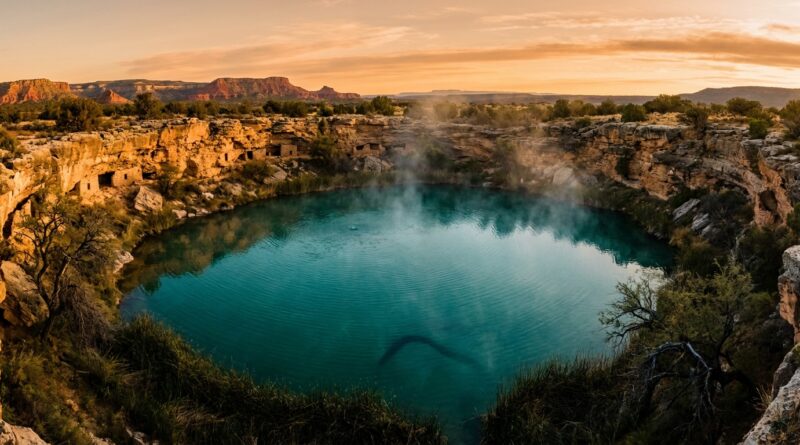
Start with the plain version. Montezuma Well is a limestone sinkhole near Camp Verde, Arizona, and part of Montezuma Castle National Monument. It looks like a quiet desert pond, but it is really a collapsed cavity connected to a deep groundwater system.
Water pours into it constantly from underground. Estimates often put that flow at around 1.5 million gallons a day. That alone would make it noteworthy in arid country. But the weird part is not just the amount of water. It is the kind of water.
The well stays at a fairly steady temperature year-round. It carries a lot of dissolved carbon dioxide. It has low dissolved oxygen. And it contains chemistry that makes life hard for many ordinary aquatic animals.
Why people call it an unexplained sinkhole mystery
This is where the clickbait usually starts, but the stronger story is more careful. Montezuma Well is not unexplained in the sense that nobody knows what it is. Geologists have a working model. The mystery is that several pieces still do not fit together as cleanly as people expect.
The geology mostly makes sense
The usual explanation is that groundwater dissolved limestone over long stretches of time, creating a cavity that eventually collapsed into the crater we see now. That is classic sinkhole behavior.
So far, so normal.
The plumbing does not fully give up its secrets
Where exactly does all that water come from? How deep is the active source system? Why does the chemistry stay so unusual? Those are harder questions.
Hydrologists can describe the broad system, but tracing every underground pathway in a karst landscape is tough. Water moves through cracks, voids, and old solution channels. Some paths may change over time. Some may be partially blocked by sediment. Some may connect to deeper gas-rich sources than early surveys assumed.
That means Montezuma Well sits in an awkward middle ground. It is studied. It is measurable. Yet parts of its behavior still resist a simple, one-sentence answer.
The water is toxic enough to kill some life, yet life thrives there anyway
This is one of the biggest reasons the Montezuma Well unexplained sinkhole mystery keeps returning. The water is loaded with carbon dioxide and low in oxygen. Most fish do badly in it. In fact, many fish released there historically did not survive long.
And yet the well is not dead.
It supports a web of organisms, including species that are specially adapted to these conditions. Biologists have documented endemic life there, meaning forms of life found in or strongly tied to that unusual habitat. That flips the usual story on its head. Toxic to many outsiders. Home to the locals.
If you like real anomalies, this is catnip. It is not supernatural proof. It is better. It is a case where nature built a selective gate and then stocked the room with specialists.
Why this matters
When a place kills off common species but supports rare ones, it tells you the environment has been stable in its strangeness for a long time. Evolution had time to work with it. That suggests Montezuma Well is not just odd by accident. It may be a long-running ecological island hidden inside a desert sinkhole.
The “false bottom” reports are the part that really grabs people
Ask around long enough and you will hear the same phrase. False bottom.
Divers and investigators over the years have described a soft, unstable lower layer, often compared to gelatinous muck or dense organic sludge. Instead of a neat rocky bottom, they found something shifting and hard to pin down. In some accounts, equipment readings and visual impressions did not line up cleanly.
That does not mean the well is literally bottomless. It means the bottom may be layered, soft, gas-charged, and difficult to measure in a straightforward way.
Possible normal explanations
There are a few. Thick organic sediment can build up over time. Gas bubbling through fine deposits can create a deceptive, unstable surface. Mineral-rich water can also affect visibility and make depth perception worse. Add fear, low visibility, and the limits of older dive gear, and stories grow fast.
Still, even the skeptical version leaves you with a strange picture. A desert sinkhole whose lower layers act more like a breathing biological-chemical trap than a clean basin.
Indigenous lore is not decoration here
This is the part a lot of travel blurbs flatten into spooky wallpaper, and they should not. For several Indigenous peoples, including Yavapai and Apache connections in the region, Montezuma Well is not just odd geology. It is part of a sacred landscape with deep historical and spiritual meaning.
Stories tied to emergence, underworld passages, and liminal places give the site a very different frame. Not “haunted roadside stop.” More like a threshold. A place where categories blur. Surface and below. Life and death. Human use and nonhuman force.
You do not have to treat oral tradition as a geology textbook to see its value. It preserves what kind of place people believed this was. Dangerous, sacred, and not casual.
That matters because modern science and older cultural knowledge are not always answering the same question. Science asks how the sinkhole formed and how the water behaves. Tradition asks what kind of relationship humans should have with a place like this.
What science explains well, and what it still does not
Here is the fair split.
Well explained
The crater is almost certainly a collapse feature in soluble rock. The water is spring-fed. The chemistry is unusual but measurable. The ecology reflects adaptation to a harsh niche.
Still fuzzy
The exact underground routing of all inflows is difficult to map. The full reason the water maintains its particular gas and mineral profile is still debated in public discussion. Sediment depth and bottom structure have produced inconsistent impressions over time. And the line between folklore, experience, and physical hazard keeps the place wrapped in more than one kind of uncertainty.
That is why this case holds up better than most internet “mysteries.” The answer is not one big hidden reveal. The answer is a stack of partial explanations with leftovers.
Why mainstream coverage keeps missing the point
Travel pieces love a tidy hook. “A weird Arizona stop with ancient ruins nearby.” Easy. Safe. Good for weekend lists.
But that framing shrinks the case. Montezuma Well is not interesting because it is quirky. It is interesting because it stays stubborn under scrutiny. The harder you look, the less useful the simple labels become.
“Sinkhole” is true, but incomplete. “Spring” is true, but incomplete. “Toxic water” is true, but incomplete. “Sacred site” is true, but incomplete.
That mix is exactly why people keep coming back to it.
If you visit, how to get more out of it
Treat it like a live case file.
1. Read every official sign
The National Park Service material gives you the baseline. You need that before you start weighing the more dramatic claims.
2. Pay attention to scale and setting
Stand there and notice how odd it is to find that much active water in that landscape. The desert context matters. So does the calm surface, which hides how chemically hostile the water can be.
3. Separate three layers of explanation
Layer one is geology. Layer two is ecology and chemistry. Layer three is cultural meaning. Most weak articles mash all three together. The stronger approach is to keep them distinct, then look at where they overlap.
4. Respect the barriers
This should be obvious, but it needs saying. Do not try to enter the water or test the bottom yourself. Apart from legal and safety issues, this is both a sensitive natural site and a culturally important one.
So, is there a simple answer?
No. But there are better and worse ways to frame the problem.
The worst way is to say, “Scientists are baffled,” and leave it there like a movie trailer. The better way is to say this: scientists understand a lot about Montezuma Well, but not enough to turn it into a boring closed case.
That is a much more honest kind of mystery.
At a Glance: Comparison
| Feature/Aspect | Details | Verdict |
|---|---|---|
| Geological origin | Best explained as a limestone collapse sinkhole fed by a major spring system. | Largely explained, but not fully mapped underground. |
| Water chemistry and life | CO₂-rich, low-oxygen water harms many species yet supports unique adapted organisms. | A genuine anomaly in ecology, not a myth. |
| False bottom and folklore | Soft sediment, gas, and difficult visibility may explain diver reports, while Indigenous traditions frame the site as a sacred threshold. | Not proof of the supernatural, but not something a glib debunk fully settles either. |
Conclusion
That is the real value of Montezuma Well right now. It is showing up again as a fun desert stop, while the deeper story is hiding in plain sight. For anyone tired of fake mysteries that collapse after a quick fact-check, this one is different. You can visit it. You can read the geology. You can study the water chemistry. You can weigh the diver reports about the soft, shifting bottom. And you can also face the fact that local sacred traditions have treated it as a liminal place long before modern tourism got there. That makes Montezuma Well more than weird tourism. It is a live anomaly. A place where hard science, strange ecology, and human meaning all meet, and none of them gets the final word on its own. In a feed full of junk mystery, that is refreshingly solid. And yes, it is worth arguing about in the comments tonight.