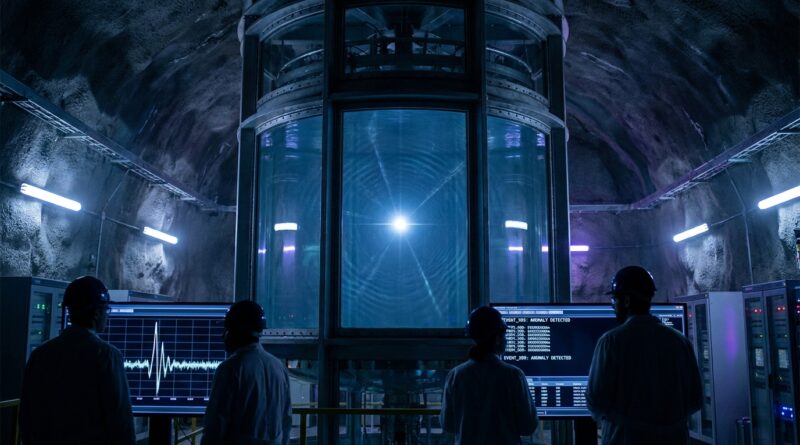
The Particle That Shouldn’t Exist: Why A Lone ‘Ghost Hit’ In A Dark-Matter Tank Has Physicists Uneasy
If you are tired of every “mystery” story turning out to be a smudge on a camera lens, this one will feel different. Physicists running a giant dark matter experiment deep underground have reported a single odd event that does not fit neatly into the usual boxes. Not ten events. Not a trend. One. That may sound flimsy, and honestly, that is part of why people feel uneasy about it. A lone signal is the hardest kind to trust, but it is also the hardest kind to ignore when your detector is built to reject almost everything else. The result came from a huge liquid xenon tank designed to catch incredibly rare particle interactions. Instead, it saw a stubborn little blip that behaves like something unusual may have passed through. The mysterious dark matter signal single unexplained event xenon detector story matters because it is not folklore. It is instrument data, and it can be checked.
⚡ In a Hurry? Key Takeaways
- A single unexplained event in a xenon dark matter detector is intriguing, but it is not proof of dark matter or a new particle yet.
- When you follow this story, watch for replication, background checks, and whether other detectors see anything similar.
- The value here is that this is a real, testable anomaly based on careful measurement, not a rumor or a blurry photo.
What actually happened
Deep underground, shielded from cosmic rays and everyday radiation, physicists run detectors that are basically giant traps for extremely rare particle interactions. One of the best tools for this is liquid xenon. Xenon is dense, clean, and very good at flashing when something bumps into it.
In this case, a detector holding roughly ten tons of xenon registered one event that stood out. It did not behave like the common background noise researchers expect from stray radiation, detector quirks, or known particle interactions. It was just one hit, but it was odd enough to get attention.
That is where the tension starts. In particle physics, one weird event is not a discovery. It is a question mark. Still, question marks are where the interesting stuff begins.
Why a single event makes physicists nervous
Most people assume scientists get excited when they see something weird. They do. But they also get suspicious fast. A single event can come from all sorts of boring causes. Tiny contamination. Electronics noise. A rare background process that nobody has modeled quite right. Even the detector itself can occasionally fake a signal.
So why the unease? Because this event apparently survived the first round of “it is probably nothing” checks. It is not just random static on a screen. It is a candidate for something real, and that is exactly what makes it uncomfortable.
One event is both weak and powerful
Weak, because you cannot build statistics from one point.
Powerful, because if the detector is as clean as researchers think, then a single clean oddity can point to a crack in the current picture. Not a broken picture. Just a crack.
Why xenon detectors matter so much
Think of a xenon detector as a very picky microphone in a very quiet room. It is listening for almost nothing. When a particle interacts inside the liquid xenon, it can create a tiny flash of light and free electrons. By measuring both, researchers can estimate where the event happened and what kind of interaction it looks like.
That matters because location and signal shape help separate real candidates from junk. Events near the detector walls are often less trustworthy. Events deep in the clean central volume are more interesting. If this unexplained hit came from the “good” region and had the wrong profile for known backgrounds, it earns extra scrutiny.
If you want a related primer on why these underground flashes get so much attention, The Flash In The Mine: Did A Single Underground Signal Finally Betray Dark Matter? gives useful context without overselling it.
Could it be dark matter
Maybe. But “maybe” is doing a lot of work here.
Dark matter is the famous possibility because these detectors are built for exactly that hunt. If some unknown particle drifted through Earth and hit a xenon nucleus or electron just right, this is the kind of setup that might catch it. The problem is that dark matter models are all over the map. Different candidates would leave different fingerprints.
So a mysterious dark matter signal single unexplained event xenon detector result is not the same as “dark matter found.” It only means the event belongs on the shortlist of things we cannot easily explain yet.
Other possibilities are still on the table
Physicists will also consider less glamorous answers first.
- A rare neutron background that slipped through.
- An unusual radioactive decay.
- An electronic artifact.
- A known particle interaction that current models underestimated.
- Something genuinely new, but not necessarily dark matter.
That last category is why this kind of story gets people hooked. New physics does not always arrive wearing a label.
How to read this story without getting fooled by hype
This is where readers can get real value from the case. The trick is to watch what scientists do next, not just what headlines say today.
1. Ask if anyone else can see it
Replication is everything. If another xenon detector, or a different kind of detector, sees a similar event pattern, the story gets stronger fast.
2. Watch the background analysis
Most anomalies die here. Researchers keep refining estimates of mundane events until the weird signal becomes less weird. That is not failure. That is science cleaning its glasses.
3. Separate “candidate” from “discovery”
A candidate is a lead. A discovery is what comes after repeated checks, statistics, and independent confirmation.
4. Notice whether the collaboration sounds cautious
When experiment teams use careful language, that is usually a good sign. Hype often comes from outside summaries, not from the actual scientists.
Why this is more exciting than the usual mystery fare
A lot of anomaly culture runs on stories you can never really test. This one is the opposite. It lives inside a machine built to be audited. The detector settings can be reviewed. The event selection can be challenged. Future runs can confirm or crush the idea.
That makes it far more satisfying than endless arguments over lights in the sky. You can actually follow the chain of evidence.
What happens next
The short answer is patience. More data. More calibration. More attempts to break the result.
If the event was a fluke, the mystery fades. If similar signals start appearing, especially across different runs or different experiments, then physicists will have a real problem in the best possible sense. They will need to explain something the current playbook does not cover.
And if nothing else appears? Even that teaches us something. It tells us how careful these instruments are, and where the edge of certainty really sits.
At a Glance: Comparison
| Feature/Aspect | Details | Verdict |
|---|---|---|
| Type of evidence | One unusual event inside a highly sensitive liquid xenon detector | Interesting, but far from conclusive |
| Best-case meaning | Could hint at dark matter or another new particle interaction | Worth watching closely |
| Most likely next step | More data, tougher background checks, and comparison with other experiments | Replication will decide everything |
Conclusion
This is exactly the kind of mystery worth following. It is fresh, testable, and balanced right on the line between known physics and the unknown. Maybe the odd xenon hit turns out to be mundane. Maybe it opens a door. Either way, it gives the Anomal community something solid to track in real time. More importantly, it teaches a useful habit. Read what the experiment actually says, not what excited summaries claim it says. Truly unexplained phenomena are not built on vibes alone. They start with careful instruments, open data, skepticism, and one stubborn signal that refuses to fit.