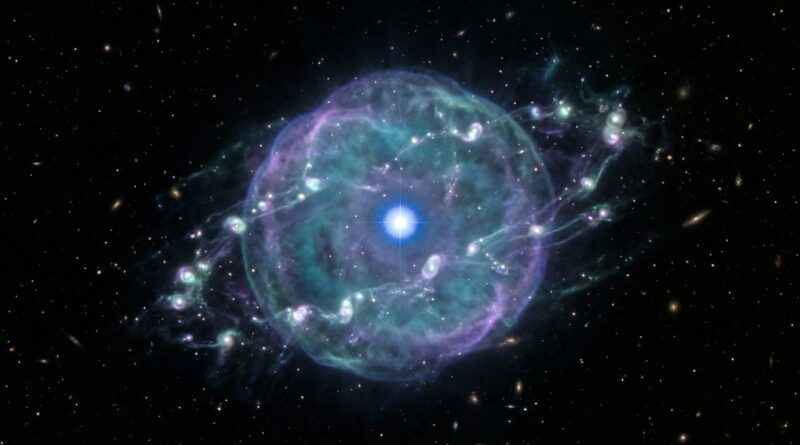
The Nebula That Behaves Like a Living Thing: Why Pa 30’s ‘Pearls on a String’ Are the Strangest Space Pattern of the Year
Space stories can get tiring fast. Either they are so abstract that your eyes glaze over, or they are dressed up like a crisis when the real science is still thin. That is why Pa 30 is such a refreshing oddball. This nebula is real, nearby by cosmic standards, and photographed in sharp enough detail that astronomers can point to one very specific mystery. It has a bizarre “pearls on a string” pattern, with neat little knots of gas lined up in a way that looks almost organized, even alive. The weird part is not just how strange it looks. It is how quickly those bead-like structures seem to have formed after a violent stellar event. Scientists have solid data, good images, and a likely backstory tied to an ancient explosion. What they do not have, at least not yet, is a clean explanation for why Pa 30 built itself into such a tidy, spooky pattern.
⚡ In a Hurry? Key Takeaways
- Pa 30 is a real nebula linked to a violent stellar blast, and its bead-like “string of pearls” gas pattern is puzzling astronomers.
- If you want a space mystery worth following, focus on Pa 30 because the images and measurements are concrete, recent, and specific.
- This is not fringe speculation. The oddity comes from telescope data, but the cause of the pattern is still an open question.
Why the Pa 30 String of Pearls Nebula Mystery Matters
The Pa 30 string of pearls nebula mystery hits a rare sweet spot. You do not need to take anyone’s word for it. The object exists. The structure is visible. The geometry is odd enough that trained astronomers are saying, in plain terms, that they do not fully get it yet.
That alone makes it more interesting than the usual vague “mysterious signal” headline. Pa 30 is not a blurry dot. It is a wreckage field with personality.
And yes, that is a technical term only in spirit.
What Exactly Is Pa 30?
Pa 30 is a nebula, which is basically a cloud of gas and stellar debris. In this case, it is thought to be the remains of a rare and violent stellar event. Many researchers connect it to a historic “guest star” recorded in the year 1181, making it a possible supernova remnant with an unusually clear backstory.
At the center sits an extreme surviving star, often described as very hot and unusual. Around it, material is racing outward. So far, that sounds dramatic but not unique. Space is full of exploded leftovers.
What makes Pa 30 different is its shape.
The Part That Has Scientists Scratching Their Heads
Those neat little beads should not be this neat
Images of Pa 30 show narrow filament-like features broken into bright knots, almost like someone threaded glowing pearls along strands. Nature does make repeating patterns, of course. But this one looks unnervingly organized.
The big question is simple. How do you get clumps of gas to form into such tidy, evenly spaced knots on a relatively short timescale after a chaotic stellar explosion?
That is where the shrug comes in.
It looks almost biological, but it is very much physics
To be clear, nobody thinks Pa 30 is alive. The “living thing” comparison comes from the way the nebula seems structured rather than randomly splattered. It gives off the same feeling you get from seeing a vine, spine, or strand of cells under a microscope.
That visual resemblance is what grabs people. The science is what keeps them there.
What Scientists Think Might Be Happening
There are a few likely suspects, but none has fully closed the case.
1. Instabilities in fast-moving gas
When hot gas slams into slower material, it can form ripples and clumps through well-known fluid instabilities. Think of wind tearing at smoke, but in space and at ridiculous temperatures and speeds. That can create structure. The issue is whether it can create this structure, this quickly, and this neatly.
2. Magnetic fields shaping the flow
Magnetic fields can herd charged particles and help organize plasma into filaments. If Pa 30 has the right magnetic setup, that could explain why the knots line up instead of scattering more randomly.
But magnetic field maps are not always easy to pin down in detail, so this remains more of a promising idea than a final answer.
3. A strange explosion history
It is also possible the original blast was not symmetrical. If the explosion or later outflow happened in jets or preferred directions, that might have pre-arranged the material into lanes where knots later formed.
That would mean the pearls are not just random clumps. They are clues to how the star died.
Why This Is Better Than the Usual Space Hype
Most overhyped space mysteries fall apart in one of two ways. Either the data are too fuzzy, or the claim outruns the evidence. Pa 30 avoids both traps.
We have a known object. We have high-quality observations. We have a likely violent origin. And we have a very narrow, very testable puzzle. That is good science. Messy, specific, and honest.
It also makes Pa 30 a great story for readers who want something odd without wandering into nonsense. You can enjoy the weirdness and still stay planted in real astronomy.
What to Watch for Next
If you want to follow the Pa 30 story like an ongoing mystery series, these are the things worth watching:
Better imaging
Sharper views could show whether the knots are truly evenly spaced or just appear that way from our angle.
Spectroscopy
This is the tool astronomers use to break light into fingerprints. It can show what the gas is made of, how fast it is moving, and whether different pearls formed under similar conditions.
Modeling and simulations
Researchers will try to reproduce the pattern in computer models. If the simulations cannot make those beads under realistic conditions, that tells us the missing ingredient may be important.
Time comparisons
Even over a span of years, astronomers may be able to track how parts of Pa 30 shift and expand. That helps test whether the knots are stable, growing, fading, or breaking apart.
Why Non-Experts Should Care
You do not need an astrophysics degree to appreciate what is happening here. Pa 30 is one of those rare cosmic stories where the mystery is visible. You can look at an image and immediately understand the problem.
That matters. A lot of science news asks you to care first and understand later. Pa 30 flips that around. First you see the strange pattern. Then the science question clicks into place.
It is a perfect reminder that the universe still produces objects that are not just grand, but genuinely confusing.
At a Glance: Comparison
| Feature/Aspect | Details | Verdict |
|---|---|---|
| What Pa 30 is | A nebula likely tied to a historic stellar explosion, with a hot central remnant and expanding debris | Real object, real data, strong scientific interest |
| What makes it strange | Bright bead-like gas knots appear lined up like “pearls on a string” | Highly unusual geometry that is not fully explained |
| Why it is worth following | Fresh observations, testable ideas, and an open mystery scientists admit they are still working through | One of the better current space enigmas for curious readers |
Conclusion
Pa 30 sits right in that sweet spot many readers want but rarely get. It is nearby enough to study well, dramatic enough to feel cinematic, and strange enough that the experts are not pretending to have it all solved. That “string of pearls” pattern is not just pretty. It is a real problem in need of a real explanation. And that is what makes this such a satisfying mystery. You are not being asked to squint at a fuzzy blob and imagine the excitement. The excitement is already there in the data. Over the coming months, new observations could show whether these gas knots come from fluid instabilities, magnetic shaping, a weirdly directed blast, or something more surprising. Until then, the Pa 30 string of pearls nebula mystery gives space fans something rare. A specific, recent cosmic puzzle they can actually dig into, debate, and keep an eye on as the science catches up with the image.