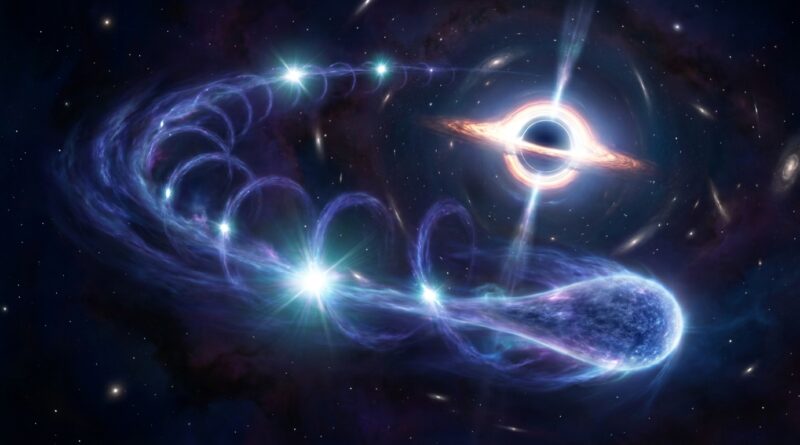
The Stars That Keep Cheating Death: Why ‘Zombie Orbits’ Around Black Holes Have Astronomers Spooked
If you are tired of space headlines that sound huge on Monday and fall apart by Friday, this one is worth your attention. Astronomers are watching what look like stars surviving close encounters with supermassive black holes, then coming back for more. That is the unsettling part. In the usual picture, a star that gets too close should be torn apart in a tidal disruption event. Game over. But a few newly studied systems seem to flash, dim, and return on repeat, as if the star got badly mauled without fully dying. That is why some researchers have started using phrases like “zombie orbits.” It is not because anyone thinks the stars are literally undead. It is because the data suggest something is making repeated passes through a danger zone where survival should be rare, messy, or short-lived. The science is still moving, and that is exactly what makes it interesting.
⚡ In a Hurry? Key Takeaways
- Some stars may be surviving repeated near-misses with supermassive black holes instead of being destroyed in one pass.
- Watch for follow-up data on repeat flares, orbital timing, and changes in brightness. That is where the best clues will show up.
- This is a real open question, not settled science. The weirdness is in the mismatch between standard models and what telescopes seem to be seeing.
Why this has astronomers genuinely uneasy
Black holes are strange enough already, but the basic idea here used to feel fairly clean. A star wanders too close to a supermassive black hole. Gravity pulls harder on the near side than the far side. The star gets stretched, compressed, and if it crosses the wrong limit, ripped apart. Some of that torn material spirals inward, heats up, and gives off a bright flare that telescopes can catch.
That story still holds up for many events. The problem is that a small but growing set of observations does not fit neatly inside it. Instead of one dramatic flare followed by decline, some systems seem to brighten more than once, or show timing that hints the same star, or the same stellar core, is coming back around on an orbit.
That is where the phrase “zombie orbit” comes from. It is shorthand for a star that should be gone, but may only be partly stripped, then returns again and again.
What “surviving” actually means here
It does not mean the star has a nice quiet flyby and heads home untouched. Think more like a car scraping the guardrail at highway speed. The car may keep moving, but it is not fine.
In these scenarios, the star may lose some outer layers during a close pass, while its core remains intact enough to stay gravitationally bound. If that happens, it could keep orbiting the black hole and shed more material on later passes. Each pass could create another burst of light.
That sounds reasonable at first. In fact, astronomers have considered partial tidal disruptions for years. What has people spooked now is that some of the observed light curves, timing patterns, and energy output do not line up cleanly with the simplest version of that explanation.
The key term: tidal disruption event
You will see this abbreviated as TDE. A normal TDE is the classic one-and-done version, where a star gets destroyed by the black hole’s tidal forces. The new excitement is over events that may be partial, repeating, or otherwise not behaving like textbook TDEs.
Why the light curves matter so much
A light curve is just a record of how brightness changes over time. It sounds dry. It is not. This is where the mystery lives.
If a star is making repeated close passes, you would expect some kind of pattern. Maybe bursts arrive at intervals linked to the orbit. Maybe each flare gets weaker as the star loses mass. Maybe the color of the light shifts in a way that tells you how hot the debris is.
But real observations are messy. Some brightenings are too sharp. Some fade in odd ways. Some repeat, but not as neatly as the cleanest orbital model would predict. So now astronomers are weighing several ideas at once:
- A partially disrupted star returning on a stretched orbit.
- A surviving stellar core shedding material over time.
- Gas in an accretion disk behaving in a way that only looks periodic.
- A second object, like another star or compact remnant, disturbing the system.
- Relativistic effects near the black hole changing the timing and shape of what we see.
That is the real story. Not “scientists found zombies in space,” but “serious teams have data that do not yet fit one simple picture.”
Why black holes make this extra confusing
Supermassive black holes are not just giant vacuum cleaners. They are extreme gravity labs. Near them, space and time do not behave the way your everyday intuition expects.
If a star swings close enough, you have several things happening at once. The star is being distorted. Gas is heating up. Some material may fall inward fast while some gets flung outward. Radiation can push back on the gas. And all of this is happening in a region where Einstein’s relativity matters.
So when people ask, “Why can’t astronomers just tell if the star lived or died?” the answer is simple. Because they are reconstructing a violent event from changing light, often from very far away, through a mix of physical processes happening all at once.
The leading explanations, in plain English
1. Partial disruption
This is the front-runner many people start with. The star dips inside the danger zone, loses outer layers, but its core survives. It comes back later and repeats the process.
Why it works: It naturally explains repeat activity.
Why it does not fully satisfy everyone: Some events look too bright, too irregular, or too persistent for the cleanest version of this model.
2. A stripped core on a “death spiral” orbit
Instead of a mostly intact star, what survives may be a dense remnant. That remnant could keep orbiting and feeding material to the black hole a bit at a time.
Why it works: A dense core might survive stronger tides than a puffier full star.
Why it is tricky: The expected emission signatures are still hard to match perfectly to all observed cases.
3. Disk effects pretending to be repeat stellar encounters
Sometimes gas around the black hole can clump, wobble, or brighten in cycles. In that case, the repeat flashes may not mean a star is repeatedly skimming the black hole at all.
Why it works: Accretion disks can be chaotic and deceptive.
Why it is frustrating: It can explain variability, but not always the specific timing clues people find so suggestive.
4. We are seeing more than one process mixed together
This may be the most realistic answer. A partial disruption, plus delayed gas fallback, plus relativistic effects, plus viewing angle. Nature does not have to pick one tidy mechanism just because humans prefer neat stories.
What makes this a live anomaly instead of recycled space clickbait
This is not another retelling of a decades-old mystery with spooky music on top. The interesting part is that better telescopes, better surveys, and more frequent monitoring are now catching these events in enough detail to expose the cracks in older models.
That matters. Science gets exciting when instruments improve faster than explanations do. We are in that phase here.
Researchers are not saying, “We have proven impossible stars exist.” They are saying, more cautiously, “We are observing behavior that might involve stars surviving close encounters with supermassive black holes, and our current models do not explain every detail well.” That is a much stronger and more interesting kind of uncertainty.
What non-experts should pay attention to next
If you like following real mysteries as they unfold, there are a few concrete things to watch.
Repeat timing
Do the flares come back on a schedule that matches a plausible orbit, or are they too sloppy for that?
Spectral changes
Brightness alone is not enough. The color and detailed fingerprint of the light can tell astronomers whether they are seeing hot gas, cooler debris, shock heating, or something else.
Energy budget
How much material would a surviving star need to lose to power what we see? If the numbers stop making sense, a favorite explanation may need to go.
Population patterns
One weird system can be a fluke. Several similar ones start to look like a real class of object or event.
Why the “zombie” label is useful, and also a little dangerous
It is useful because it gives people an easy mental handle. You immediately get the idea. Something that seemed doomed keeps coming back.
But it can also oversell the case. These are not immortal stars laughing at black holes. They are possible survivors of repeated extreme tidal stress, and maybe only for a while. The phrase is fun. The physics is brutal.
At a Glance: Comparison
| Feature/Aspect | Details | Verdict |
|---|---|---|
| Classic tidal disruption event | Star is shredded in one close pass, followed by a flare and decline. | Still the standard model for many events. |
| Partial disruption or surviving core | Star loses mass but remains partly intact, possibly returning on later orbits. | Best current explanation for “zombie orbit” cases, but not a complete fit. |
| Disk or gas-driven variability | The black hole’s surrounding gas may create repeating signals without a surviving star. | Plausible in some systems, but may not explain all observed timing and flare shapes. |
Conclusion
This is the kind of anomaly worth your time because it is happening now, in public, with real data still coming in. These newly reported “death-defying” stars sit right at the messy intersection of relativity, stellar physics, and high-energy astronomy. They are not a reheated mystery from the 1970s. They are a concrete case where the best telescopes on Earth and in space have caught something that does not quite behave the way it should. The papers are cautious. The models are still being argued over. The light curves are not fully cooperating. That is exactly where curious readers can do more than just watch from the sidelines. You can track follow-up observations, compare cases across black-hole systems, and be skeptical of neat early explanations that smooth over the weird parts. In other words, this headline is not the end of the story. It is your invitation to watch a real scientific mystery unfold almost in real time.