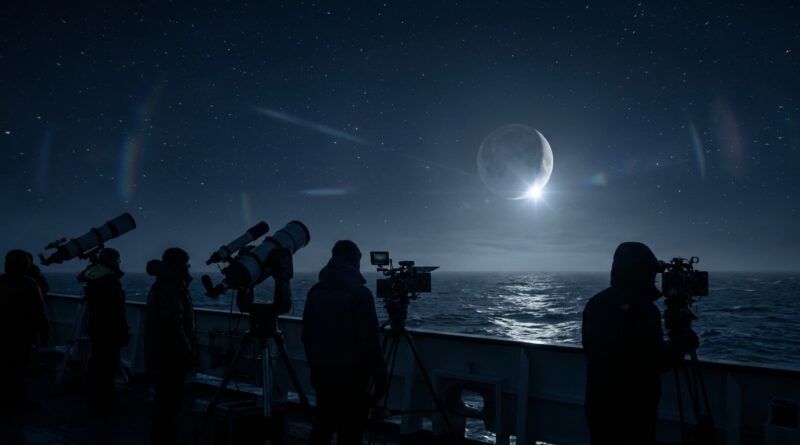
The Moon’s ‘Impossible Glare’: Why a Silent Flash Over the Pacific Is Freaking Out Astronomers
If you saw people posting about a mysterious bright flash on the moon today and felt stuck between eye-rolling skepticism and full-on sci-fi panic, that reaction makes sense. Space stories often get flattened into two bad choices. Either it is treated like proof of aliens, or it gets waved away with a vague “probably nothing.” What has astronomers and satellite trackers uneasy right now is that this was not a routine glint, not an obvious meteor strike, and not a clean match for known debris or scheduled lunar activity. The reported flash showed up on the Moon’s night side over the Pacific-facing view window, which is exactly why it stands out. The dark side of the visible lunar disk is not supposed to produce a sudden, intense burst of light without leaving a very ordinary explanation behind. So let’s slow this down, sort the likely from the weird, and look at how you can verify the breadcrumbs yourself instead of waiting for a thin official statement.
⚡ In a Hurry? Key Takeaways
- A bright lunar flash was reported, but as of now there is no confirmed public explanation tying it to a known impact, spacecraft event, or normal reflection.
- If you want to track this yourself, start with lunar weathering and impact monitoring feeds, satellite tracking sites, and time-stamped telescope footage from multiple locations.
- The safest conclusion today is not “aliens” and not “nothing.” It is “unconfirmed anomaly with several testable possibilities.”
Why this flash is getting attention
The Moon is not a dead, perfectly predictable light bulb. It gets hit by small meteoroids. It reflects sunlight in odd ways. Cameras produce artifacts. Atmosphere can distort what we see from Earth. So a flash by itself is not shocking.
What is unusual here is the mix of details being discussed. The flash was described as intensely bright, short-lived, and visible on the Moon’s night side. Early chatter from observers says it does not neatly line up with a known meteor shower peak, a logged impact prediction, a booster dump, or a standard specular reflection from an orbiting object.
That does not make it impossible. It just means the easy answer has not shown up yet.
What could cause a flash on the Moon?
1. A meteoroid impact
This is the boring answer, but boring answers win a lot. Small rocks hit the Moon all the time because there is no real atmosphere to burn them up first. When they strike at high speed, they can create a very brief flash.
Why this fits. Impact flashes can happen on the dark part of the Moon and can be surprisingly bright for a split second.
Why it does not fully satisfy people yet. If the timing, brightness, and location do not line up well with known observing programs or if no quick corroboration appears from impact-monitoring groups, people start asking harder questions.
2. Space junk or an unscheduled artificial impact
Old rocket bodies and hardware do hit the Moon from time to time. Sometimes these impacts are expected. Sometimes the tracking history is messy.
Why this fits. Artificial debris can make flashes, and the catalog of what is up there is not perfect.
Why it is shaky right now. The people who spend their days tracking this stuff usually get a rough match fairly quickly. If they are still swapping notes, either the object was not well tracked, the flash was misread, or the event was something else entirely.
3. A glint from a satellite or spacecraft
Sometimes what looks lunar is not lunar at all. A satellite passing in the foreground can catch sunlight and create a sharp flash that appears close to the Moon in images or video.
Why this fits. It happens more often than most people realize, especially in smartphone clips or telescope setups with limited field context.
Why it may not fit this case. If multiple observers at different places saw the flash pinned to the same spot on the lunar disk at the same time, a local foreground glint becomes less likely.
4. Camera sensor artifact or atmospheric distortion
This is the least exciting explanation and one of the most common. Compression, hot pixels, dropped frames, and turbulence can turn a faint flicker into a dramatic “event.”
Why this fits. Viral clips often outrun verification.
Why it may not fit. If independent instruments captured it with matching time stamps, then it stops being just a camera problem.
Why the Moon’s night side matters
When people say “night side,” they usually mean the darkened portion of the Moon visible from Earth, not the permanently hidden far side. That dark part can still glow faintly from earthshine, which is sunlight reflected from Earth back onto the Moon. But earthshine is soft and diffuse. It does not produce a single hard flash.
That is why this report is sticking in people’s heads. A bright point-source event on the darkened lunar face has to come from something specific. An impact. A reflected glint. A foreground object. A bad sensor read. Something.
What astronomers are likely checking right now
If you picture astronomers peering dramatically at giant screens, the real process is less cinematic and more like digital detective work.
Time stamps
The first question is simple. Did multiple observers record the same event at the same moment? If yes, confidence goes up fast.
Location on the lunar disk
If the flash maps to a fixed spot on the Moon across different observations, that argues for a real lunar event.
Satellite pass data
Trackers will compare the event time against known objects crossing near the Moon’s line of sight.
Known meteor streams
Even outside major showers, sporadic meteors can hit the Moon. But a stream match helps.
Follow-up imaging
If the flash came from a large enough impact, later high-resolution imagery might reveal a fresh crater or ejecta pattern. That part usually takes longer.
How to follow the evidence yourself without getting lost
You do not need a PhD or a backyard observatory dome to keep up. You just need a decent checklist.
Look for independent captures
One clip is interesting. Three clips from different locations are data.
Check whether the original post includes UTC time
If there is no precise time stamp, verification gets messy fast.
Use satellite tracking tools
Sites like Heavens-Above and other orbital trackers can help rule in or rule out foreground objects.
Watch lunar monitoring communities
Impact flash watchers, amateur astronomy forums, and observatory feeds are often faster than formal press offices.
Be careful with cropped videos
A tight crop removes context. You want the full frame, raw timing, and ideally the imaging setup used.
What not to do
Do not jump from “unexplained” to “impossible.” Science is full of events that look bizarre for a day and ordinary a week later.
Also, do not let anyone bully you into pretending the question is stupid. It is reasonable to ask what caused a bright flash on the Moon, especially when experienced observers are still comparing notes.
My read, based on how these cases usually go
The most likely answer is still a natural impact or a line-of-sight object that has not been matched yet. That is the base-rate bet. Space is busy. Cameras are messy. Human reporting is uneven.
But the reason this story has legs is that the first-wave explanations appear incomplete. That is enough to justify attention, not hysteria.
The useful middle ground is this. Treat the event as real enough to investigate, but not resolved enough to narrate with confidence.
If you want a simple “is this weird?” answer
Yes, it is weird enough to be worth watching.
No, it is not weird enough to call extraordinary yet.
That may sound unsatisfying, but it is the honest answer.
At a Glance: Comparison
| Feature/Aspect | Details | Verdict |
|---|---|---|
| Natural impact | Fits a brief flash on the Moon’s darkened face, especially if multiple observers confirm timing and position. | Most likely, but not confirmed. |
| Satellite or debris glint | Can mimic a lunar flash in video, especially with limited frame context or a foreground crossing. | Plausible, needs pass-data match. |
| Sensor artifact or distortion | Common in viral astronomy clips, but weaker if several independent instruments saw the same event. | Always worth checking first. |
Conclusion
Right now the talk around the Moon’s strange flash is stuck in the usual bad split. One side is yelling “aliens.” The other is waving everyone off. Neither helps much if you actually want to know what happened. The better approach is calm and forensic. Check the time stamps. Compare observer locations. Look at satellite pass data. Wait for independent confirmation, but do not wait passively. Follow the live breadcrumbs. That gives you a front-row seat while the evidence is still fresh, before a neat official story hardens around incomplete facts. If this turns out to be a routine impact, you will know why. If it turns out to be something rarer, you will already understand the trail that got us there. That is the real value here. Not panic, not dismissal. Just a clear-eyed way to track the next mysterious bright flash on the moon today, and the next one after that.