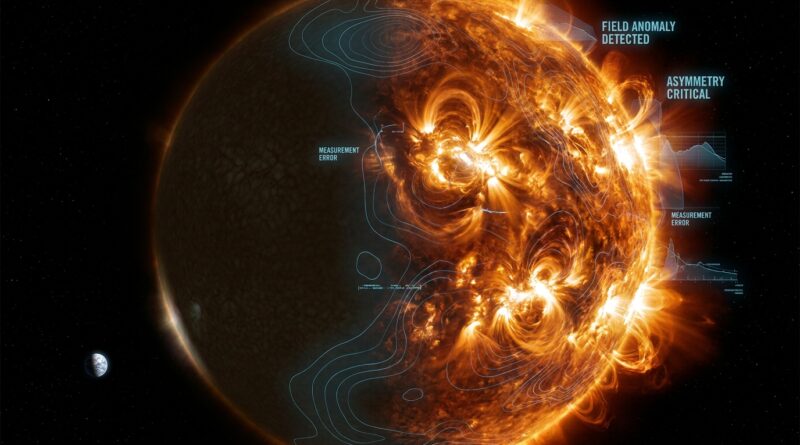
The Sun’s Magnetic Field Just Broke The Script: Are We Living Through A One‑Off Stellar Anomaly?
If you feel like every new solar headline says something different, you are not imagining it. One day the Sun is a well-behaved clock. The next day, scientists are quietly admitting its magnetic field may be doing something the standard script did not fully predict. That is frustrating, especially if you are trying to figure out whether this is a real anomaly, a media exaggeration, or just normal science getting messy in public. The short version is this. The Sun’s magnetic field does seem to be acting oddly enough in 2026 to get experts’ attention. But “odd” does not mean “doomsday.” It means the Sun’s usual magnetic cycle, the roughly 11-year swing tied to sunspots, solar storms, and polarity shifts, is showing timing, structure, or strength that some models did not cleanly call. That makes this a live scientific puzzle, not proof that Earth is suddenly in danger.
⚡ In a Hurry? Key Takeaways
- The Sun’s magnetic field behaving oddly unexplained anomaly 2026 story is real in the sense that researchers are watching unusual patterns, but it is not evidence of an extinction-level event.
- If you want to follow this sensibly, track official solar data from NOAA, NASA, and ESA instead of relying on scary clips or one-off screenshots.
- The main near-term risk is to satellites, radio, GPS, and power systems during stronger space weather, not the sudden loss of Earth’s habitability.
What is actually supposed to happen with the Sun’s magnetic field?
Under normal conditions, the Sun runs on a cycle that is messy up close but fairly regular from far away.
About every 11 years, solar activity rises and falls. Sunspots become more common, solar flares and coronal mass ejections pick up, and then things calm down again. Over about 22 years, the Sun’s magnetic polarity fully flips and returns. Think of it like a heartbeat with a rhythm that is not perfect, but usually recognizable.
That rhythm matters because the Sun’s magnetic field helps drive space weather. It shapes when charged particles get flung into space and how strongly Earth’s magnetic shield gets rattled.
So when researchers say the Sun may be “off script,” they usually mean one of a few things. The cycle may be stronger than expected. It may be peaking at an odd time. The magnetic poles may be shifting in unusual ways. Or the internal magnetic structure may be showing asymmetry that models struggle to explain.
Why people are calling this a possible anomaly in 2026
The phrase “sun magnetic field behaving oddly unexplained anomaly 2026” sounds dramatic, but the underlying issue is pretty simple.
Scientists build models of the solar cycle using past observations, sunspot counts, magnetic field measurements, helioseismology, and dynamo theory. Those models are useful. They are not crystal balls. If the current data shows the Sun’s surface magnetism, polar field strength, hemispheric balance, or reversal timing drifting from forecasts, that is a big deal scientifically.
Not because the Sun has “broken physics.” More because it may be exposing parts of solar physics we still do not understand well.
What might be unusual right now?
Depending on which solar team you read, the concern tends to fall into a few buckets.
Cycle strength. Activity may have risen faster or harder than some forecasts expected.
Magnetic asymmetry. One solar hemisphere may be acting differently from the other, which can complicate predictions.
Polar field behavior. The strength and timing of changes at the Sun’s poles help shape future cycles. If those look off, long-range forecasts get shaky.
Field complexity. The Sun’s magnetic lines can tangle, reconnect, and reorganize in ways that produce bursts of activity that are hard to map neatly to the old pattern.
None of this means scientists are clueless. It means the Sun is reminding us that “predictable” in astronomy often means “predictable within a range,” not “runs like a Swiss watch.”
Does this mean Earth is in danger?
Probably not in the cinematic sense. But there are real-world effects worth paying attention to.
What space weather can actually do
A more active or magnetically odd Sun can increase the chance of:
- stronger auroras appearing farther from the poles
- radio blackouts
- GPS errors
- satellite glitches or drag on low-Earth orbit satellites
- stress on power grids during major geomagnetic storms
That is serious infrastructure stuff. Airlines, satellite operators, power companies, and military systems care a lot about it.
What it probably does not mean
It does not mean Earth is about to become uninhabitable.
Our planet has a magnetic field and atmosphere that do a lot of protective work. A strange solar cycle can absolutely create technological headaches. It is not the same as the Sun suddenly “turning hostile” to life on Earth.
Why scientists still disagree
This part is important. Public confusion often comes from expecting science to sound finished when it is still in progress.
The Sun is incredibly hard to model because we cannot directly sample its deep interior. Researchers infer what is happening through surface observations, magnetic maps, plasma behavior, and wave patterns moving through the star. That leaves room for honest disagreement.
One group may say, “This is unusual, but still within historical variation.” Another may say, “No, this is a meaningful mismatch with our best dynamo models.” Both can be acting in good faith.
That is why this moment is interesting. We are watching the argument while it is still alive, before it gets cleaned up into a textbook sentence years later.
Could our Sun be a cosmic oddball?
That is the bigger and more fascinating question.
For a long time, we treated the Sun as a kind of baseline star because it is the one we know best. But modern astronomy has shown that stars can vary a lot in magnetic behavior, flare activity, and cycle regularity.
If our Sun’s current behavior turns out to be truly unusual, it could cut two ways.
It might mean the Sun is less average than we thought.
Or it might mean stellar magnetic cycles in general are more chaotic than our models assume, and we only notice because the Sun is the one star we can watch in obsessive detail.
Either way, this matters beyond space weather. It touches habitability, exoplanet research, and how we judge whether other star systems are stable enough for life.
How to separate a real mystery from clickbait
This is where readers can save themselves a lot of stress.
Signs the reporting is probably grounded
- It names the data source, such as NOAA’s Space Weather Prediction Center, NASA missions, or peer-reviewed work.
- It describes what is uncertain instead of pretending everything is solved.
- It talks about infrastructure risk before jumping to human survival risk.
Signs the reporting is probably hype
- It says scientists are “hiding” the truth.
- It jumps from magnetic irregularities straight to apocalypse.
- It uses one graph or one solar image as total proof of a giant theory.
If you want a steady approach, use agencies first, social media second.
How the Anomal community can track this together
This story is useful precisely because it is still moving. You do not have to wait for a final verdict to follow it responsibly.
A simple monitoring checklist
Watch these over the next few weeks:
- Sunspot counts. These give a rough read on activity levels.
- Solar flare alerts. Especially M-class and X-class events.
- Geomagnetic storm scales. NOAA’s G1 to G5 levels are easy to follow.
- Aurora maps. Good for seeing when space weather effects are reaching lower latitudes.
- Polar magnetic updates. More technical, but useful if the anomaly discussion centers on field reversal or polar strength.
Good sources to check
- NOAA Space Weather Prediction Center
- NASA solar mission updates
- ESA solar and heliophysics updates
- University solar observatories and heliophysics labs
The goal is not to become a solar physicist overnight. It is to build a shared fact pattern so the community can talk about the same thing, instead of reacting to random alarming posts.
What happened here, in plain English
The cleanest way to say it is this.
The Sun was never as perfectly predictable as popular science summaries made it sound. In 2026, current observations appear strange enough that experts are openly debating whether this is a normal wobble inside a messy cycle or a more meaningful mismatch between reality and our models. That debate is the story.
So yes, something interesting may be happening with the Sun’s magnetism. No, that does not automatically translate into danger on the ground. But it does make this one of those moments where science feels alive, incomplete, and worth watching closely.
At a Glance: Comparison
| Feature/Aspect | Details | Verdict |
|---|---|---|
| What is unusual? | Solar magnetic timing, strength, symmetry, or polar behavior may not line up neatly with forecasts. | A real scientific puzzle, not settled proof of a major break from nature. |
| Risk to Earth | Main concerns are satellites, radio, GPS, auroras, and grid stress during strong space weather events. | Worth monitoring, but not a habitability crisis. |
| What readers should do | Follow NOAA, NASA, and research updates. Compare multiple sources. Track changes over time. | Best way to stay informed without getting pulled into fear-driven noise. |
Conclusion
This is exactly the kind of anomaly worth paying attention to because it is still unresolved. The experts are not speaking with one tidy voice yet, and that is not a flaw. That is the signal. Right now, the Sun’s magnetic behavior seems strange enough to raise real questions, while still leaving plenty of room between “interesting” and “catastrophic.” For the Anomal community, that makes this a rare sweet spot. You can follow a live mystery with enough scientific backbone to filter out nonsense, but without pretending the answer is already locked in. If you keep one eye on official solar data and one eye on how the story evolves, you will be in a much better position than people getting their updates from panic posts. More than anything, this gives readers a shared way to track the Sun together over the coming weeks, treating the story as a living investigation instead of a disposable headline.