The 400-Year-Old Shark And The Cities Of The Deep: Are ‘Immortal’ Animals Hiding A Secret World Beneath Us?
If you are tired of the same blurry UFO clip and the latest “ghost caught on camera” post, you are not alone. A lot of people still want mystery. They just want the real kind. The kind that starts with hard science, then gets stranger the more you look. That is exactly why the 400 year old shark unexplained deep sea mystery has grabbed so much attention. We are talking about animals that may live for centuries, creatures found where sunlight never reaches, and ocean zones so poorly mapped that they make some space stories look almost ordinary. The weird part is not that people are making things up. The weird part is that scientists are finding life down there that seems to run on a very different clock from ours. If you want a genuine mystery grounded in biology, aging research, and deep ocean exploration, the sea is giving us plenty to think about.
⚡ In a Hurry? Key Takeaways
- The “400-year-old shark” is real science, not internet fiction. Greenland sharks can live for centuries, and they point to how little we understand about deep-sea life.
- If you want to separate solid mystery from hype, start with peer-reviewed studies, ocean mapping projects, and marine biology reports instead of viral clips.
- The deep ocean is strange enough on its own. You do not need fake monsters to appreciate how unknown, fragile, and important it really is.
The shark that broke our sense of time
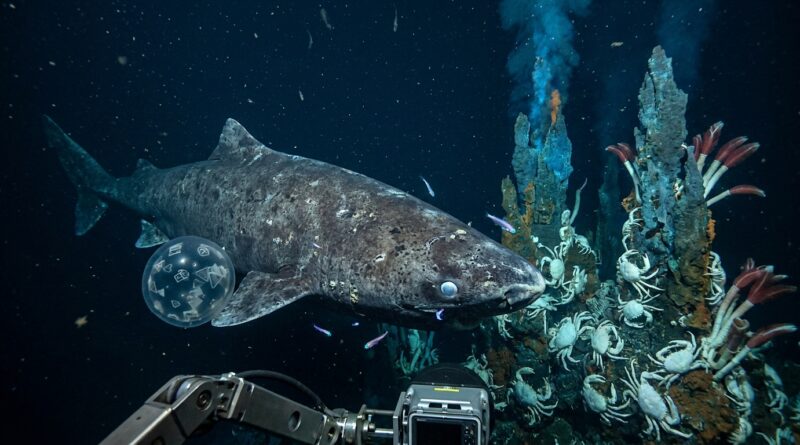
The animal at the center of this story is the Greenland shark. It is big, slow, cold-water adapted, and about as dramatic as a drifting submarine. What made headlines was not just its size. It was its age.
In 2016, researchers used radiocarbon dating on proteins in the lenses of Greenland shark eyes. Their estimate suggested some individuals may live roughly 250 to 500 years, with one famous estimate putting a shark at around 392 years old, give or take over a century. That means some of these animals may have been alive before modern industry, before many countries existed in their current form, and long before cameras turned every mystery into content.
That is not immortality, of course. The word “immortal” gets thrown around because it grabs attention. But the real finding is still wild enough. Here is a vertebrate, a large one, living on a timescale that barely fits human intuition.
Why this matters more than a fun animal fact
It is easy to treat the 400-year-old shark as a trivia item. It is not. It raises some big questions.
How does a body last that long?
Greenland sharks grow very slowly. They live in extremely cold water. Their metabolism is low. They mature late, possibly not reaching sexual maturity until around 150 years of age. That is hard to wrap your head around. Imagine an animal whose entire life strategy is built around patience.
Scientists are trying to understand whether their longevity comes mostly from cold temperature, slow metabolism, unusual DNA repair, reduced cellular damage, or some mix of all of these. If researchers can figure out even part of that story, it could improve how we think about aging in general.
What else have we missed?
This is the bigger mystery. If a giant shark can spend centuries in dim Arctic waters and remain poorly understood until recently, what else is down there that does not fit our normal expectations?
The deep sea covers most of the planet. We have explored only a tiny fraction of it in detail. That means every new expedition has a decent chance of finding something odd, whether that is a strange species, a weird behavior, or a habitat that changes what we thought life needed in order to survive.
The cities of the deep are real, just not in the way movies sell them
When people hear “cities of the deep,” they may picture Atlantis, glowing domes, or hidden civilizations. Real oceanography gives us something different, but honestly, it is stranger.
Hydrothermal vent communities
At the bottom of the ocean, hydrothermal vents support dense clusters of life around superheated, mineral-rich water. No sunlight. No normal food chain. Instead, microbes use chemicals from the Earth itself to make energy, and larger animals build whole ecosystems around them.
These places can look like alien neighborhoods. Tube worms. Blind shrimp. Crabs. Mats of bacteria. Towering mineral chimneys. In practical terms, they function like deep-sea cities. Life gathers there in concentrated pockets, surrounded by vast emptiness.
Cold seeps and coral mounds
There are also cold seeps, places where methane and other hydrocarbons leak from the seabed, feeding unusual communities. Then you have deep-water coral habitats, sponge grounds, and seamount ecosystems. Again, not cities built with stone, but organized, long-lasting communities that feel almost urban when seen by submersible cameras.
What makes them mysterious is that they can be stable for long periods, then shift or disappear. Some may hide species found nowhere else. Some may preserve chemical and geological clues from Earth’s deep history.
So are “immortal” animals hiding a secret world beneath us?
The careful answer is no, not in the comic book sense. Greenland sharks are not gatekeepers to a lost undersea civilization. There is no evidence of that.
But in a more interesting sense, yes. These long-lived animals are clues. They point toward a part of Earth that still feels secret because, for us, it is. Not fake secret. Not internet secret. Actual unknowns.
They hint that the ocean contains forms of life, rhythms of survival, and ecosystems so unlike our day-to-day world that they can feel almost unreal. The secret world is not necessarily a hidden society. It is a hidden layer of biology and time.
What makes deep-sea life feel so alien
Part of the fascination comes from how badly deep-sea life matches human experience.
Time runs differently
We think in days, years, maybe decades. Deep-sea organisms can operate on much slower clocks. Some corals may live for thousands of years. Some sponges may be older than human institutions. Greenland sharks may take a century and a half just to become adults.
That changes the whole meaning of survival. These animals are not rushing. Their world rewards endurance.
Senses run differently
In dark water, sight is often less useful. Many deep-sea creatures rely more on pressure, chemistry, vibration, or bioluminescent signals. Their “view” of reality may be built from cues we barely notice.
That is one reason they can seem so uncanny. They are not just living where we cannot. They may be perceiving their surroundings in ways we do not naturally understand.
Habitats run differently
Pressure is extreme. Temperatures are often near freezing. Food can be scarce. Then, in some zones, chemicals from below the crust create lush islands of life. It is not one ocean. It is a stack of worlds.
Why people are drawn to this now
There is a reason this kind of story is landing right now. People are worn out on mystery that feels staged. They want something they can argue about without feeling tricked.
The 400 year old shark unexplained deep sea mystery hits that sweet spot. It is factual enough to stand up. Strange enough to spread. Open-ended enough to keep a conversation going.
You can talk about aging. Evolution. Ocean mapping. Unknown species. Whether intelligence always has to look familiar. Whether the most alien thing on Earth is not from outer space at all, but from cold black water under our own planet.
What science actually knows, and what it does not
It helps to separate the solid ground from the fog.
What we know
We know Greenland sharks are extremely long-lived. We know deep-sea ecosystems exist in places once thought nearly barren. We know many marine species remain undiscovered or poorly described. We know the ocean depths are underexplored compared with their size.
What we do not know
We still do not fully know why some species live so long. We do not know how many unusual deep-sea communities remain unseen. We do not know how many biological strategies for survival are down there waiting to be documented. And we definitely do not know how much human activity, from warming seas to deep-sea mining, may damage systems before we even understand them.
How to follow this mystery without getting pulled into nonsense
If this topic hooks you, good. It should. Just keep your feet on the ground while your imagination roams a bit.
Look for source quality
Start with university releases, marine institutes, NOAA material, and peer-reviewed papers. If a video says “scientists stunned” but names no scientist, be skeptical.
Watch for language tricks
Words like “immortal,” “forbidden,” and “proof” are often there to spike clicks. The truth is usually less dramatic in wording, but more interesting in substance.
Pay attention to the real stakes
The ocean is not just a mystery box. It is a living system under pressure. Climate change, fishing, noise pollution, and industrial plans for the seabed all matter here. Wonder is good. Protection is better.
The deeper question people keep circling back to
Could there be forms of intelligence or awareness in the ocean that we are failing to recognize because they are too unlike us? That question sits just under the surface of stories like this.
There is no evidence that Greenland sharks are secret geniuses. But the broader point stands. Humans are very good at noticing minds that act like human minds. We are much worse at noticing slow, distributed, or non-visual ways of interacting with the world.
That is one reason the deep ocean keeps pulling us back. It is not just hidden geographically. It challenges our assumptions about what counts as normal life.
At a Glance: Comparison
| Feature/Aspect | Details | Verdict |
|---|---|---|
| 400-year-old shark claim | Based on scientific age estimates of Greenland sharks using eye-lens radiocarbon analysis | Real and credible, though exact ages come with uncertainty |
| “Immortal” animals | A dramatic label for species with extreme longevity or unusual aging, not true invincibility | Useful as a hook, but scientifically oversimplified |
| Secret world beneath us | Deep-sea ecosystems, vents, seeps, and long-lived species reveal vast underexplored habitats | Absolutely real, though mysterious in a scientific sense, not a fantasy one |
Conclusion
The best part of this story is that you do not have to choose between science and wonder. You can have both. The 400 year old shark unexplained deep sea mystery gives people a way to move past recycled sky-object headlines and into something fresher, stranger, and more grounded. It is a living mystery built from real biology, real oceanography, and real gaps in human knowledge. That makes it perfect for debate, research, and sharing right now. And it leaves you with a humbling thought. The most alien intelligence on Earth may not be far above us in the sky. It may be moving slowly, silently, in the dark layers of the ocean we still barely understand.