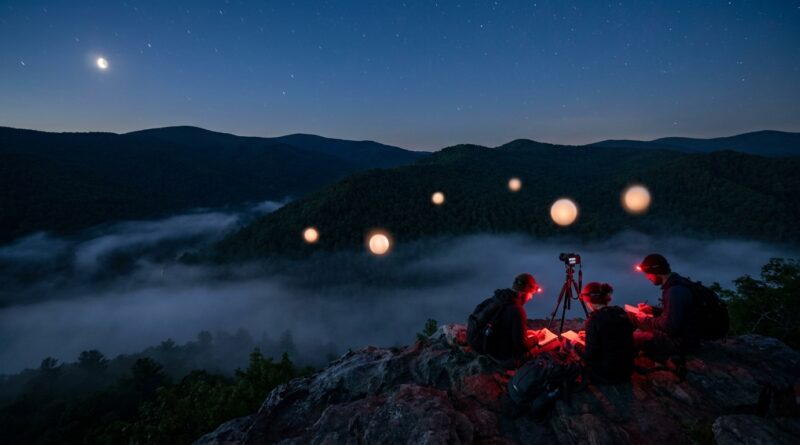
The Mountain Lights That Won’t Go Out: Inside Earth’s Most Persistent Ghost-Glow Mystery
You can see why this one drives people up the wall. The same valleys, the same ridgelines, the same reports of silent glowing balls that hover, drift, split, or wink out. Then you go looking for answers and run straight into two dead ends. One side says it is obviously ghosts, portals, or aliens. The other says it is probably car headlights, move along. Neither feels satisfying when sightings keep coming from the same mountain areas decade after decade. The truth is messier, and honestly more interesting. Some unexplained mountain lights glowing orbs likely do have ordinary causes like distant vehicles, temperature inversions, stars near the horizon, or people misjudging scale at night. But a smaller set of cases stays stubbornly unresolved because the reports are repeated, location-specific, and hard to recreate on demand. That does not prove anything supernatural. It does mean the mystery is real enough to study properly, instead of laughing it off or turning it into clickbait.
⚡ In a Hurry? Key Takeaways
- Most recurring mountain lights probably come from a mix of known causes, but a small number of reports remain genuinely unresolved.
- If you see one, log the time, weather, direction, elevation angle, color, movement, and whether roads or towns are in line of sight.
- Do not hike into rough terrain at night chasing a glow. The best sighting report is a safe, detailed one with photos, video, and location notes.
Why these lights keep pulling people in
Mountain ghost-light stories show up all over the world. Brown Mountain in North Carolina. The Marfa Lights in Texas. The Min Min lights in Australia. Hessdalen in Norway. Different landscapes, same basic report. People see glowing points or orbs, often silent, often at a distance, sometimes moving in ways that seem too deliberate to be normal.
That pattern matters. It tells us this is not just one local legend with a tourist gift shop attached. It is a class of sightings. And that is why the argument never really ends. If even half the stories are mistakes, that still leaves a chunk worth looking at closely.
The boring explanations that often turn out to be right
Let’s start with the part nobody loves but everybody needs. Human eyes are terrible measuring tools at night. Distance collapses. Bright points look bigger than they are. Motion gets weird when you have no fixed frame of reference.
Distant headlights
This is the classic answer, and in many places it fits surprisingly well. A car several miles away, partly hidden by terrain, can look like a floating light. Add fog, layers of warm and cold air, or a winding mountain road, and the light can seem to rise, dip, vanish, and reappear.
Stars and planets near the horizon
Venus has fooled a lot of people. So have bright stars seen through unstable air. When a bright object sits low over a ridge, atmospheric shimmer can make it look like it is pulsing or drifting.
Temperature inversions and light refraction
This is where dry research papers start getting less dry. Under the right conditions, air bends light. In a mountain valley, that bending can carry distant man-made light farther than you would expect and distort how it looks. A hidden town, train, or road can produce a light that seems detached from its source.
Campers, drones, and plain old hoaxes
Some reports are exactly what they sound like. Flashlights on ridges. Lanterns. Recreational drones. Social media has only made this worse because one blurry clip can spread before anyone checks whether there was a campsite or wedding venue nearby.
So why are some cases still unresolved?
Because the easy answers do not neatly explain every report. In a few hotspots, observers have reported lights before roads were built in the right places, or from viewing angles where headlights seem less likely. In other cases, instruments have picked up unusual light behavior without a clean match to cars, stars, or aircraft.
The most famous example scientists still talk about is Hessdalen, Norway. That valley has had repeated light reports for decades, and it has drawn actual monitoring efforts, not just ghost stories. Some observations may involve dust, ionized gas, combustion chemistry, or other natural electrical effects. But there is still no single explanation that wraps up every event with a neat bow.
That is the key point. “Unresolved” does not mean magic. It means the current evidence is incomplete.
What science thinks might be happening
There is no one master theory that covers every place people report unexplained mountain lights glowing orbs. Instead, there are a few buckets of ideas.
Misidentified human-made lights
This is still the biggest bucket. It is not glamorous, but it solves a lot of sightings.
Atmospheric optics
Light bending, scattering, and mirage-like effects can do more than most people realize. Mountains are especially good at creating weird viewing conditions because of layered air, humidity changes, and long sightlines.
Geological or electrical activity
This is where things get interesting. Some researchers have looked at whether stress in certain rocks can release electrical charges, especially near fault zones. Others have considered ball-lightning-like effects, plasma, or combustion of natural gases in rare conditions. None of these ideas has become the answer. But they are real scientific attempts, not fringe fan fiction.
A mix, not one cause
This may be the most likely answer of all. “Ghost lights” might not be one thing. One valley’s lights could be headlights and refraction. Another valley’s could include a rarer natural light process. Once you accept that, the mystery starts to make more sense.
The folklore part is not useless
Locals often get waved off too quickly, which is a mistake. No, a story passed down for generations is not hard proof. But repeated local knowledge can point to patterns. People may know the season when lights are most common, the ridges where they show up, or the weather that seems to trigger them.
That kind of pattern is useful. Folklore is not data by itself, but it can help you know where to look for data.
How to tell whether a sighting is worth logging
If you want to help sort signal from noise, the goal is simple. Make your report useful to someone who was not there.
Good signs a report may be valuable
- It happens in a known repeat location.
- Multiple witnesses see the same thing from different angles.
- The light appears away from obvious roads, towns, or flight paths.
- Its movement changes in a way that can be timed and described clearly.
- You have weather data, compass direction, and exact viewing point.
Red flags that make a report weak
- No time stamp or location.
- Only a zoomed-in shaky video with no landscape reference.
- No check for planets, aircraft, roads, or local events.
- Claims that jump straight to a cause without evidence.
A practical sighting checklist
If you see a glowing orb in the mountains, write this down right away. Memory gets sloppy fast, especially after an adrenaline spike.
- Date and exact time.
- Viewing location, ideally GPS coordinates.
- Direction you were facing, using a compass app if needed.
- Estimated height above the horizon.
- Color, brightness, shape, and whether it changed.
- Movement pattern. Hovering, drifting, rising, zigzagging, splitting, fading.
- Duration in seconds or minutes.
- Weather conditions, including wind, fog, temperature, and cloud cover.
- Known roads, towns, towers, or trails in line of sight.
- Any sounds, or lack of sound.
- Photos or video that include foreground landmarks.
If possible, also check a star map app, flight tracker, and local road map afterward. That one extra step filters out a lot of false alarms.
What not to do
Do not drive or hike deeper into dangerous terrain at night to “get closer.” Mountain distances are deceptive, and a harmless-looking glow can pull you into a ravine, off-trail area, or someone’s private land.
Also, do not over-zoom your phone camera and expect a miracle. Tiny bright lights become fuzzy blobs fast. A wider shot with landmarks is usually more useful than a dramatic close-up that proves almost nothing.
Why social media makes this harder
Right now, reports are spreading faster than careful checking. A clip gets posted with a spooky caption, then every repost strips away a little more context. Soon a likely road reflection turns into a “silent orb with impossible motion.”
That does not mean every viral clip is fake. It means the internet is very good at flattening nuance. If you care about real anomalies, the best move is to be annoyingly specific. Time. Place. Conditions. Cross-checks.
What a level-headed conclusion looks like
The best answer at the moment is not “it is all nonsense” and not “nobody can explain it, so it must be paranormal.” The honest answer is this. Many mountain-light sightings have normal explanations. Some may involve unusual but natural optical or geophysical effects. And a smaller residue remains unexplained because the evidence is incomplete, not because the case is closed.
That middle ground can feel unsatisfying, but it is where real progress usually starts.
At a Glance: Comparison
| Feature/Aspect | Details | Verdict |
|---|---|---|
| Most common cause | Distant headlights, horizon objects, atmospheric distortion, and ordinary misidentification explain a large share of reports. | Best first check |
| Scientific mystery level | A small number of cases in repeat hotspots remain unresolved because they are hard to reproduce and lack complete instrument data. | Genuinely open question |
| Best move for witnesses | Record exact time, place, direction, weather, and visual details, then compare with roads, stars, and aircraft data. | Most useful contribution |
Conclusion
The reason these lights keep hanging around, in both the sky and the public imagination, is simple. They sit in that uncomfortable space between legend and lab notes. Right now, reports of recurring ghost lights and unexplained mountain orbs are spiking on social feeds and in regional news, but most coverage either sensationalizes them or shrugs them off. A calm, practical approach is more useful. It helps the Anomal community separate repeatable patterns from hoaxes, understand where science is genuinely stumped, and build better sighting records. If you spot one, do not just post a spooky clip and call it a night. Log it carefully. Share the context. Real mysteries do not get solved by louder stories. They get solved by better notes.