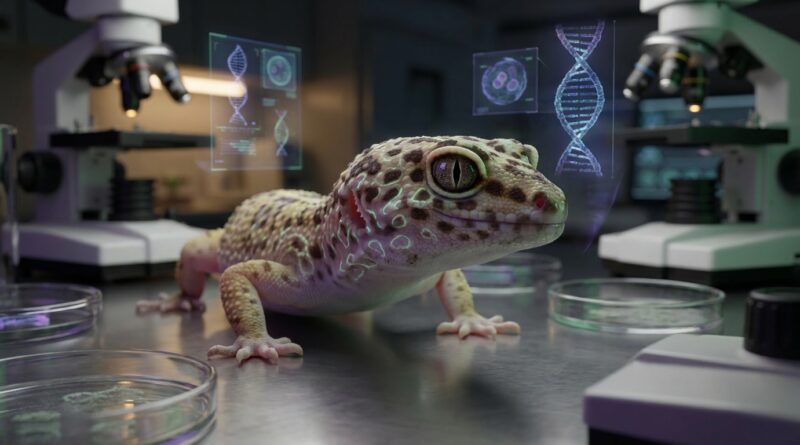
The Gecko That Refuses To Die: Is Nature Hiding A Built‑In ‘Resurrection Switch’?
If you are tired of blurry lights in the sky and the same recycled “experts stunned” headlines, this one is a lot more satisfying. It is weird, it is real, and it is happening in actual labs. Researchers have been watching a mutant gecko survive injuries and tissue damage that should, by normal biology rules, end very badly. Instead of following the usual script of inflammation, scarring, runaway cell death, or obvious cancer, this animal seems to keep finding a way back. That is why the mysterious cancer proof gecko that baffles scientists has started to attract serious attention. Not because it proves magic. Because it appears to break some of the neat little boundaries biology likes to keep tidy. The big question is simple enough to ask and brutally hard to answer. Is this gecko using some kind of built-in repair program that turns on when it should not exist at all?
⚡ In a Hurry? Key Takeaways
- This is not a folklore story. Scientists are studying a real gecko anomaly tied to regeneration, abnormal survival, and possible cancer resistance.
- The smart way to follow this mystery is to watch for peer-reviewed papers on wound healing, apoptosis, stem cells, and tumor suppression, not viral headlines.
- It is exciting, but not proof of human “resurrection.” The value here is that the animal may help explain how cells repair damage without turning into cancer.
Why this case matters more than the usual anomaly story
Most mystery stories fall apart the second you ask for clean evidence. This one gets stronger.
The gecko in question is interesting because the puzzle is not “Did someone see something strange?” The puzzle is “Why is this living tissue not behaving the way textbooks say it should?” That is a much better kind of mystery. It can be tested. It can be repeated. It can be challenged by other labs.
And that is exactly why people are paying attention. A biological oddity is often more valuable than a dramatic headline, because it gives scientists something they can actually measure. Cells divide or they do not. Genes switch on or they do not. Tumors grow or they do not.
What scientists mean when they hint at a “resurrection switch”
Let’s keep the language grounded. Nobody is saying the gecko comes back from the dead in the horror-movie sense.
What they are really asking is whether this animal has some built-in emergency program that lets damaged tissue survive, reset, and regrow in a way that should be impossible or at least extremely rare in vertebrates. In plain English, the body seems to hit a panic button, then somehow chooses repair over collapse.
That is where the phrase “resurrection switch” comes from. It is a dramatic nickname for a serious biological idea. A hidden system that tells cells, “Do not die yet. Rebuild.”
The normal rulebook
In most animals, serious injury kicks off a chain of trade-offs. Some cells die. Some tissue scars. Inflammation rises. If repair signals go too far, you risk tumors. If they do not go far enough, the tissue fails.
Biology usually makes you pay somewhere.
This gecko seems to dodge part of that bill.
Why that is so weird
The thing that has researchers scratching their heads is not just regeneration by itself. Plenty of animals regenerate in some form. The weird part is the possible mix of extreme repair, survival after damage, and a lack of the cancer behavior you might expect when growth pathways stay active.
That combination is the real anomaly.
The cancer angle is what turns this from curious to huge
If you let cells keep dividing and rebuilding, you are playing with fire. Cancer is, in part, what happens when growth escapes the usual brakes.
So if a gecko can recover from severe tissue damage without falling into that trap, scientists want to know how. Is it better at switching damaged cells off? Better at clearing bad DNA? Better at controlling inflammation? Better at telling stem-like cells when to stop?
Those are not tiny questions. They cut straight into some of the biggest problems in medicine.
This is why the mysterious cancer proof gecko that baffles scientists is more than a fun oddball story. If the mechanism is real and repeatable, it could become a model for studying cancer suppression and tissue regeneration at the same time. That is a rare combo.
What may be going on inside the gecko
No honest scientist will tell you the case is solved. It is not. But there are a few likely areas researchers will keep hammering on.
1. Cell death control
Cells are supposed to self-destruct under certain conditions. This process, often called apoptosis, is one of the body’s main quality-control systems. If the gecko delays or redirects that process after injury, it may buy tissue enough time to recover.
That sounds helpful, but it is risky. In many animals, messing with cell death can open the door to cancer. So if the gecko pulls this off safely, that is a big clue.
2. Stem-like repair cells
Some animals can call in more flexible cells during healing, almost like a repair crew that can take on different jobs. If this gecko has a stronger or smarter version of that system, it could explain why damaged tissue does not just scar over and quit.
3. Immune system balance
A lot of healing depends on not overreacting. Too much inflammation can wreck the site you are trying to repair. Too little can leave danger behind. The gecko may have an immune response that is unusually well tuned, one that cleans up the mess without trashing the building.
4. Tumor suppression that stays on the job
This is the dream scenario for researchers. Maybe the gecko can activate growth and repair pathways while also keeping a second layer of anti-cancer controls fully active. If true, that would be a huge biological trick.
Why scientists are being careful with the hype
Because they should be.
Nature is full of one-off oddities that look revolutionary until someone finds the simpler explanation. A strange survival case might turn out to depend on age, environment, a very specific mutation, or lab conditions that do not apply widely.
That does not make it boring. It just means good science moves slower than social media.
The right questions are these:
- Can other labs reproduce the finding?
- Does the same gecko trait hold up across multiple injuries and generations?
- What genes are active during the repair window?
- Are tumors truly absent, or just delayed?
- Can any part of the mechanism be compared with known regenerative animals?
That is where the real action is. Not in shouting “immortality discovered,” but in watching whether the data keeps surviving contact with scrutiny.
What this could mean for humans, and what it definitely does not mean
Let’s keep both feet on the ground.
This does not mean human resurrection is around the corner. It does not mean a gecko is going to cure cancer next year. And it does not mean every viral “animal miracle” clip deserves belief.
What it does mean is that biology may still be hiding repair systems we do not fully understand. If one small reptile can bend the rules around injury, cell death, and tumor risk, then researchers may be able to learn how to copy tiny parts of that trick.
That matters for wound healing. It matters for degenerative disease. It matters for cancer prevention. Sometimes the biggest medical ideas start with a very small animal doing something rude to the textbook.
How to follow this mystery without getting fooled
If this story grabs you, good. It should. But follow it the smart way.
Look for these signs of real progress
- Named research institutions or labs
- Peer-reviewed papers, preprints, or conference abstracts
- Specific terms like regeneration, apoptosis, oncogenesis, or gene expression
- Replication by independent teams
- Measured outcomes, not vague “scientists stunned” phrasing
Be skeptical of these red flags
- Claims that jump straight from gecko biology to human immortality
- No mention of sample size or methods
- Headlines that say “proof” when the research is still early
- Videos or posts that show no actual lab source
If you treat it like a real scientific detective story, it gets more interesting, not less.
At a Glance: Comparison
| Feature/Aspect | Details | Verdict |
|---|---|---|
| Nature of the anomaly | A real lab-observed biological case involving unusual survival, tissue repair, and possible cancer resistance | Much stronger than folklore or random internet clips |
| Scientific value | Could help explain how regeneration and tumor suppression might coexist | Potentially very important if results hold up |
| Hype versus reality | Exciting early mystery, but not evidence of human immortality or a finished cure | Worth watching closely, with healthy skepticism |
Conclusion
This is the kind of anomaly many readers have been asking for. Not another fuzzy light. Not another conspiracy carousel. A fresh, non-UFO mystery unfolding in real research labs, where scientists can poke it, measure it, argue over it, and maybe learn something big from it. The mysterious cancer proof gecko that baffles scientists is compelling because it sits right at the fault line between cell death, tumor growth, and tissue repair. The rules seem to wobble. Nobody gets to pretend the answer is obvious. And that is exactly why it is worth your attention. Instead of doomscrolling the same old mysteries, you can follow a live scientific puzzle that may end up teaching us something deep about healing, survival, and the strange backup systems nature still has not fully shown us.