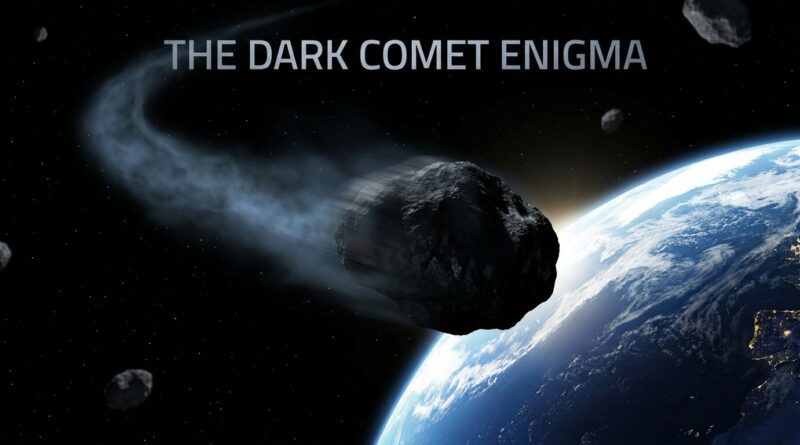
The ‘Dark Comet’ Lurking Near Earth: Astronomers Just Found a New Kind of Invisible Visitor
It is almost annoying how rude this object is being to astronomers. We expect a comet to show off. Give us a glowing coma, a bright tail, something easy to spot. Instead, this dark comet near Earth looks more like a cosmic sneak. It reflects very little light, hangs around near-Earth space, and still seems to get tiny pushes in its motion that suggest comet-like behavior. That odd mix had researchers puzzled for months. If you are wondering how something can act like a comet while barely looking like one, you are asking the exact right question.
The new find matters because it is not some fuzzy mystery at the far edge of the solar system. It is a peer-reviewed, trackable unexplained object in our own neighborhood. That makes it useful, and a little unsettling. It hints that the sky may hold more hard-to-see visitors than our current surveys are catching. For anyone who follows strange activity overhead, this sits in the same wider conversation as Mysterious Fireballs Are Surging Over Earth: Why 2026’s Sky Is Acting So Strange. The difference is that this time, the mystery is not a flash. It is something that may have been quietly sharing nearby space with us all along.
⚡ In a Hurry? Key Takeaways
- A newly studied dark comet near Earth appears to behave like a comet but stays unusually dim, making it a rare and unexplained object.
- If you follow sky news, pay attention to how astronomers track motion, not just brightness. Some important objects may be nearly invisible in normal telescope images.
- There is no sign this object is about to hit Earth, but it is a useful reminder that space-survey blind spots are real.
What exactly is a “dark comet”?
Think of it as an object with mixed signals.
A normal comet usually gives itself away by heating up near the Sun and venting gas and dust. That creates the fuzzy glow and tail people recognize in photos. An asteroid, on the other hand, is more likely to look like a plain rocky point of light.
A dark comet seems to sit awkwardly between those categories. It can show comet-like motion, meaning its path changes in subtle ways that gravity alone does not fully explain, but it does not put on the usual bright visual show.
That is what makes this dark comet near Earth unexplained object so interesting. It is not invisible in the sci-fi sense. It is just very hard to notice because it is faint and not acting the way people expect.
Why astronomers got stuck on it
The big problem was the mismatch between what they saw and how it moved.
If an object is getting tiny thrusts from escaping material, that points toward comet behavior. But if telescopes do not see the obvious cloud of gas or dust, the case gets murky fast. Researchers then have to ask a whole list of annoying questions.
Is it really a comet?
Maybe. But not in the classic bright-tail way most of us learned in school.
Is it just a weird asteroid?
Possibly. Some asteroids shed dust, spin oddly, or break apart in small ways that can change their motion.
Could we be missing something?
Yes, and that is the point. The object may be releasing too little material for easy detection, or that material may behave in ways current surveys do not catch well.
This is why the discovery feels bigger than one object. It suggests our sorting system for “asteroid” and “comet” may be too neat for the messy reality of space.
Why this matters more than it first sounds
At first glance, a dim object with a strange orbit can sound like niche astronomy news. It is not.
Near-Earth space is where we want our map to be as complete as possible. Not because every mystery object is dangerous, but because the closer something is, the less room there is for surprises.
The value of this case is that it gives scientists a real, current example to study. This is not folklore, not a blurry rumor, and not a one-night flash in the sky. It is a tracked object with data behind it.
That means astronomers can test ideas instead of guessing. How dark is it really? Is it venting material? How common are objects like this? Could there be more in similar orbits that blend into the background?
How something can hide near Earth
This part tends to surprise people. “Near Earth” does not mean floating outside your window.
It means an object’s orbit brings it into Earth’s neighborhood on a solar-system scale. Even then, spotting it can be difficult for a few simple reasons.
It does not reflect much light
Some objects are just dark. They absorb more sunlight than they reflect, which makes them much harder to detect.
It is small
Even a nearby object can look incredibly faint if it is not large.
Its position can work against us
Some regions of the sky are harder to search because of glare from the Sun, survey timing, weather, or the limits of telescope coverage.
We are trained to look for the obvious
Bright tails and clear signatures are easier to flag. A dim object with only subtle hints can slip through automated systems or take longer to classify.
Does this pose a danger?
Right now, the more honest answer is “not from what has been reported.”
There is no reason to treat this as an impact alert. The story here is not immediate danger. The story is detection, classification, and how much we may still be missing.
That may sound less dramatic, but it is actually more useful. Space safety is not only about headline-grabbing threats. It is also about building better catalogs, better models, and better early-warning systems.
What scientists may learn next
This object gives researchers a live test case.
They can watch whether its motion keeps showing non-gravitational changes. They can observe it at different wavelengths, search for faint dust or gas, and compare it to other odd bodies that never fit comfortably into one category.
If more examples turn up, dark comets may stop being a curiosity and start becoming a recognized class of object. That would be a big deal. It would mean our picture of the small-body population near Earth has been incomplete.
And if only a few exist, that is still fascinating. Rare objects can teach us a lot about how the solar system formed, how material changes over time, and how some bodies become almost invisible without becoming truly inactive.
Why Anomal readers should keep an eye on this
This kind of story hits the sweet spot for people who care about unexplained phenomena but want something solid to stand on.
It is unexplained, yes. But it is not vague. There is an orbit. There are observations. There is a published scientific discussion. That makes it the kind of mystery worth following.
It also opens a larger question that is hard to ignore. If one dark comet near Earth unexplained object can stay this hard to read, how many other faint visitors are moving through nearby space with little fanfare?
At a Glance: Comparison
| Feature/Aspect | Details | Verdict |
|---|---|---|
| Brightness | Unusually dim, with very low reflectivity and no dramatic tail on display | Hard to detect, easy to underestimate |
| Behavior | Its motion suggests comet-like effects, even though the usual visual signs are weak or absent | Genuinely strange and worth close study |
| Risk to Earth | No current report suggests an immediate collision threat | Important for awareness, not panic |
Conclusion
This is why the story matters. We now have a fresh, peer-reviewed example of a truly odd object hiding in our own cosmic backyard, not some far-off corner of space nobody can check twice. That makes the mystery real, trackable, and worth following in public. For readers who care about the unexplained, this is the good kind of weird. It gives us something concrete to watch while raising a bigger question that is hard to shake. How many dark visitors have already slipped past our telescopes, and what else might be sharing Earth’s orbital neighborhood without us noticing? Even if this object turns out to have a perfectly ordinary explanation later, it has already done something useful. It has shown us where our blind spots still are.