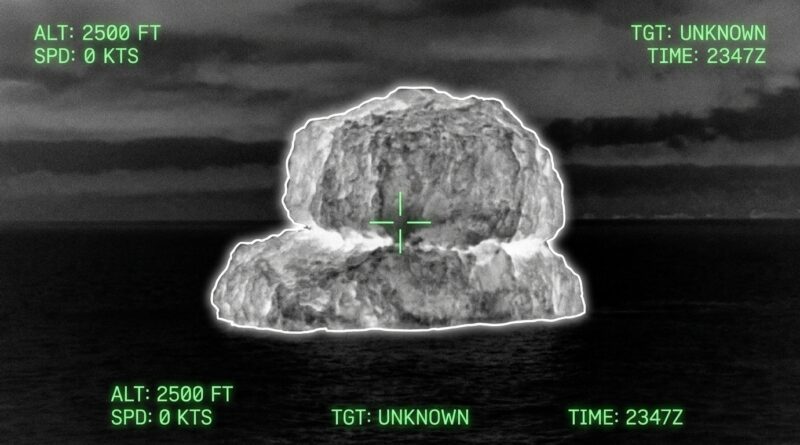
The Pentagon’s ‘Rocky’ UFO: Why This New 32‑Second Video Is Freaking Out Even Veteran Skeptics
If you feel numb every time a new UFO clip hits your feed, that makes sense. Most of them are short, blurry, stripped of context, and pushed with headlines that promise world-changing proof. Then you watch the video and it looks like three hot pixels and a zoom button. The Pentagon Rocky UFO video 2026 stands out because it landed inside a wider batch of roughly 40 fresh UAP files, and this one has just enough detail to make even cautious skeptics stop and look twice. It is only 32 seconds long. That is not much. But the shape, the infrared signature, and the way the object seems to present a two-tiered form are unusual enough that this clip deserves a slower, calmer read than most viral UFO posts get. The trick is separating what is truly odd from what could still be camera behavior, compression, or plain old misreading.
⚡ In a Hurry? Key Takeaways
- The Pentagon Rocky UFO video 2026 is interesting because its shape and heat pattern look unusual, not because it clearly shows alien tech.
- Before trusting any UAP clip, check four things first: sensor type, zoom level, object motion, and whether the background is moving too.
- A strange video is not the same as proof, but this case is worth attention because it may survive some of the easy debunks that kill weaker clips.
What exactly is the “Rocky” UFO video?
At the center of the buzz is a 32-second infrared clip reportedly included in the Pentagon’s fourth batch of UAP-related files. Online, it has picked up the nickname “Rocky” because the object looks chunky, irregular, and almost layered, rather than like a neat dot or tic-tac.
That matters because most boring explanations start with simple shapes. A plane, a bird, a balloon, a distant drone, or a glare artifact often turns into a blob once a military sensor zooms in hard enough. The Rocky object does not instantly behave like one of those clean, familiar examples.
Still, slow down. “Doesn’t instantly match a balloon” is not the same thing as “therefore extraordinary.” This is where UFO coverage usually falls apart. People jump from weird-looking to impossible. Good analysis lives in the middle.
Why veteran skeptics are paying attention
Longtime skeptics are usually hard to impress, and for good reason. They have seen years of clips that collapse under basic checks like focus shift, parallax, infrared bloom, or stabilization glitches. Rocky appears to get attention because it raises several questions at once.
The shape looks structured
Viewers describe the object as “two-tiered,” almost like one form stacked on another. In infrared footage, that can mean a real shape, but it can also mean different temperatures across one object, sensor sharpening, or edge contrast tricks.
The clip is short but not empty
Many viral UAP videos give you almost nothing to work with. Rocky, while brief, seems to offer enough visible behavior for frame-by-frame review. That makes it more useful than a three-second flash on a night-vision scope.
It arrived with paperwork, not just a leak
Context is everything. A mystery clip posted by a random account is one thing. A clip that appears inside a broader document release is another. That does not make it true by default, but it gives analysts more to cross-check.
What people may be getting wrong about the Pentagon Rocky UFO video 2026
Here is the biggest trap. People are treating the image itself as the event. It is not. The event is the full sensor situation.
With infrared footage, what you see depends on more than the object. It depends on zoom, tracking mode, thermal contrast, compression, atmospheric distortion, lens behavior, and whether the platform filming it is moving. A weird silhouette can come from the target. It can also come from the system trying very hard to lock onto a weak, distant source.
So if someone says, “Look at that shape, no human craft looks like that,” the honest answer is, maybe. But maybe that shape is not the true outline at all.
How to analyze this clip like a calm adult, not a headline machine
You do not need a defense lab to get smarter about these videos. You just need a checklist.
1. Start with the sensor, not the object
Ask what kind of camera captured it. Infrared systems often exaggerate hot spots and smooth edges. If the object has bright and dim sections, that may reflect temperature differences more than physical structure.
If the Rocky clip is from a targeting pod or similar military imaging system, that matters a lot. These devices can produce shapes that look solid and mechanical even when the raw target is less dramatic.
2. Watch the background
This is the easiest trick that most viewers skip. Ignore the object for a minute. Watch the clouds, horizon, or any fixed points. If the camera is panning, rolling, or zooming, the target can appear to dart, wobble, or rotate when it is actually doing very little.
That is how parallax fools people. A far object and a moving camera can create motion that looks shocking until you compare it to the background.
3. Check whether the shape changes with zoom or tracking
If the object looks two-tiered only at one zoom level, that may be a camera artifact. If it keeps the same general shape through multiple framing changes, that becomes more interesting.
This is one of the first things investigators should test with Rocky. Is the odd shape stable, or is it “born” when the system magnifies and sharpens the image?
4. Separate unknown from extraordinary
Unknown just means not identified yet. That is all. It does not mean alien. It does not even mean advanced secret tech. A lot of decent UAP cases stay unresolved because the data is incomplete, not because the object broke physics.
Rocky may remain unknown for a while. That alone would not make it historic. What would make it special is if the full data ruled out the usual suspects and still left us with structured, controlled behavior.
So what is genuinely weird here?
Based on the current discussion around the clip, three things seem worth flagging.
The apparent two-level form
If the object really shows a consistent stacked or layered shape across the full 32 seconds, that is harder to shrug off than a single bright dot. It suggests either a real physical structure or a repeatable imaging effect. Both are worth studying.
The thermal contrast
Infrared footage can tell you where heat is, but not always why it is there. If Rocky shows distinct hot and cooler sections that remain stable, analysts will want to know whether that fits an engine, exhaust plume, reflected heat, or something less ordinary.
The fact that it resists instant pattern matching
A lot of debunks work because an object quickly matches a common category. Rocky appears to frustrate that first-pass sorting. That does not prove anything dramatic. It does mean the case deserves more than a meme and a shrug.
What could still explain it without rewriting physics?
Plenty.
Sensor bloom or edge enhancement
Infrared cameras can make hot targets look thicker, split, or layered. A simple object can pick up a more complex outline if the system is pushing contrast or dealing with atmospheric distortion.
A conventional object seen at a bad angle
Drones, aircraft, balloons, and even birds can look deeply strange when viewed at long range in thermal imaging. If the angle is unusual and the footage is compressed, your brain fills in structure that may not really be there.
Platform motion and parallax
If the filming aircraft or sensor platform is moving quickly, the target may seem to slide or pivot in ways that are misleading. This has fooled smart people before.
Incomplete public data
This is the boring answer, but often the right one. We may simply not have enough metadata. Without altitude, range, sensor mode, direction of travel, and any corroborating radar notes, public viewers are working half blind.
Why this one still matters
Because not every UAP clip is equal. Some are junk on arrival. Some are mildly odd but thin. A few sit in the middle where honest people can disagree. Rocky seems to live there.
That middle zone is where useful public analysis happens. Not because it delivers instant answers, but because it teaches us how to think. A decent case forces better habits. It makes us ask what the camera was doing, what the operator knew, what the file release includes, and what remains missing.
That is much more valuable than arguing for a week about whether a blur “looks alien.”
Your reusable 2026 UAP toolkit
Here is the simple framework I would keep handy for every new leak that drops this year.
Ask these five questions every time
1. What sensor captured it?
Infrared, optical, night vision, radar-linked display, or phone camera. Each has its own failure modes.
2. Is the camera moving?
If yes, apparent motion may be misleading.
3. Does the object keep the same shape over time?
Stable shape is more interesting than a shape that changes with zoom or focus.
4. Is there metadata?
Time, location, altitude, heading, weather, and operator notes matter more than dramatic music.
5. What is the least exotic explanation that still fits?
Start there. If it fails, move one step stranger. Not ten steps.
What to watch for next in the Rocky case
If more documents or higher-quality frames appear, these are the details that could move the story forward.
Range and speed estimates
Without distance, speed claims are often nonsense. A nearby slow object and a distant fast one can look very similar.
Any radar or pilot corroboration
One sensor can be fooled. Multiple sources are stronger.
Longer sequence or rawer footage
A compressed public clip is rarely the best evidence. Even a few extra seconds can change the whole read.
Whether analysts inside the release treated it as unresolved
An unresolved label is not proof of anything wild, but it tells you trained reviewers did not close it quickly.
At a Glance: Comparison
| Feature/Aspect | Details | Verdict |
|---|---|---|
| Object shape | Appears irregular and possibly two-tiered in infrared imagery | Interesting, but could still be imaging artifact |
| Motion and behavior | Hard to judge cleanly without full metadata and background tracking analysis | Unclear, do not overclaim |
| Evidence quality | Better than random social clips because it comes from a broader file release, but still limited | Worth studying, not final proof |
Conclusion
The Pentagon Rocky UFO video 2026 is not important because it solves the UFO question. It is important because it is the kind of case that rewards careful thinking instead of knee-jerk reactions. Our community is starved for signal in a flood of clickbait, and the fourth batch of UAP files is exactly where that confusion spikes. If you can learn to break down Rocky by sensor type, motion, shape stability, and missing context, you will be far better prepared for every new clip that lands for the rest of 2026. That is the real value here. Not panic. Not hype. Just a smarter way to tell the weird from the worthless.