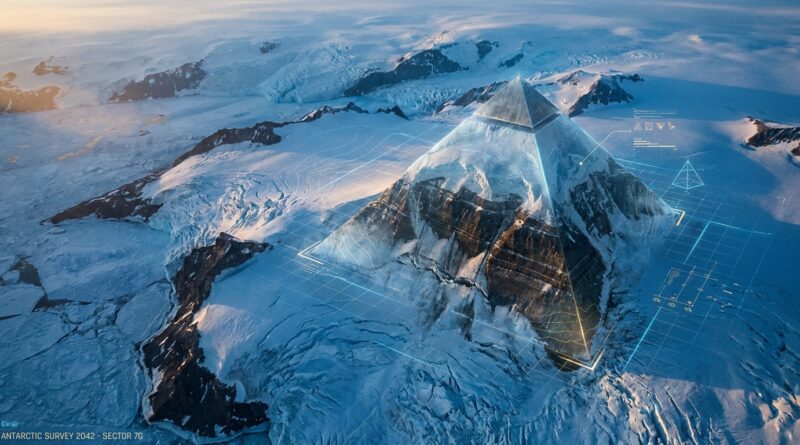
The Pyramid That Shouldn’t Be There: AI Just Flagged A Perfect Geometric ‘Ghost Structure’ Under Antarctic Ice
You are not wrong to roll your eyes at this one. The internet has trained us to treat every “lost pyramid in Antarctica” post like junk food for the conspiracy brain. Usually it is a blurry mountain, a weird shadow, or an AI-made image dressed up as satellite proof. That is what makes this latest claim about a mysterious pyramid structure under Antarctic ice more interesting than most. The shape was reportedly flagged during an AI-assisted scan of sub-ice survey data, not just spotted in a random social media screenshot. Better still, the geometry appears in the underlying mapping, which gives this story a little more weight than the usual recycled meme. That does not mean we have Atlantis in a snowbank. It means we may have found an anomaly worth checking with boring, serious tools. And honestly, that is the sweet spot. Real curiosity, with the hype dial turned way down.
⚡ In a Hurry? Key Takeaways
- This is not confirmed to be a man-made pyramid. It is an unusually geometric subsurface anomaly that AI helped flag for review.
- If you want to judge claims like this, look for raw survey methods, ice-penetrating radar references, elevation data, and whether multiple datasets match.
- The real value here is not proving an ancient civilization. It is learning how to separate honest anomalies from fake satellite hype.
What actually happened
The key detail is the method. This was not, at least in the more credible versions of the story, a case of someone circling a triangle on Google Earth and calling it proof. The reported anomaly came from an AI-assisted review of Antarctic mapping data, likely the kind of information gathered through radar, gravimetric sensing, or ice-penetrating surveys that help researchers “see” below the surface.
That matters because Antarctica is deceptive. Snow cover smooths everything. Ice hides ridges, valleys, buried mountains, and all sorts of shapes that can look far more deliberate than they really are. A computer trained to spot unusual symmetry can easily pull out forms that a human might miss. Sometimes that leads to a real discovery. Sometimes it just finds a very tidy natural feature.
So the phrase “perfect geometric ghost structure” should be read carefully. “Ghost structure” is colorful language. What researchers actually seem to have is a shape with suspiciously clean lines under ice, not a confirmed building.
Why people are paying attention this time
Most Antarctic pyramid stories fall apart in minutes because they rely on a single image, no coordinates, and no source data. This one has attracted attention because the geometry was not dismissed immediately by the people looking at the survey outputs.
That is a small but important difference.
Scientists do not usually get excited by the word “pyramid.” They get excited by things like repeated angular returns, unusual symmetry, and structures that appear across more than one scan type. If this anomaly showed up in a machine-learning pass and also made sense in the raw imagery, then it earns a second look. Not a History Channel voice-over. A second look.
What AI is doing here, and what it is not doing
This is where a lot of readers get tripped up. AI did not dig a tunnel into the ice, discover a temple, and write a press release. It likely did pattern detection. Think of it like a very fast intern with a sharp eye for odd shapes.
What AI can do well
AI is good at scanning huge volumes of survey data and highlighting outliers. Antarctica is enormous. Humans cannot manually inspect every subtle variation in radar maps and elevation models with equal attention. Software can help sort through the pile.
What AI cannot do by itself
AI cannot tell you whether a buried shape is artificial, geological, or just a data artifact. That still takes old-school work. Researchers need to compare datasets, check for sensor errors, test whether the angles survive at different resolutions, and see if the feature fits known glacial or volcanic processes.
In plain English, AI can point and say, “Hey, this looks weird.” It cannot finish the sentence.
Could a natural process make something pyramid-like?
Absolutely. And this is the boring answer that often turns out to be right.
Nature makes sharp geometry more often than people think. Mountain peaks can form clean triangular faces through erosion. Buried nunataks, which are rocky peaks surrounded or covered by ice, can produce strikingly regular outlines depending on the scan angle. Volcanic landforms can look engineered. So can fracture patterns and compressed sediment blocks.
Then there is the ice itself. Radar and topographic models can exaggerate edges. A feature that looks crisp in one render may soften into something much more ordinary when viewed from another angle or with different processing settings.
That is why the phrase mysterious pyramid structure under Antarctic ice should be treated as a description of appearance, not identity.
What would make this a serious anomaly
If you want to know whether this is worth your time, here is the checklist.
1. Multiple data sources agree
If radar, elevation models, and perhaps gravity data all point to the same basic geometry, confidence goes up.
2. The shape survives reprocessing
Sometimes a “perfect” structure is really just the product of smoothing, contrast tweaks, or AI overfitting. If the feature still looks unusual in the rawer versions of the data, that is more compelling.
3. It does not fit the local geology
If nearby formations do not show the same kind of symmetry, researchers have a stronger case that this is something unusual rather than a standard regional landform.
4. Experts outside the original team can inspect it
This is huge. Anomaly stories get stronger when independent glaciologists, geophysicists, or remote sensing specialists can review the same material.
What should make you skeptical
There are also a few red flags that should send you reaching for the brakes.
- Claims built around dramatic wording with no coordinates or no source dataset.
- Images that look more like 3D concept art than survey output.
- Any jump from “geometric” to “ancient civilization” with no middle steps.
- Posts that use the same old Antarctic mountain image from years ago.
This is one of the loudest and messiest corners of the mystery world because the visuals are so powerful. A triangle under snow basically writes its own viral caption.
Why Antarctica keeps producing stories like this
Part of it is simple psychology. Antarctica feels hidden. It is remote, expensive to study, and hard for most people to picture accurately. That makes it a perfect home for speculation.
The other part is technical. We really are still improving our maps. Not in the “there are blank spots on the globe” sense, but in the more practical sense that better sensors and smarter analysis tools keep revealing features we could not clearly see before. Some of those features are mundane. Some are surprising. A few may be genuinely strange.
That is what makes AI useful here. It can surface oddities in places humans assumed were already understood.
How to follow this story without getting played
If you are curious, stay curious. Just be picky.
Look for the raw stuff
Trust stories that point back to survey data, institutional releases, conference abstracts, or named researchers. Be wary of dramatic summaries that never show the source.
Watch for updates, not declarations
Real science stories get more specific over time. Fake ones get louder. If this anomaly is real, you should eventually see coordinates, method notes, comparison maps, or expert comment.
Separate “interesting” from “proven”
You do not have to decide today whether this is geological or artificial. The honest position is often the least flashy one. “That is weird, and I want better data” is a perfectly smart reaction.
So, is it a buried pyramid?
Right now, no one can responsibly say that.
What we can say is that an AI-assisted search appears to have flagged an unusually geometric feature beneath Antarctic ice, and that alone is enough to justify attention. Not belief. Attention.
If the structure keeps its shape across better scans and independent review, this story gets more interesting. If it fades under scrutiny, then it joins the long list of Antarctic almosts. Either way, the process matters, because it shows how modern tools are changing the way mysteries surface in the first place.
At a Glance: Comparison
| Feature/Aspect | Details | Verdict |
|---|---|---|
| Source of the claim | AI-assisted review of Antarctic subsurface or mapping data, not just a viral screenshot | More credible than typical social posts, but still unconfirmed |
| Shape itself | Reportedly very geometric, with pyramid-like symmetry under ice | Interesting anomaly, not proof of an artificial structure |
| Best next step | Cross-check with raw radar, topography, geology, and independent expert review | This is where the real answer will come from |
Conclusion
This is exactly the kind of story that can either spark genuine wonder or waste everybody’s time. The trick is not to shut down your curiosity. It is to aim it better. The value here is that we can look at a mysterious pyramid structure under Antarctic ice without falling straight into AI-generated junk, overcooked geology claims, or the same old conspiracy memes in a fresh snowcoat. When you anchor yourself in the method and the underlying imagery, you get a rare thing online. A safe place to be amazed without being gullible. And that may be the most exciting part of all. Not that Antarctica definitely hides a lost structure, but that new machine-learning tools are starting to find real oddities in places we thought were already mapped and filed away.