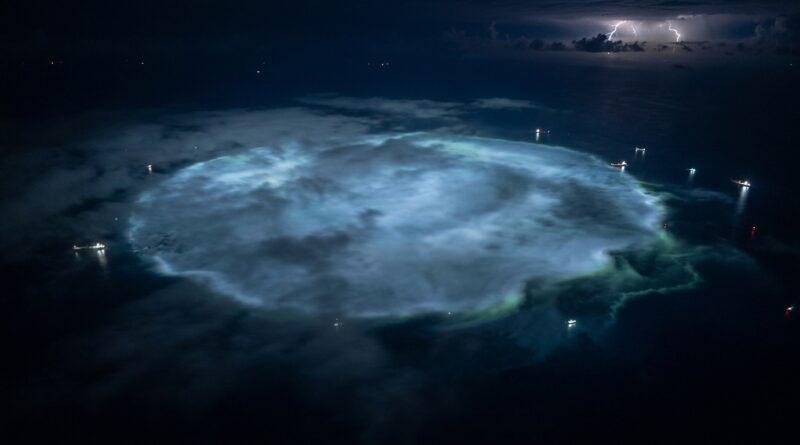
The Ocean Glow Nobody Ordered: Satellites Just Caught a Giant ‘Ghost Light’ in the Pacific
It is oddly frustrating when a mystery shows up in plain sight and the best answer is still, “we’re not fully sure yet.” That is where we are with this mysterious ocean glow satellite anomaly in the Pacific. Satellite watchers and researchers have flagged a huge, faint, milky patch of light over remote ocean water, and it does not fit neatly into the usual box of city glow, lightning, wildfire smoke, or a camera glitch. What makes this one so compelling is the scale. We are not talking about a tiny bright speck. We are talking about a broad, low-light bloom that appears to be coming from the ocean itself. If that sounds like something from an old sailor story, you are not wrong. Reports of “milky seas” have been around for centuries. The difference now is that we may be watching one unfold from space, in near real time, with public tools that regular people can check for themselves.
⚡ In a Hurry? Key Takeaways
- A large, faint glow in the Pacific has been spotted by satellites, and the leading idea is a rare “milky sea” event, but it is not confirmed yet.
- If you want to follow it yourself, start with public Earth-observation maps and compare nighttime imagery over several passes instead of trusting one viral screenshot.
- This is a good reminder that some of the strangest real anomalies are on Earth, not just in deep space, and they often stay unresolved for a while.
What was actually seen?
The short version is simple. A broad glowing patch showed up over a remote part of the Pacific in low-light satellite data. It looked diffuse, pale, and unusually uniform. That matters because most bright things at night have obvious structure. Cities make clusters. Ships make points or streaks. Lightning flashes and fades. This looked more like a softly lit veil spread across the water.
That is why people quickly landed on one old but very real possibility. A milky sea. These are rare ocean events where vast areas of water appear to glow steadily at night, often with a whitish or bluish cast. Sailors have described them for generations, sometimes over areas so large they seem impossible.
The key word here is “possible,” not “proven.” A mysterious ocean glow satellite anomaly is exciting precisely because the first interpretation is not always the right one.
Why scientists are being careful
This is where the story gets more interesting, not less. Researchers are being cautious because low-light satellite imagery is powerful, but it is also easy to overread if you strip away context.
Low-light satellites can see amazing things, but they need cross-checks
Nighttime sensors can pick up dim signals that normal weather satellites miss. That includes airglow, fishing fleets, aurora, wildfire signatures, and reflected moonlight. But faint light over water is tricky. Clouds, haze, sensor noise, moon angle, and even image processing choices can make a subtle feature look more dramatic than it really is.
So the smart approach is boring in the best way. Check multiple passes. Check weather conditions. Check known ship traffic. Check moon phase and cloud cover. See whether the glow holds its shape over time or behaves like an atmospheric artifact.
The best explanation so far is bioluminescence
If this does turn out to be a true milky sea, the usual suspect is bioluminescent bacteria. Unlike the quick sparkle you get from disturbed plankton near shore, milky seas are thought to involve massive numbers of glowing microbes spread across huge areas. Instead of flashing when waves break, the water can appear to shine steadily.
That said, even that explanation has loose ends. Scientists still debate exactly how these giant glowing fields start, how long they last, and what ocean conditions help them grow to such an enormous size.
Why this is such a big deal
A lot of “anomaly” stories online fall apart once better data shows up. This one is different because even the cautious version is still fascinating. If confirmed, this would be one of those rare moments when folklore, marine science, and satellite technology all meet in the same frame.
There is also something refreshing about an unresolved Earth mystery. We spend so much time looking outward for strange signals that we forget our own planet is still full of poorly understood behavior. Oceans cover most of Earth, and large parts of them remain thinly observed. So when a giant glow appears in a remote stretch of water, the honest answer may be that we are seeing something real in a place humans rarely watch closely.
How to follow the mystery without getting fooled
If you want to track a mysterious ocean glow satellite anomaly yourself, you do not need a secret lab. You do need patience.
1. Look for repeat observations
One image can be a fluke. Several consecutive observations are much stronger. If the glow persists across different times and viewing angles, confidence goes up.
2. Compare with weather and cloud maps
Thin cloud can scatter light in odd ways. So can humidity and haze. Before you assume “ghost light,” rule out the sky.
3. Check shipping and fishing activity
Dense fleets can create strange nighttime patterns, especially when lots of vessels use bright lamps. They usually look more structured than a milky sea, but they are still worth ruling out.
4. Treat dramatic colorized images with caution
Many public satellite images are enhanced to make faint features visible. That is useful, but it can also make a subtle signal look like a giant glowing wound in the ocean. The underlying data matters more than the prettiest repost.
What a “milky sea” actually looks like
People often imagine bioluminescence as bright neon surf at the beach. Milky seas are different. Witness accounts describe a soft, almost eerie luminosity, as if the sea has been painted with weak moonlight from below. Sailors have reported horizons that glow. Ships appear to cut through illuminated water for hours at a time.
That quiet, steady quality is one reason the satellite angle is so useful. If the ocean is glowing over a very large area, space-based low-light sensors may be one of the only practical ways to catch the full shape of the event.
Could it be something else?
Yes. And that is important.
Other explanations could include odd reflection conditions, atmospheric scattering, processing artifacts, or a mixed signal where real ocean light is exaggerated by viewing conditions. That is why “scientists don’t agree yet” is not a sign the story is weak. It is a sign people are doing the job properly.
The internet likes fast certainty. Science usually does not work that way. Especially not over the middle of the Pacific at night.
Why the public angle matters
One of the best parts of this story is that it is not locked away behind a classified telescope or a private corporate dashboard. Public satellite tools have gotten good enough that interested readers can start learning how to inspect Earth data on their own. You do not need to become a remote sensing expert overnight. You just need to get comfortable with comparing sources and resisting the urge to jump at the first spooky explanation.
That is part of what makes this worth watching right now. We are not just reading a polished answer after the fact. We are watching the puzzle take shape while the evidence is still coming in.
At a Glance: Comparison
| Feature/Aspect | Details | Verdict |
|---|---|---|
| Most likely explanation | A large-scale bioluminescent “milky sea” event caused by glowing marine bacteria | Plausible, but not confirmed |
| What makes it unusual | The glow appears broad, dim, and ocean-based rather than point-like or obviously man-made | Genuinely anomalous enough to study carefully |
| What readers should do | Follow repeat satellite passes, compare with weather and ship data, and avoid overhyped reposts | Best way to stay informed without getting misled |
Conclusion
This is exactly the kind of story that rewards attention. It is huge in scale, genuinely unresolved, and happening on our own planet instead of safely tucked away in deep space. Most people will never hear about a possible milky sea from orbit because it does not come packaged with aliens, explosions, or some clean Hollywood ending. But that is also why it matters. Covering a mysterious ocean glow satellite anomaly right now lets you watch a real mystery in motion instead of reading the watered-down version months later. It also nudges our curiosity back toward Earth, where some of the strangest and least understood things are still unfolding in open view. Better yet, this is the kind of mystery that connects directly to public satellite tools and hands-on exploration. For a community that likes being early, curious, and a little skeptical, this is the sweet spot.