The Illegal Signal In The Sky: Amateur Radio Astronomers Just Stumbled Onto A ‘Forbidden’ Cosmic Transmission
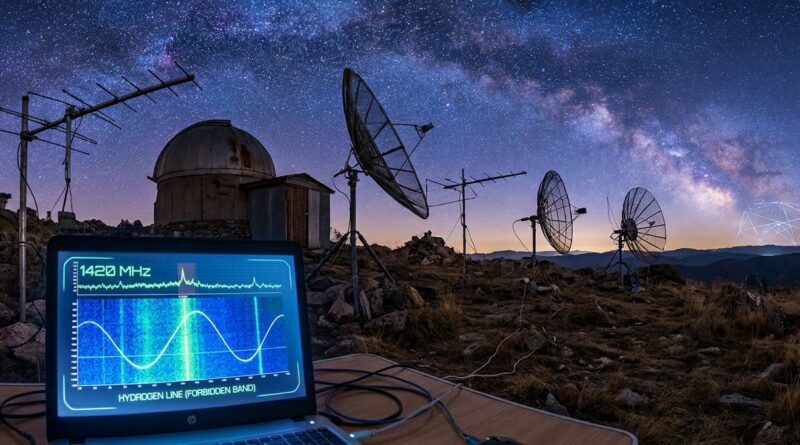
If you are tired of “mystery signal” stories that fall apart the second anyone asks for a frequency chart, you are not alone. That is why this one has people paying attention. A growing group of amateur radio astronomers says they have spotted a strange, narrowband transmission near 1420 MHz, the famous hydrogen line. That slice of spectrum is supposed to be one of the quietest places in radio astronomy. It is protected because hydrogen is everywhere in space, and scientists use that signal to map the galaxy and listen for unusual activity. So when something that looks oddly man-made shows up there, people notice fast. The current buzz is not that aliens have called. It is simpler, and in some ways more interesting. There appears to be a real, trackable signal in a “forbidden” band, and hobbyists are using open software, shared waterfall plots, and Doppler checks to figure out whether it is interference, a satellite, or something nobody has properly identified yet.
⚡ In a Hurry? Key Takeaways
- The mysterious 1420 MHz hydrogen line radio signal is interesting because it appears in a protected astronomy band where ordinary transmissions are not supposed to be.
- If you want to follow the story yourself, look for shared spectrum plots, check whether the signal drifts with Doppler, and compare reports from different locations.
- Do not jump straight to “alien message.” The most likely causes are still human-made interference, equipment artifacts, or a transmitter operating where it should not be.
Why 1420 MHz matters so much
1420.40575177 MHz is the hydrogen line. That sounds dry, but it is one of the most important frequencies in radio astronomy.
Neutral hydrogen, the most common element in the universe, naturally emits radio waves at this frequency. Because hydrogen is spread across galaxies, astronomers can use the line to map spiral arms, gas clouds, and motion in space.
It is also famous in SETI circles. The logic is simple. If any civilization wanted to send a signal on a “universal hailing channel,” the hydrogen line would be an obvious choice because any radio-capable species would likely know it.
That is why a suspicious signal there gets attention fast. It is not just another noisy part of the dial. It is sacred ground for radio astronomy.
What people are actually seeing
The reports making the rounds are not about a giant broad burst or a one-second blip. They describe something much more ordinary-looking. A narrow, stable signal. A pattern that can look a bit like data. Something that seems to sit on, or very near, the hydrogen line band.
That “ordinary” look is part of the mystery. Natural radio sources usually do not behave like clean engineered transmissions. When hobbyists see a thin line on a waterfall display that holds together over time, they start asking practical questions.
Is it really coming from space?
That is the first test. A signal can seem cosmic when it is really much closer to home. Bad shielding, a noisy USB cable, a local oscillator, an overhead aircraft, a satellite, or even a distant illegal transmitter can all fool people.
The useful part of this story is that observers are not stuck guessing. They can compare recordings from different sites. If the same signal appears across wide distances and shifts in a way that matches sky motion, it gets more interesting. If it only shows up in one backyard, that usually points to local interference.
Why Doppler math matters
Doppler shift is the change in frequency caused by motion. It is the same basic effect that changes the pitch of a passing siren.
For radio work, Doppler is one of the best reality checks. A satellite will often show a predictable frequency drift as it moves. A true celestial source may show a different pattern tied to Earth’s rotation and orbit. A local source often shows little or no drift at all.
So when people say they are checking “the math,” this is what they mean. They are asking whether the signal moves like a thing in orbit, a thing fixed on Earth, or a thing far beyond both.
Why a “forbidden” signal does not automatically mean anything exotic
Protected does not mean physically impossible to pollute. It means the frequency is supposed to be kept clean for science. Real life is messier.
Transmitters drift. Harmonics happen. Equipment breaks. Satellites sometimes radiate outside intended limits. Military, commercial, or experimental systems may also be misidentified at first, especially if public records are incomplete.
There is also the simple fact that consumer radio gear is better than it used to be. More hobbyists can now watch spectrum that used to be the domain of labs and universities. That means more eyes on the sky, but it also means more chances for false alarms from cheap hardware, poor calibration, or overloaded front ends.
What would make this signal truly compelling
Right now, the difference between “interesting interference” and “big scientific story” comes down to repeatability and independent confirmation.
Here is the checklist serious observers care about
Seen by multiple stations. If observers in different regions record the same feature, that is a strong start.
Accurate frequency calibration. A cheap SDR can be off by more than you think. Without calibration, “1420 MHz” may really be “near 1420 MHz.”
Clear Doppler behavior. The drift pattern should match a real source model, not random wobble.
Antenna direction tests. If the signal strengthens when the dish points at a certain part of the sky and fades elsewhere, that matters.
Known-source elimination. Satellite databases, local interference surveys, and equipment swap tests should all be part of the process.
How hobbyists can follow this without a PhD
This is the part I like most. You do not have to just sit there while headlines yell “scientists baffled.” This is one of those rare stories where normal people can inspect the evidence.
Start with the waterfall
A waterfall display is just a picture of radio power over time. Bright narrow lines usually mean strong, focused signals. If the line stays perfectly flat, that suggests one thing. If it curves or drifts, that suggests another.
You are not looking for magic. You are looking for patterns.
Compare timestamps and locations
If one observer in Europe and another in North America catch the same signal at the same time, that narrows the list of explanations. If only one person sees it, do not get too excited yet.
Check open tracking tools
Satellite tracking databases, SDR logging groups, and amateur radio forums can help rule out common suspects. Many odd signals stop being mysterious once someone overlays a satellite pass.
Be suspicious of screenshots alone
A single image is easy to misunderstand. Better evidence includes raw IQ recordings, frequency logs, antenna details, gain settings, and calibration notes.
The SETI angle, and why people keep bringing it up
Any signal near the hydrogen line is going to attract SETI chatter. That is unavoidable. The band has symbolic weight.
But the grown-up way to handle that is to separate romance from evidence. A clean narrowband transmission at or near 1420 MHz is worth checking because of where it sits, not because it gives us permission to skip the hard work.
That hard work is slow. It is also what makes the story better. If this turns out to be a rule-breaking terrestrial transmitter, that is still a real finding. If it turns out to be a satellite or instrumentation artifact, that teaches people how these investigations actually work. And if it survives all those checks, then the stakes go up for good reasons, not because a headline got dramatic.
What is most likely going on?
If I had to bet today, I would still put my money on human-made interference of some kind. Not because the reports are silly, but because that is what usually wins.
The most likely explanations, in rough order, are:
1. Local or regional interference
Nearby electronics, poor filtering, or unexpected emissions can produce very convincing false “sky” signals.
2. Satellite or spacecraft transmission
Something in orbit can look mysterious until somebody matches its path and drift.
3. Receiver artifact
Cheap SDRs, overloaded front ends, clock error, and software settings can all create ghosts.
4. Unauthorized transmission in a protected band
This would be unusual, but not impossible. “Forbidden” does not mean nobody ever breaks the rules.
5. A genuine unexplained astronomical source
This is the exciting option. It is also the one that needs the most proof.
Why this story feels different from empty clickbait
Most viral “space mystery” stories evaporate when you ask basic questions. Where is the raw data? Who measured the frequency? Did anyone else confirm it? What does the drift look like?
This case is getting traction because those are exactly the questions people are asking. The signal is concrete enough to inspect. It lives in a famous part of the spectrum. And the tools needed to study it are no longer locked inside giant institutions.
That makes this a better kind of mystery. Less campfire story, more neighborhood investigation.
At a Glance: Comparison
| Feature/Aspect | Details | Verdict |
|---|---|---|
| Frequency location | Reported near the 1420 MHz hydrogen line, a protected band used for radio astronomy and often watched by SETI researchers | Genuinely noteworthy |
| Signal behavior | Looks narrowband and somewhat data-like, which often suggests engineered transmission rather than a natural source | Interesting, but not proof of anything exotic |
| Best next test | Independent observations, Doppler analysis, calibration checks, and satellite rule-outs | This is where the mystery either sharpens or collapses |
Conclusion
The smart way to watch this story is with curiosity and a little discipline. Our community loves wild claims, but people are worn out by clickbait that disappears the moment you ask a technical question. This case is better than that. It is unfolding in real time. It involves a concrete, trackable signal. And it sits right where serious SETI researchers have been listening for decades. By sticking to spectrum plots, Doppler math, calibration checks, and open tools anyone can use, you get something much more satisfying than another vague “scientists baffled” headline. You get a mystery you can actually follow, test, and argue about with other people who care about the evidence. Whether the mysterious 1420 MHz hydrogen line radio signal turns out to be interference, a rule-breaking transmitter, or something rarer, the process of checking it is the real story. And for once, that story is worth your time.