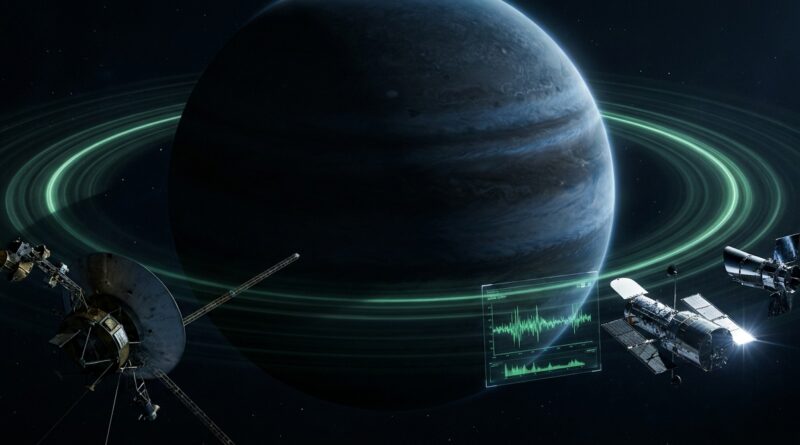
The Planet That Suddenly Started Ringing: Mystery ‘Spacequakes’ Are Echoing Through Our Solar System
It is frustrating when a big space story breaks and the internet instantly fills with wild guesses, fake certainty and recycled sci-fi jokes. What scientists have actually flagged is far more interesting. In the last 24 hours, researchers quietly noted a strange pattern of low-frequency vibrations coming from a distant planet, a kind of signal some are informally calling “spacequakes.” The odd part is not just that the planet seems to be shaking. It is that the rhythm does not line up with the usual suspects like seasonal weather, magnetic activity or normal orbital effects. That has left teams doing the least glamorous but most important work first. They are checking whether the data is real, whether the instruments glitched and whether a known explanation is hiding in plain sight. If you are looking for the grounded version of this developing story, this is the right place to start. We will keep it simple, stick to what is known and separate the mystery from the noise.
⚡ In a Hurry? Key Takeaways
- Scientists are tracking mysterious planetary spacequakes baffling scientists because the new low-frequency pattern does not match known planetary behavior.
- The smartest move right now is to watch for repeat observations from separate instruments, not social media claims or dramatic one-off screenshots.
- There is no evidence of danger to Earth, but the finding could matter a lot for how we understand the inside of distant planets.
What actually happened
Researchers monitoring a distant planet have reported an unusual repeating signal that looks like deep, low-frequency shaking. Think less “planet exploding” and more “something inside or around this world is humming in a way we did not expect.”
That matters because planets usually give off patterns scientists can sort into familiar buckets. Some signals come from storms. Some come from magnetic fields interacting with charged particles. Some line up with a moon tugging on the planet, or with a known orbital cycle. This new pattern does not fit neatly into any of those boxes, at least not yet.
That is why the phrase mysterious planetary spacequakes baffling scientists is starting to show up. Not because anyone has proved something impossible, but because the data is annoying in the most scientific way possible. It refuses to behave.
Why scientists are second-guessing their own instruments
This is normal. In fact, it is a good sign.
When researchers see something strange, the first question is usually not “What amazing new phenomenon did we find?” It is “Did our equipment fool us?” Instruments in space and on Earth can produce false signals for boring reasons. Heat changes. Calibration drift. Software filtering. Timing errors. Background noise. Even the way data is cleaned up can create patterns that look real at first glance.
So before anyone starts writing headlines about a planet “ringing” like a bell, teams will want answers to basic questions:
Are multiple sensors seeing the same thing?
If one detector sees a pattern and another does not, confidence drops fast.
Does the signal repeat over time?
A one-off blip is interesting. A repeating pattern is much harder to dismiss.
Can known causes be ruled out?
Researchers will test weather models, magnetosphere activity, orbital timing and spacecraft noise before reaching for exotic ideas.
What could cause a planet to “ring”
Right now, there is no tidy answer. But there are a few sensible possibilities scientists will likely check first.
1. Deep internal activity
If the planet has a layered interior, motion far below the surface could produce slow vibrations. On Earth, quakes tell us a lot about what is happening inside the planet. A distant version of that idea is not crazy.
2. Atmospheric coupling
Some planets have thick atmospheres that can interact with the surface or magnetic field in messy ways. That could create a low, repeating signal without needing a classic quake.
3. Tidal stress from a moon or nearby object
A gravitational tug can flex a planet over time. If the timing is just right, it may create periodic internal strain.
4. Magnetic effects we do not fully understand yet
Planets with strong magnetic environments can produce weird signatures. What looks seismic at first could turn out to be electromagnetic.
5. Data processing artifacts
This is the least exciting option, but it stays on the table until independent teams confirm the signal.
What this does not mean
It does not mean aliens. It does not mean a planet is breaking apart. It does not mean our models are worthless.
It means science is in the awkward early stage where the signal is interesting enough to take seriously, but not settled enough to explain with confidence. That middle phase often gets mangled online because people want a final answer immediately. Space research rarely works that way.
Why this story matters even if the signal turns out to be mundane
Even a boring explanation would be useful. If the pattern comes from instrument quirks, that teaches researchers how to avoid false readings in future missions. If it comes from a known process behaving in a new setting, that helps improve planet models. And if it turns out to be something truly new, then we may be watching the first chapter of a much bigger discovery.
This is also why early anomalies are worth following carefully. They show how science actually works. Not as a clean movie reveal, but as a slow process of checking, doubting, testing and checking again.
How to follow this without getting pulled into rumor chaos
If you want to stay informed without drowning in hype, use a simple filter.
Look for independent confirmation
The strongest updates will come when separate teams, tools or observatories report matching results.
Watch for specific language
Words like “preliminary,” “candidate signal,” “unconfirmed” and “under review” are not red flags. They are honest labels.
Be careful with dramatic visuals
A slick animation can make uncertain data feel settled. It often is not.
Pay attention to what changed
The best updates explain what is newly known, what remains unclear and what got ruled out.
What readers should keep in mind over the next few days
The next step is not a grand press conference. It is likely a quiet stream of checks, comparisons and maybe a technical note or conference update. That is how real anomalies move from “huh, that is odd” to “yes, this is real.”
So if you see breathless claims before those steps happen, treat them as entertainment, not evidence.
At a Glance: Comparison
| Feature/Aspect | Details | Verdict |
|---|---|---|
| Current evidence | Low-frequency repeating signal has been flagged, but early verification is still underway. | Interesting, but not confirmed. |
| Likely next step | Scientists will compare data across instruments and test ordinary explanations first. | This is the stage to watch. |
| Risk to readers | No sign of danger to Earth. Biggest risk is misinformation and overblown claims online. | Stay curious, not panicked. |
Conclusion
This is exactly the kind of live, unfolding anomaly our readers care about. There is no safe, tidy explanation yet, and that is what makes it worth watching. You do not need a physics degree to follow it. You just need a clear view of what is known, what is guesswork and why the slow, careful part of science matters. If these strange signals hold up, they could teach us something important about how distant planets behave beneath the surface. If they do not, we still learn how researchers sort real discoveries from false alarms. Either way, you can follow the investigation from day one and stay part of a grounded conversation instead of getting swept into the usual social-media rumor spiral.