The Meteorite In The Living Room: Scientists Say This Rock Carries ‘Alien World’ Chemistry
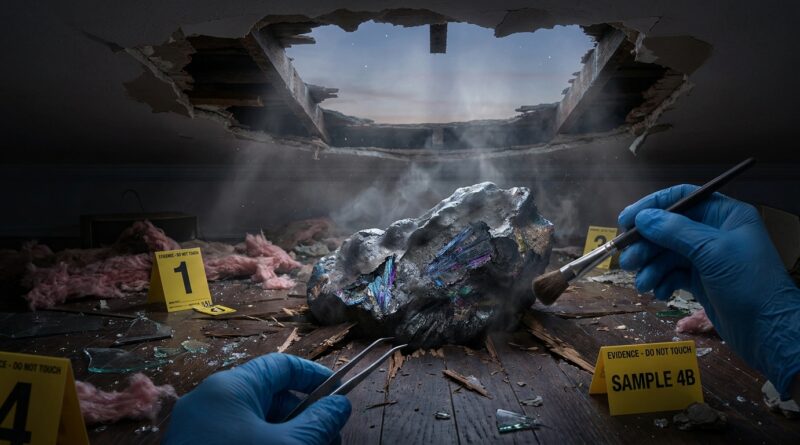
If you are worn out by shaky UFO videos and endless message-board theories, this one feels different right away. A rock reportedly slammed through a roof in New Jersey, landed hot, and gave scientists something they can actually hold, test, weigh, slice, and argue over in a lab. That is why the phrase “New Jersey meteorite alien world chemistry” is catching attention. It sounds wild, but the interesting part is not little green men. It is the chemistry.
Researchers studying the stone say its makeup may point to material from a world that started to form, then never quite made it into a full planet. That is a big deal. Meteorites are time capsules, and some carry clues from the earliest days of the solar system. So this is not just a weird rock story. It is a chance to watch real science work in public, with evidence that can be checked instead of just shared.
⚡ In a Hurry? Key Takeaways
- The New Jersey meteorite is interesting because scientists can physically test it, and its chemistry may trace back to a partially formed ancient world.
- When you see a “mystery rock” headline, look for chain of custody, lab analysis, mineral data, and isotope testing before believing the hype.
- Do not touch or move a suspected meteorite too much. Fresh samples can hold valuable surface clues, and hot or contaminated rocks are harder to study properly.
Why this story feels different
Most so-called alien stories fall apart fast. The video is blurry. The witness account changes. The “evidence” turns out to be a lighting glitch or a repost from three years ago.
This case starts from a stronger place. There is a reported impact. There is property damage. There is a physical object. And there are scientists looking at its composition instead of trying to build a myth around it.
That matters.
When experts talk about “alien world chemistry,” they do not mean proof of life. They mean the rock appears to carry chemical signatures that formed somewhere off Earth, possibly in a parent body with a strange history. In plain English, this may be debris from a failed world, a chunk of material from the chaotic construction zone that once made planets.
What “alien world chemistry” actually means
The phrase sounds dramatic, but the science behind it is pretty grounded.
It is alien because it is not from Earth
Every confirmed meteorite is, in a basic sense, alien. It formed in space and later fell here. But some meteorites are far more interesting than others because their minerals and isotopes point to rare origins.
Chemistry can reveal a parent body
Scientists look at things like metal content, silicate minerals, tiny melted spheres, shock features, oxygen isotope ratios, and whether the rock shows signs of heating inside a larger body. Those details can hint at whether the meteorite came from:
- An ordinary asteroid
- A differentiated body, where heavy materials sank inward and lighter materials rose
- A partially formed protoplanet that broke apart long ago
That last category is where the phrase gets exciting. A “failed planet” is not sci-fi shorthand. It usually refers to an early body that began the same process as a planet but got smashed up or never grew large enough to finish the job.
Why scientists care so much about failed planets
Think of the early solar system like a kitchen during a rushed holiday dinner. Stuff was colliding everywhere. Some ingredients stuck together. Some burned. Some got knocked off the counter. What we have now is the final meal. Meteorites are the crumbs and dropped bits that still tell you how the recipe came together.
If this New Jersey meteorite really carries signs of a disrupted protoplanet or an unusual parent body, that gives researchers a direct sample of a building block from the solar system’s early years. That is rare. And unlike distant telescope observations, they can test this material over and over.
How a meteorite gets identified for real
This is the part worth learning, because it helps you sort science from nonsense the next time a mystery stone trends online.
Step 1: Basic physical clues
Fresh meteorites often have a dark fusion crust from burning through the atmosphere. They may be denser than normal Earth rocks. Some are magnetic because they contain iron-nickel metal.
But none of that is enough on its own. Plenty of Earth rocks can fake parts of that look.
Step 2: Microscopic and mineral analysis
Scientists cut thin sections and study the internal structure. They look for classic meteorite textures, metal grains, chondrules, and shock effects that are hard to explain with ordinary Earth geology.
Step 3: Chemistry and isotopes
This is where the real confidence comes from. Isotope ratios, especially oxygen isotopes, can help place a rock into known meteorite groups or show that it is unusual. Trace elements can also reveal how the parent body formed and changed over time.
Step 4: Classification and peer review
A claim becomes far more credible when specialists compare the sample against known meteorite classes and publish or formally submit findings. Until then, smart caution is your friend.
What happened in New Jersey, in practical terms
Based on reports, the rock was dense, hot, and arrived with enough force to punch through a roof. Those details fit the broad outline of a recent fall, though each point still needs careful documentation.
A fresh fall is gold for researchers because contamination is lower. Rain, soil, fingerprints, and enthusiastic souvenir hunters can all mess up a sample. The sooner a specimen is documented and preserved, the more useful it becomes.
That is another reason this case stands out. A newly fallen meteorite is a live science event, not just a dusty museum object with an old label.
What to be skeptical about
You can enjoy the wonder without switching off your brain.
Do not confuse “alien” with “biological”
Nothing here suggests aliens built it, rode in it, or left a message inside it. “Alien world chemistry” is about origin, not life.
Wait before accepting dramatic claims
Early descriptions are often a little messy. Initial excitement can lead to headlines that run ahead of the data. The strongest version of this story will come from lab results, not social posts.
One unusual rock does not rewrite physics overnight
Even if the meteorite turns out to be from a rare parent body, it would expand our understanding of early planetary formation. It would not mean every conspiracy thread was right all along.
How to spot a real science story in a sea of online noise
Here is the simple checklist I use.
- Is there a physical sample?
- Is there a clear chain of custody?
- Are named researchers or institutions involved?
- Are they talking about minerals, isotopes, and classification?
- Do the claims get more careful as more data comes in, not more dramatic?
If the answer is yes to most of those, pay attention. If the story leans mostly on blurry photos, bold captions, and “experts say” with no actual experts named, keep your wallet and your belief system closed.
What this could teach us next
Best case, the New Jersey meteorite becomes a valuable sample from a rare class of parent body, maybe even one linked to a partially formed world that was shattered billions of years ago. That would give planetary scientists another piece of the puzzle about how rocky planets start, change, and sometimes fail.
Even the less dramatic outcome would still matter. If the stone turns out to be a more ordinary meteorite, the case is still useful because it shows the public how real identification works. That alone is a nice change from the usual cycle of hype and letdown.
What to do if a “space rock” lands near you
Very briefly:
- Do not assume it is safe to handle right away.
- Take photos before moving it.
- Note the time, location, smell, sound, and any damage.
- Use clean gloves if you must move it.
- Store it in a clean container, not a random plastic bag full of dust.
- Contact a local university geology department, museum, or meteoritics expert.
That may sound fussy, but those small steps can preserve the very evidence that tells scientists where the object came from.
At a Glance: Comparison
| Feature/Aspect | Details | Verdict |
|---|---|---|
| Physical evidence | A reported hot, dense stone that caused real damage and can be tested directly. | Much stronger than photo-only UFO claims. |
| Scientific value | Its chemistry may point to a rare parent body, possibly a partially formed ancient world. | Potentially significant, pending full lab confirmation. |
| Public takeaway | A live example of how to separate measurable evidence from internet mythmaking. | Worth following with curiosity and healthy skepticism. |
Conclusion
The best thing about the New Jersey meteorite alien world chemistry story is that it gives people something rare. A fresh mystery that feels strange, but can still be tested. That is the sweet spot. You get the wonder of a possible fragment from a failed world, plus the very practical lesson that extraordinary claims should come with samples, lab work, and patience. If you keep that balance in mind, you can enjoy the excitement without falling for noise. And if the science holds up, this little rock from a quiet suburb may end up telling us a lot about planets that almost were, and the debris that still drops in on us from deep time.