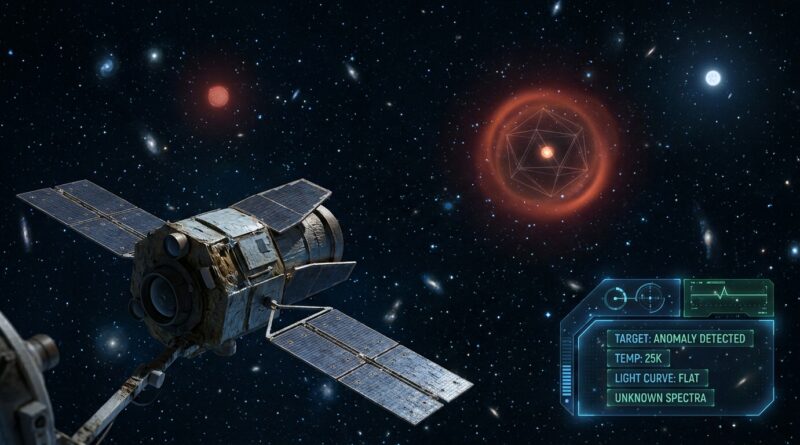
The Galaxy’s Coldest ‘Stars’ Might Be Alien Power Plants, Not Failed Suns
Space mysteries can be oddly frustrating. The flashy stuff gets all the headlines, while the genuinely weird clues often sit buried in star catalogs with names only a database could love. That is why this new work matters. Astronomers are taking another hard look at some of the coldest star-like objects in the galaxy, bodies so dim and strange that they blur the line between failed stars, giant planets, dust-shrouded oddballs, and something even harder to say out loud. If you have ever suspected the real alien story would show up not as a flying saucer but as a stubborn little data point that refuses to behave, you are not alone. These objects are interesting because they may be perfectly natural. They are also interesting because, in theory, the waste heat from a very advanced civilization could look a lot like an unusually cold, faint object in infrared surveys. That does not mean aliens. It does mean the question is finally being asked in a serious way.
⚡ In a Hurry? Key Takeaways
- Some of the galaxy’s coldest “stars” do not fit neatly into known categories like brown dwarfs, planets, or dusty stellar remnants.
- If you want to help, start with citizen-science sky searches that compare old infrared maps and flag objects with strange temperatures or light changes.
- The safest reading of the new data is “unexplained, not extraterrestrial,” but it is a real scientific mystery worth watching.
Why these objects are getting attention
Most people think of stars as hot. Very hot. So when astronomers find something star-like that is shockingly cold by stellar standards, ears perk up.
These objects are often grouped with brown dwarfs, which are sometimes called failed stars. That nickname is a little unfair, but useful. A brown dwarf forms like a star, from a collapsing cloud of gas, but it never gets massive enough to keep hydrogen fusion going in the way a true star does. So it glows faintly, mostly in infrared, and cools over time.
That is the normal story. The strange part is that a few of the coldest known examples seem to push the models hard. Their temperatures, spectra, brightness, or changes over time do not always line up cleanly with what astronomers expect. Some may just be rare edge cases. Some may be wrapped in dust. Some may have weird atmospheres full of methane, ammonia, water clouds, or chemistry we do not yet model well.
And some, at least in the most speculative conversations, raise a classic Dyson sphere mystery. What if a sufficiently advanced civilization built structures around an energy source and re-radiated that energy as low-temperature waste heat? From far away, that might not look like a beacon. It might look like a cold, dim infrared object that does not fit.
What the new paper actually says
Here is the important part. The paper does not announce alien power plants. Not even close.
What it does is more useful than that. It sharpens the problem. It revisits a set of very cold star-like candidates and asks whether existing natural explanations fully account for the observed data. In plain English, the researchers are saying, “These things are odd, and we should be more careful before we wave them away as just another brown dwarf.”
That is how real science usually works. Not with a trumpet blast, but with a tighter error bar and a more annoying unanswered question.
What the data seem to show
The new observations and reanalysis point to a few big themes:
- Some objects are colder than expected for their apparent class.
- Some emit light in infrared bands that do not match standard models very well.
- A few may show unusual variability, meaning their brightness changes in ways that are not easy to explain with current atmospheric models alone.
- Catalog confusion remains a problem. Dust, background galaxies, and measurement limits can make weird things look even weirder.
If that sounds messy, it is. Astronomy at the faint edge often is.
The natural explanations still come first
Before anybody jumps from “coldest stars alien megastructure dyson sphere mystery” to “case closed,” it is worth slowing down.
Nature is extremely good at making objects that look artificial until we learn the trick. Pulsars once sounded like they could be signals. Fast radio bursts caused years of debate. Even Tabby’s Star, which sparked megastructure chatter a few years back, ended up looking much more like dust than engineering.
So what could these cold objects be if not technology?
1. Extremely cold brown dwarfs
This is still the leading answer for many candidates. Brown dwarfs can cool to temperatures closer to a hot oven than a star. The coldest Y-dwarfs are already astonishingly dim and weird.
2. Dusty or cloud-heavy atmospheres
If an object has thick clouds, strange chemistry, or layers of dust, it can hide heat and distort the infrared signature we use to identify it.
3. Misclassified background sources
A faint galaxy, instrument noise, or a blended source can sometimes sneak into a catalog as a “star-like” object when it is really something else.
4. Exotic stellar remnants or free-floating planets
There are also less common classes of natural objects that might explain part of the sample. The universe has more categories than our neat textbook diagrams suggest.
So where does the Dyson sphere idea enter the picture?
Mostly as a test, not a conclusion.
A Dyson sphere, or more realistically a Dyson swarm, is a hypothetical set of energy-collecting structures around a star. The key idea is simple. If a civilization captures lots of starlight, that energy does not vanish. Thermodynamics says it must come back out as waste heat. Depending on the design, that heat could show up in infrared surveys.
That means astronomers can ask a careful question: if we search the sky for unusually bright infrared sources, or for objects whose temperature and luminosity make no natural sense, do any stand out?
Most do not. Or rather, most that looked promising have turned out to be dust, stars in awkward environments, or data issues. But the search itself is not silly. It is just hard.
The current mystery lives right in that gap. The alien megastructure angle is not the claim. It is the measuring stick that reminds us to look for waste heat, not movie-style spacecraft.
Why this matters more than another UFO clip
For readers who follow anomalies, this is refreshingly grounded. No shaky cockpit video. No unnamed source. No recycled argument about a light in the sky.
This is about physical measurements. Temperature. Brightness. Spectra. Repeat observations. Catalog cross-checks.
That is why the story has value even if every last object turns out to be natural. It teaches a better habit of mind. Instead of asking, “Do I believe in aliens?” the useful question is, “What would advanced engineering look like in the data, and how would I rule out ordinary astrophysics first?”
How regular people can actually help
This is the nice surprise. You do not need a backyard observatory the size of a shed to take part.
Join citizen-science classification projects
Several astronomy projects let volunteers inspect images, compare object behavior across surveys, and flag odd sources. Look for efforts tied to Zooniverse, Backyard Worlds, and infrared sky searches using WISE and NEOWISE data.
Backyard Worlds in particular has a strong track record of helping volunteers spot brown dwarfs and other faint moving objects that automated systems miss.
Learn what “normal weird” looks like
If you want to be useful, spend some time learning the ordinary classes first. Brown dwarfs, red dwarfs, dusty stars, galaxies, and image artifacts each have patterns. Once you know the usual suspects, the real oddballs stand out faster.
Track light curves and motion
A source that changes brightness strangely, or moves across the sky differently than expected, deserves more attention than one odd-looking infrared snapshot.
Be boring in the best possible way
Document everything. Save links. Record coordinates. Compare multiple surveys. The people who help most in anomaly hunting are usually the least dramatic.
What remains unexplained
There are still a few stubborn gaps.
- Some temperature estimates and spectral signatures do not fit existing model grids very well.
- A few objects appear too faint, too cold, or too oddly colored for easy classification.
- Cloud physics in ultra-cool atmospheres is still messy, which means “unexplained” may reflect limits in our models, not something exotic in the sky.
That last point matters. Sometimes the mystery is not the object. It is our software.
What to watch next
The next big step is not a press conference. It is better infrared data, more repeat observations, and cleaner separation between true anomalies and catalog junk.
Newer instruments and improved analysis should help astronomers measure temperatures more accurately, test whether these objects vary over time, and see whether their spectra line up with exotic atmospheres or something stranger.
If even a tiny handful still refuse to fit after that, interest will grow fast. Not because “aliens” wins by default, but because astronomy loves a clean outlier.
At a Glance: Comparison
| Feature/Aspect | Details | Verdict |
|---|---|---|
| Best current explanation | Ultra-cool brown dwarfs, dusty atmospheres, or classification errors explain many of these objects. | Natural causes still lead. |
| Why the story is exciting | A few sources remain awkward fits for standard models, especially in infrared temperature and spectral behavior. | A real anomaly, but not proof of anything exotic. |
| What readers can do | Use citizen-science projects like Backyard Worlds and survey archives such as WISE to help spot odd objects. | Practical and worth trying. |
Conclusion
Today’s paper on the galaxy’s coldest “stars” quietly reopens one of the strangest questions in modern astronomy: how do you tell the difference between an exotic natural object and the waste heat of a galaxy-spanning civilization. That is a wonderful question because it forces everyone, scientists and curious readers alike, to get more precise. It gives the anomalies crowd something rare. A fresh, high-signal story that is not another worn-out Pentagon clip. It gives a clear breakdown of what the new data actually show, and what remains unexplained. And it gives you a way to join in, through citizen-science searches combing old sky maps for objects whose light curves and temperatures simply do not fit any known class of star. In a news cycle full of noise, this is a rigorous maybe. Sometimes that is better than a loud certainty. It invites you to look up, check the data, and help decide whether we are seeing failed suns, dark dust, or the first engineering scars of something that learned to bottle a star.