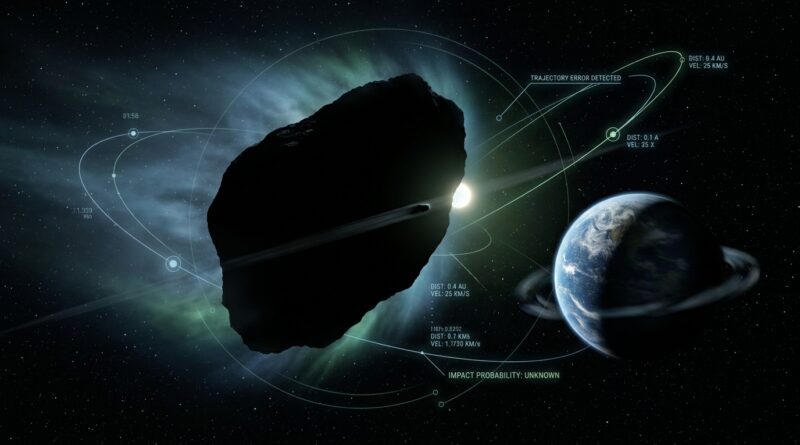
The Asteroid That Was Lying To Us: How A ‘Perfectly Normal’ Space Rock Turned Out To Be A Hidden Comet
It is unsettling when the sky turns out to be less sorted than we thought. For 27 years, astronomers logged one near-Earth object as a fairly ordinary asteroid. Nothing dramatic. Nothing to lose sleep over. Now the newer evidence points to something stranger. This asteroid turned out to be a dark comet, a rare kind of object so dim and dust-poor that it can pass for a plain space rock until someone looks much closer. That matters because our catalogs are supposed to tell us what is actually moving through Earth’s neighborhood. If one object could hide its real nature in plain sight for nearly three decades, it is fair to ask what else we may be labeling a little too confidently. This is not a panic story. It is a reminder that space science is often a long correction process, and sometimes the biggest surprise is not a new object. It is realizing an old one was quietly lying to us all along.
⚡ In a Hurry? Key Takeaways
- A long-classified near-Earth asteroid now appears to be a dark comet, not a normal rocky asteroid.
- When you read future “asteroid risk” headlines, check whether scientists are still refining the object’s true type and behavior.
- This does not mean immediate danger, but it does mean our space catalogs are less final and tidy than many people assume.
What actually changed?
The big shift is not that a new object suddenly appeared. It is that better observations and updated analysis changed the story of an object we already knew.
For years, this near-Earth body looked like an asteroid. Asteroids are usually rocky or metallic. Comets, by contrast, are better known as icy bodies that heat up near the Sun and throw off gas and dust, creating a fuzzy coma or tail.
But nature does not always respect our neat labels.
A dark comet sits in the awkward middle. It can move through space with some comet-like behavior, possibly driven by subtle outgassing or other non-gravitational forces, while staying visually bland enough to pass as an asteroid. No glorious tail. No obvious glow. Just a very sneaky object.
Why a dark comet is such a headache
Most people hear “comet” and picture a bright streak with a dramatic tail. A dark comet is the opposite of that mental image. It is faint. It can be hard to detect. And it may not advertise what it is doing.
That makes classification tricky.
Scientists often sort objects using brightness, orbit, reflectivity, and signs of activity. If an object is extremely dark and only weakly active, those clues can point in different directions. You end up with something that looks normal until the math starts acting odd.
That is what makes this case so interesting. The problem was not that astronomers were careless. The problem is that the object itself seems built to fool the usual boxes.
Why this matters beyond one weird rock
This is the part that should hold people’s attention. Space catalogs are not just lists. They are the foundation for how we estimate risk, track motion, and decide what deserves follow-up observation.
If an asteroid turned out to be a dark comet, that changes more than its label. It can change how we think it moves over time, how it reacts to solar heating, and how easy it is to spot again in future passes.
Classification affects prediction
When astronomers model an object’s path, they mostly use gravity. But comets can get tiny pushes from escaping gas or dust. Those pushes are small, but over years they can add up. If you mistake a comet-like object for a simple inert rock, your long-term predictions can be slightly off.
Not wildly wrong. But wrong enough to matter.
Dark objects are easy to underestimate
Very dark bodies reflect little sunlight. That can make them harder to study and easier to miss until they are closer than anyone would like. It also means size estimates can get messy. A dim object could be small, very dark, or both.
That uncertainty is exactly why stories like this land so hard with readers who already suspect our picture of near-Earth space is less complete than official summaries suggest.
Does this mean Earth is in danger?
Right now, no. A revised label is not the same as an impact warning.
It does mean caution is smart. Not fear. The lesson here is about confidence levels, not instant doom. One hidden comet inside the asteroid files does not mean every catalog is broken. It means the catalog is a working draft, and some entries will need revision as tools improve.
That is a healthier way to read space news. Be curious. Stay skeptical. Do not jump straight to catastrophe.
How scientists likely figured it out
These cases usually come down to patient detective work. Researchers compare older observations with newer ones. They look for tiny mismatches in motion. They study how sunlight affects the object. They check whether the orbit behaves as expected for a plain asteroid.
If the object keeps showing small anomalies, the old explanation starts to crack.
This is how real anomalies usually enter science. Quietly. Not with a giant press conference, but with a pile of little details that stop fitting the original story.
That is one reason this feels more meaningful than the average flashy headline. It has the texture of a real scientific correction, not a made-for-clicks mystery.
What it says about the sky right now
For people already watching reports of odd activity overhead, this discovery fits into a broader mood. There is a growing sense that Earth’s local space environment may be messier than the public conversation usually admits.
If you have been following unusual sky events, you might also want to read The Week the Sky Turned Hostile: Why 2026’s Fireball Surge Has Meteor Hunters Whispering ‘Cosmic Cluster’. It tackles a different phenomenon, but the thread is similar. The sky does not always behave in the calm, predictable way our tidy categories suggest.
How to read stories like this without falling for hype
This is where a little discipline helps.
Look for the difference between “reclassified” and “dangerous”
Those are not the same thing. A new classification means scientists learned more. It does not automatically mean the object is on a collision course.
Watch for language like “non-gravitational acceleration”
That phrase often signals the object may be acting more like a comet than a dead rock. It is one of the clues researchers use when the visual evidence is weak.
Expect updates, not certainty
When an object has already fooled observers once, future revisions are normal. The honest answer is sometimes, “We know more than we did, but not everything yet.”
Why this story hits the Anomal sweet spot
This is not pure speculation. It is not “maybe aliens did it.” It is a documented case where an accepted label held for decades and then started to fail under closer inspection.
That is the kind of anomaly worth paying attention to.
It gives readers useful language. You can question official classifications without drifting into fantasy. You can say, with good reason, that scientific catalogs are powerful tools but not sacred texts. They are built by humans, updated by humans, and sometimes corrected very late.
At a Glance: Comparison
| Feature/Aspect | Details | Verdict |
|---|---|---|
| Old classification | Treated as a normal near-Earth asteroid for about 27 years | Now looks incomplete |
| New interpretation | Behavior suggests it may be a dark comet, faint and hard to identify | Scientifically important |
| Risk takeaway | No immediate panic, but less certainty in how some near-Earth objects are classified and tracked | Stay alert, not alarmed |
Conclusion
This is why the story matters. Not because one object suddenly became a movie villain, but because it shows how a supposedly settled fact can sit in the books for 27 years and still be wrong in a basic way. If a dark, almost invisible comet can hide in plain sight as an asteroid, then our picture of what patrols Earth’s neighborhood is shakier than many headlines let on. For Anomal readers, this is the real thing. A genuine anomaly taking shape through slow correction, not instant spectacle. It gives you a grounded way to question official categories without slipping into conspiracy thinking, and it turns the next round of observations into something worth watching closely. The sky did not just get stranger. It got more honest about how much we still do not know.