NASA’s Hexagon From Hell: The 20,000‑Mile Storm On Saturn That Shouldn’t Exist
You can be forgiven for rolling your eyes at “space mysteries” now. Too many of them turn out to be blurry photos, recycled UFO claims, or a headline trying way too hard to sound spooky. Saturn’s north pole hexagon is different. It is not a rumor, not a trick of light, and not something built up by internet folklore. It is a real, measured, planet-sized storm pattern about 20,000 miles wide, first spotted decades ago and studied up close by NASA’s Cassini spacecraft. That is what makes it so strange. A giant cyclone on a gas planet is expected. A giant cyclone neatly boxed inside a long-lasting six-sided jet stream is not. Scientists have models, lab tests, and some good ideas. What they do not have is a clean, final answer. For readers tired of fake mysteries, the Saturn hexagon unexplained storm is the real thing. Hard data. Real debate. No nonsense.
⚡ In a Hurry? Key Takeaways
- The Saturn hexagon unexplained storm is a real, long-lived six-sided jet stream around Saturn’s north pole, confirmed by spacecraft data.
- If you want a real mystery, follow peer-reviewed planetary science and old Cassini mission data instead of viral “anomaly” clips.
- This is valuable because it is unexplained without being vague. Scientists can measure it, model it, and still disagree on why it is so stable.
What exactly is Saturn’s hexagon?
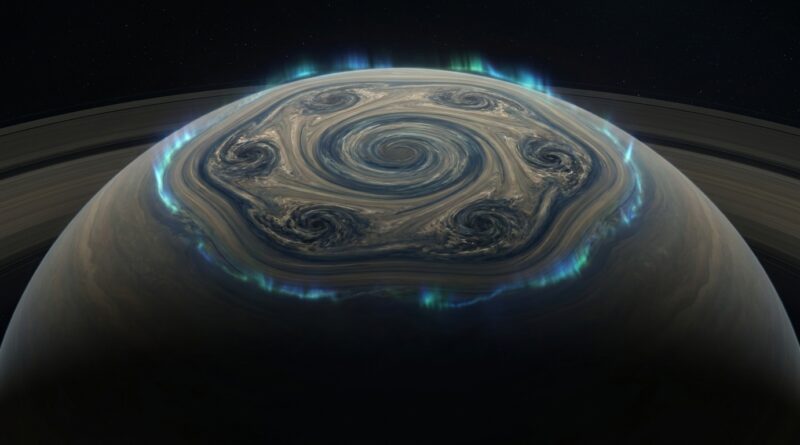
At Saturn’s north pole, there is a giant six-sided weather pattern circling the planet. Each side of the hexagon is enormous. The whole structure spans roughly 20,000 miles, wide enough to fit several Earths across.
It is not a solid thing floating in the atmosphere. It is a fast-moving jet stream, a band of winds wrapping around the pole in a hexagonal shape. Inside that shape sits a spinning polar cyclone.
Think of it like this. The storm in the middle is one problem. The fact that the boundary around it looks like a near-geometric hexagon is the bigger problem.
That shape was first spotted by NASA’s Voyager mission in the early 1980s. Decades later, Cassini arrived at Saturn and found the hexagon was still there. That alone got scientists’ attention. Weather changes. Planetary atmospheres shift. Yet this thing kept showing up like a machine that never clocked out.
Why scientists expected a storm, but not this storm
Gas giants are messy places. They have roaring winds, layered chemistry, deep convection, and huge temperature differences. So yes, a polar cyclone on Saturn is not shocking. Jupiter has intense storms too. Earth has polar vortices. Fluid dynamics can do wild things.
But a stable, six-sided jet stream is another story.
Nature can make stripes, swirls, and vortices pretty easily. Perfect-looking polygons on a planetary scale are much harder to explain. Not impossible. Just unusual enough that scientists still argue over the details.
The part that “shouldn’t exist”
When people say the hexagon “shouldn’t exist,” they do not mean it breaks physics. They mean the atmosphere should not naturally settle into something this tidy and keep it for so long without a very specific setup.
Researchers think the shape comes from a standing wave in Saturn’s atmosphere. In plain English, that means the jet stream may be wobbling in a repeating pattern that locks into six large bends. Lab experiments with rotating fluids have created polygon-like flows, which is encouraging.
Still, a lab tank is not Saturn.
Saturn’s atmosphere is deeper, faster, colder, more layered, and more complicated than any tabletop experiment. So while scientists can make hexagon-like behavior appear in models, matching the real object in full detail is still hard.
What Cassini actually saw
Cassini gave researchers the best close-up look we have ever had. It tracked the hexagon in visible light, infrared, and over multiple Saturn seasons.
That mattered a lot.
Saturn takes about 29.5 Earth years to orbit the Sun, so seasons there move slowly. Cassini watched the north pole shift from winter darkness toward spring sunlight. During that time, the hexagon stayed in place. Its color changed somewhat with season and haze, but the core structure remained stubbornly stable.
Key observations from Cassini
Scientists found that the hexagon is centered near 78 degrees north latitude. Winds along its edges can reach roughly 200 miles per hour or more. The feature rotates at nearly the same rate as Saturn’s deep interior radio rotation estimate, though Saturn’s exact internal rotation has been a headache of its own.
Infrared imaging also suggested the hexagon is not just a shallow cloud-top doodle. It appears to extend vertically high into the atmosphere, which makes the system even more interesting. If it were only a surface-level pattern, that might be easier to dismiss as a temporary quirk. But it seems tied to deeper atmospheric behavior.
So what might be causing it?
This is where the Saturn hexagon unexplained storm gets fun. There are real ideas. None of them fully close the case.
1. A jet stream instability
This is the leading explanation. A fast eastward jet near the pole may become unstable in a way that forms a repeating wave. That wave then sharpens into six broad corners, giving the hexagon its outline.
This is the most grounded theory because it fits what fluid physics can do.
2. A standing Rossby wave
Rossby waves are large-scale waves that show up in rotating atmospheres and oceans, including on Earth. Some scientists think Saturn’s hexagon may be a giant, trapped Rossby wave circling the pole.
That sounds technical, but the basic point is simple. Rotation plus moving fluid can create organized wave patterns. Saturn may have landed on one of the weirdest examples.
3. Deep atmospheric structure
Another big question is how deep the pattern goes. If the hexagon is linked to atmospheric layers far below the visible clouds, that would help explain its stability. But it also makes it harder to model because now you are not just tracking a surface wind. You are trying to understand a deep planetary engine.
4. Seasonal chemistry and haze
Changes in sunlight affect Saturn’s haze, temperature, and cloud chemistry. These can alter how the hexagon looks. But appearance is not the same as cause. Seasonal effects may decorate the pattern without creating it.
Why the “it’s alien” idea falls apart fast
A six-sided shape in space sounds like clickbait bait. Fair enough. But there is no evidence the hexagon is artificial.
It is made of moving atmospheric gas. Its edges are not hard walls. Its shape shifts subtly. And most important, scientists can recreate similar polygon patterns in rotating fluid experiments. Not perfectly. Not at Saturn’s full complexity. But enough to show that physics can make angular shapes without any need for spaceships, megastructures, or hidden civilizations.
The mystery is not whether it is natural. It is natural. The mystery is why Saturn’s atmosphere produces this exact large, stable version so well.
Why this mystery is better than internet “mysteries”
This is the part I think matters most for readers. A lot of modern “anomalies” ask you to lower your standards. Ignore the missing data. Trust the blurry clip. Accept a wild claim because it feels exciting.
Saturn’s hexagon asks you to do the opposite. Start with the data. Look at what spacecraft measured. Notice where scientists agree, and where they still do not.
That is a healthier kind of curiosity. It is not less exciting. It is more exciting, because the strange part survives contact with evidence.
What makes it credible
First, multiple missions observed it. Voyager saw it. Cassini confirmed and tracked it for years.
Second, it has been studied in peer-reviewed papers, not just TV specials and social feeds.
Third, the open question is precise. Not “what are they hiding?” but “which atmospheric mechanisms can produce and maintain this shape?” That is a real scientific puzzle.
How to follow the science without getting lost
If you want to keep up with this mystery in a useful way, start with mission archives and major space agencies. NASA’s Cassini pages remain a great source. So do journal summaries from planetary science groups and universities.
Look for a few things when new claims pop up:
Check whether the claim uses actual mission data
If an article never mentions Voyager, Cassini, infrared imaging, wind speeds, or published atmospheric models, it may just be selling wonder instead of information.
Watch for the difference between “unexplained” and “unexplainable”
Those are not the same. Saturn’s hexagon is unexplained in the sense that no single model answers every detail. It is not magic. It is not beyond science. It is an active problem inside science.
Prefer sources that admit uncertainty
The best researchers do not pretend to know more than they do. If a source says the mystery is solved forever, be cautious. If it says nothing is known at all, also be cautious. The truth is usually in the middle.
What the hexagon teaches us about planets
One reason this matters beyond pure curiosity is that giant planet atmospheres are laboratories for fluid physics. Saturn helps scientists test ideas about jets, waves, storms, rotation, and energy flow under extreme conditions.
That can feed back into how we understand weather systems on Earth, brown dwarfs, and even exoplanets. No, Saturn’s hexagon is not going to improve your weekend forecast. But the physics behind large rotating atmospheres is deeply connected across worlds.
It is also a reminder that the universe does not owe us simple shapes for simple reasons. Sometimes a natural system can look engineered just because the underlying rules are rich enough to produce order out of chaos.
At a Glance: Comparison
| Feature/Aspect | Details | Verdict |
|---|---|---|
| What it is | A six-sided high-speed jet stream surrounding Saturn’s north polar cyclone, about 20,000 miles across. | Confirmed and well observed. |
| Why it is strange | Storms are common on gas giants, but such a stable geometric boundary is not easy to explain. | Genuinely unusual. |
| Best current explanation | A long-lived atmospheric wave or jet instability shaped by Saturn’s rotation and layered atmosphere. | Plausible, but not fully settled. |
Conclusion
Saturn’s hexagon is the kind of mystery worth keeping. It is not a fake artifact, not a hoax, and not a story inflated by bad evidence. It is a live scientific problem backed by spacecraft observations, years of tracking, and real disagreement over the details. At a time when people are buried under debunked claims and low-effort “what if” content, the Saturn hexagon unexplained storm gives you something better to hold onto. It is strange, measurable, and still open. That makes it a rare anchor point for curious readers who want wonder without giving up standards. If you want to recalibrate your sense of mystery, this is a good place to start. The universe is still fully capable of being weirder than the headlines. Saturn has been quietly proving that for decades.