The Ghost Particles That Shouldn’t Be Here: Mysterious Cosmic Rays Are Slamming Into Earth From ‘Nowhere’
You are not crazy if headlines about “impossible particles” make you feel like science writers are either talking down to you or hiding behind jargon. This story is genuinely weird. Earth keeps getting hit by ultra-high-energy cosmic rays, basically subatomic bullets moving through space with absurd amounts of energy. Some are so extreme that, on paper, the known universe should have a hard time making them, and in many cases we cannot cleanly trace them back to an obvious source. That is the real mystery behind the mysterious ultra high energy cosmic rays unexplained origin story. It is not that physics has failed. It is that the sky is giving us clues we still cannot neatly sort. A fresh batch of new detections has sharpened the problem again. Something out there is accelerating ghostlike particles to jaw-dropping energies, and our best list of suspects is starting to look a little shaky.
⚡ In a Hurry? Key Takeaways
- Scientists are seeing ultra-high-energy cosmic rays that are hard to match to known sources, which is why their origin still looks unexplained.
- When you read new reports, focus on three things: particle energy, arrival direction, and whether any known galaxy, black hole, or blazar lines up.
- This is a real scientific mystery, not clickbait. But it is also not proof of aliens or magic. The best answer right now is “something extreme is out there, and we are still narrowing it down.”
First, what are these things?
Cosmic rays are not rays in the flashlight sense. They are mostly particles, often protons or atomic nuclei, flying through space at close to the speed of light. Most are energetic. A tiny few are ridiculously energetic.
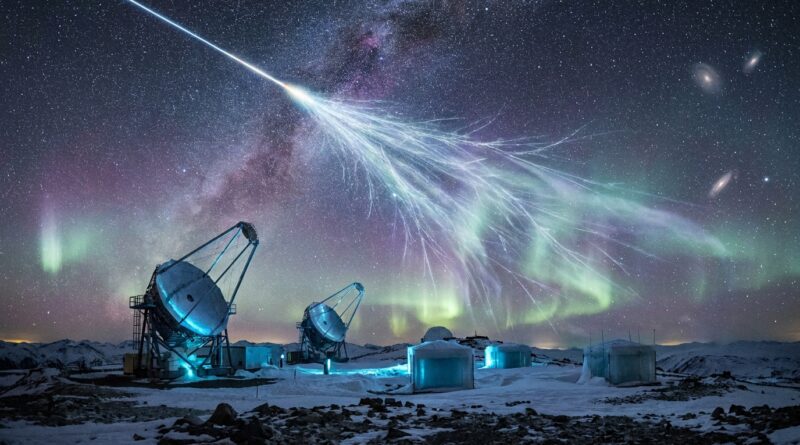
Those rare ones are the stars of this mystery. They slam into Earth’s atmosphere and create giant particle cascades called air showers. Scientists do not usually catch the original particle directly. Instead, they detect the splash it makes, using huge observatories spread over miles of ground.
Think of it like hearing a bowling ball crash through your roof, then trying to figure out who threw it from the dent pattern and debris.
Why are scientists so bothered by them?
Because the numbers are rude.
These particles carry energies far beyond anything we can produce in human-made accelerators. That part alone is impressive. The harder part is figuring out what in nature could pump that much energy into something as tiny as a proton or nucleus and then aim it across the cosmos.
A few kinds of cosmic objects are supposed to be good candidates. Supermassive black holes. Active galactic nuclei. Gamma-ray bursts. Blazars. Maybe colliding galaxies. These are the usual suspects because they are violent, magnetized, and energetic.
But here is the snag. Some of the newest events do not line up cleanly with where we would expect the sources to be. Others seem to arrive with energies that push up against limits in our standard models. The universe is not exactly breaking the rules. It is acting like it found a loophole we have not spotted yet.
The big headache: they seem to come from “nowhere”
That phrase needs a little translating.
Scientists do not literally mean the particles pop out of empty nothingness. They mean we cannot confidently point to a source and say, “There. That galaxy did it.”
There are a few reasons for that.
1. Magnetic fields bend their paths
Most cosmic rays are charged particles. Charged particles do not travel in perfect straight lines through the universe. Magnetic fields in galaxies and between galaxies can deflect them.
So even if a particle started from a dramatic cosmic engine, by the time it gets here, its path may be bent enough to muddy the trail.
2. The highest-energy particles should lose energy on the way
There is a famous limit here, often discussed in connection with the cosmic microwave background, the leftover glow from the early universe. If an ultra-high-energy cosmic ray travels too far, it should interact with that background radiation and lose energy.
That means the most extreme particles should come from relatively nearby, in cosmic terms. If we do not see a convincing nearby source in the direction they seem to arrive from, the mystery gets sharper.
3. The sky map is messy
Sometimes events cluster a bit. Sometimes they look scattered. Sometimes a proposed source seems promising, then follow-up data makes the fit less convincing. This is not unusual in frontier science, but it frustrates anyone hoping for a clean answer.
What changed with the latest burst of attention?
The important part is not one single Hollywood-style “we found it” moment. It is the growing pile of very energetic detections, including fresh events discussed over the last day, that keep pressure on the standard explanations.
Each new event adds a data point. Direction. Energy. Timing. Composition clues. On its own, one event can be a curiosity. A pattern of them can turn into a problem.
Right now, that problem looks like this: some of our favorite cosmic accelerators are still plausible, but not comfortably plausible. The new data are not lining up as neatly as researchers would like. That does not mean the old ideas are dead. It means they are under stress.
Do these particles hint at new physics?
Maybe. But “maybe” is doing honest work here.
There are three broad possibilities.
Option 1: We are underestimating normal astrophysical engines
This is the most conservative answer. Maybe black holes, jets, shock waves, or other extreme environments can accelerate particles more efficiently than our current models say.
If that is true, the mystery teaches us more about violent astrophysics, not brand-new physics.
Option 2: We do not yet understand how these particles travel
Maybe the source models are fine, but our picture of magnetic deflection, energy loss, or particle composition is incomplete. If the particles are heavier nuclei rather than lone protons, for example, the story changes.
In other words, the engine might not be impossible. Our map might just be blurry.
Option 3: Something genuinely new is involved
This is the exciting one, and the one headlines love to overcook. Some physicists have long wondered whether ultra-high-energy events could point to unknown particles, exotic decay processes, relics from the early universe, or other physics beyond the standard model.
That is not the leading claim yet. It is the open door at the end of the hallway. Scientists are not sprinting through it, but they are definitely looking at it.
Why people call them “ghost particles,” even though that is a bit sloppy
Strictly speaking, “ghost particle” is more often used for neutrinos, because neutrinos pass through matter so easily. Cosmic rays are not the same thing.
But the nickname sticks in popular coverage because these ultra-energetic visitors are elusive. We do not see them coming. We infer them from what they smash into. They arrive rarely, violently, and with incomplete return addresses.
That makes them feel ghostly, even if the label is not textbook perfect.
How scientists actually detect them
This part is pretty amazing and worth understanding because it shows why the evidence is real.
Ground arrays
Large observatories place detectors across huge areas. When a cosmic ray hits the atmosphere, it creates a shower of secondary particles. Those particles spread out and trigger detectors on the ground.
Fluorescence telescopes
Some facilities also watch the atmosphere itself. The particle shower excites nitrogen molecules, which give off faint flashes of light. Telescopes can catch that glow on dark nights.
Why this matters
Using both methods together helps scientists estimate the incoming particle’s energy, direction, and likely type. It is not guesswork. It is careful reconstruction from indirect evidence.
What the mainstream explanation is, and where it struggles
The mainstream view is still that ultra-high-energy cosmic rays come from extreme astrophysical sources. That remains the safest bet.
The struggle is not “we have no ideas.” The struggle is “our ideas do not yet fit all the details cleanly.”
That distinction matters. A lot of frontier science lives in that uncomfortable middle ground. You have enough data to know something interesting is happening, but not enough to stop the arguments.
For readers who are tired of mystery stories that never move, this one is different. It is trackable. New events matter. Better observatories matter. Cross-checks with neutrino and gamma-ray astronomy matter. This is not a cold case. It is an active investigation.
What to watch next if you want the real signal, not the hype
If you want to follow the mysterious ultra high energy cosmic rays unexplained origin story without getting lost, keep an eye on these questions:
Are the new events clustering in one region of the sky?
If yes, that strengthens the case for identifiable sources.
Do the energies sit above what standard models comfortably explain?
If yes, theorists will have more pressure to rethink acceleration limits.
Do neutrino or gamma-ray observations match the same regions?
If yes, the source hunt gets much stronger.
Are the particles mostly protons or heavier nuclei?
This changes how much magnetic fields would bend their paths, which changes how “source-less” they really are.
Why this mystery matters beyond physics labs
Because this is one of those rare science stories where the unknown is clean and concrete.
We are not talking about a vague anomaly buried in statistical fog. We are talking about real particles, real detections, measured energies, and a direct challenge to our picture of the violent universe. Something is acting like a cosmic particle cannon, and we have not pinned down the operator.
That is why this topic deserves more attention than recycled internet myths. It sits right at the edge where solid astrophysics meets the genuinely unknown.
At a Glance: Comparison
| Feature/Aspect | Details | Verdict |
|---|---|---|
| What they are | Ultra-high-energy charged particles, usually protons or atomic nuclei, detected through atmospheric particle showers. | Very real, very measurable. |
| Why they are mysterious | Some arrive with energies and directions that do not match known nearby sources in a neat, satisfying way. | A serious open problem. |
| Best current explanation | Extreme cosmic engines like active galaxies or black hole jets are still the leading suspects, but the fit is imperfect. | Likely astrophysics, with room for surprises. |
Conclusion
The smartest way to read this story is not as “scientists found magic particles,” and not as “this is nothing.” It is a live anomaly, and that is what makes it worth your time. A fresh burst of ultra-energetic, origin-unknown particles in the last day has quietly deepened one of the strangest open questions in physics. Something out there is flinging ghostlike projectiles at energies our best-known cosmic engines should struggle to produce. Following it now helps the Anomal community stay ahead of the curve on a real, evolving mystery instead of circling old UFO arguments or recycled dark-matter chatter. Better yet, this is a mystery you can track as new detections come in. And right now, the data are pushing researchers into an uncomfortable but exciting place: their favorite explanations are still on the table, but they are no longer fitting the evidence as neatly as they once hoped.