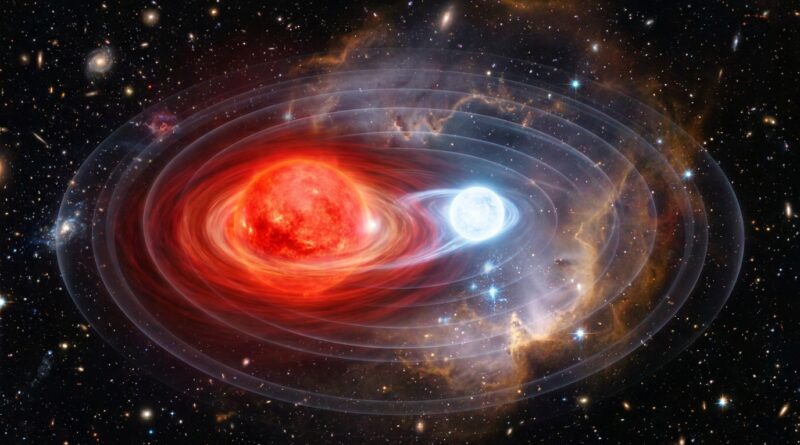
Astronomers Just Tracked a ‘Vampire Star’ Radio Signal – And It’s Not Playing By Any Known Rules
You can only roll your eyes at so many “weird space signal, could it be aliens?” headlines before tuning out completely. Fair enough. Most of those stories leave out the useful part, which is what astronomers actually detected, how they checked it, and why it matters. This case is different. Scientists have been tracking a genuinely odd, peer-reviewed radio source tied to what looks like a “vampire” star system, where one star is pulling matter off its companion. The signal repeats slowly, much more slowly than classic pulsars, and it does not fit neatly into the usual boxes. That is what makes it interesting. Not because anyone serious thinks it is a spaceship, but because nature may be doing something our current models do not fully explain yet. If you want a real cosmic mystery with receipts, this is one of the best recent examples.
⚡ In a Hurry? Key Takeaways
- This mysterious repeating radio signal vampire star system appears to come from a binary where one star is feeding on another, and the pulses do not match normal expectations for known radio sources.
- When you see “mystery signal” news, look for three things first: whether it is peer-reviewed, whether astronomers found the source, and whether they ruled out common causes like pulsars or instrument error.
- The value here is real science, not clickbait. Researchers agree something unusual is happening, even if they do not have the final answer yet.
What astronomers actually found
The short version is this. Astronomers detected a repeating radio signal that turns on and off in a slow rhythm. That alone is unusual. Many famous radio sources in space, like pulsars, pulse very quickly. This one is part of a newer, stranger group called long-period radio transients.
Then came the more interesting twist. The source seems linked to a compact binary system, likely involving a white dwarf and a companion star. In plain English, one dead or dying star is pulling gas from the other. That is why people call it a “vampire star” system.
That feeding process can create strong magnetic fields, hot plasma, and bursts of energy. So yes, there is a real physical setup that could make weird signals. But the exact timing and behavior still do not sit comfortably inside the usual models.
Why this is not just another “maybe aliens” story
There is a big difference between “we do not know yet” and “anything goes.” Scientists are not shrugging and tossing out wild guesses. They have narrowed the possibilities by tracing the source to an actual system and comparing it with known classes of objects.
That matters because many viral signal stories stop way too early. They never get beyond “a telescope saw something odd.” Here, the work goes further. Researchers linked the radio pulses to a likely astrophysical engine, then ran into a new problem. The engine does not behave the way the textbooks would predict.
If you want a good companion read, The Star That Eats Its Partner: Astronomers Trace a Bizarre Repeating Radio Signal to a ‘Vampire’ Binary does a nice job of laying out why this system has caught so much attention.
What makes the signal so strange
It pulses too slowly
Traditional pulsars are neutron stars that spin fast and sweep radio beams past Earth like lighthouse beams. Their timing is often measured in seconds, milliseconds, or fractions of a second. This newer class can pulse over minutes, which is much harder to explain with the standard pulsar playbook.
It comes from the “wrong” kind of setup
A vampire binary can be violent, but not every violent star system produces this sort of radio pattern. That means astronomers are not just asking, “What object is this?” They are asking, “What mechanism inside this object is producing such organized, repeating radio behavior?”
It may point to a missing category
One possibility is that astronomers are seeing an extreme version of something known. Another is that they are looking at a class of radio-emitting systems that has been mostly hidden from us until newer surveys started catching them.
How a vampire star system works, without the jargon headache
Picture two stars orbiting each other very closely. One is compact and dense, often a white dwarf, which is the leftover core of a once normal star. Its gravity is strong enough to pull material off its neighbor. That stolen gas forms a stream or disk as it spirals in.
When matter piles up in a system like that, things get messy fast. Gas gets heated. Magnetic fields can twist. Charged particles can be accelerated. Light can pour out in different wavelengths, including radio waves.
So the idea that a feeding binary could make a strange signal is not crazy at all. The puzzle is the regularity, power, and timescale of the radio pulses. Those details are where the current models start to wobble.
What scientists think might be happening
There are a few serious ideas on the table.
Magnetic interaction between the two stars
The stars may be orbiting in a way that creates periodic blasts of radio emission through magnetic reconnection, a bit like snapping and reconnecting magnetic field lines. We see versions of this process elsewhere in space, but perhaps not quite like this.
A white dwarf acting a bit like a pulsar
In rare cases, white dwarfs may produce pulsar-like radio beams. That would be a big deal, because pulsar-style behavior is usually associated with neutron stars. If white dwarfs can do a version of this more often than we thought, astronomers may need to rethink some old assumptions.
Something transitional
Nature does not care about our neat categories. This system may sit between known classes, mixing accretion, magnetic activity, and orbital effects in a way that creates a new kind of repeating source.
What is known, and what is still not known
What seems solid
The signal is real. It repeats. It has been studied seriously. And the source appears tied to a compact binary system involving a star losing matter to a companion.
What remains open
Astronomers still do not know exactly what part of the system creates the radio pulses, why the timing is what it is, or whether this source is one oddball or a clue to a larger hidden population.
Why that uncertainty is exciting
This is the good kind of scientific uncertainty. Not hand-wavy mystery for clicks. A specific object, observed carefully, that does not quite fit the current rulebook.
Why the Anomal community should care
If you follow unexplained phenomena, this is the kind of case worth your time. It is current. It is grounded in data. And it shows that the universe can still surprise us without anyone needing to jump straight to aliens.
Better yet, this mystery teaches a useful habit. Real anomalies get more interesting as evidence improves. Fake ones usually fall apart when you ask for details. Here, the details make the story stronger.
What to watch next
The next step is more observing. Astronomers will want to track the system across radio, optical, X-ray, and maybe other wavelengths to see how the pulses line up with the orbit and the flow of stolen matter.
If more sources like this turn up, the field could move fast. One object is intriguing. A whole population would force a rewrite of how we think dead stars, magnetic fields, and binary feeding systems behave over long stretches of cosmic time.
At a Glance: Comparison
| Feature/Aspect | Details | Verdict |
|---|---|---|
| Type of signal | A slow, mysterious repeating radio signal linked to a likely vampire binary system | Genuinely unusual and worth watching |
| Best current explanation | Interaction in a star system where one compact star siphons matter from a companion | Promising, but not complete |
| Does it fit known rules? | Not neatly. The pulse timing and behavior do not match standard expectations | Possible sign of new physics in familiar objects |
Conclusion
This is the kind of space mystery people have been asking for. Not another vague “signal from deep space” story padded with alien hints, but a real, current case where astronomers can point to a source, describe the system, and still admit that part of the behavior does not make sense yet. That helps the Anomal community today because it focuses on a genuinely current, peer-reviewed mystery, a bizarre, slowly pulsing radio source that appears to come from a star siphoning matter from a companion, and makes the science readable without sanding off the interesting parts. You come away with a clear map of what is known, what is still unexplained, and why this mysterious repeating radio signal vampire star system could change how we think about dead and dying stars across the universe.