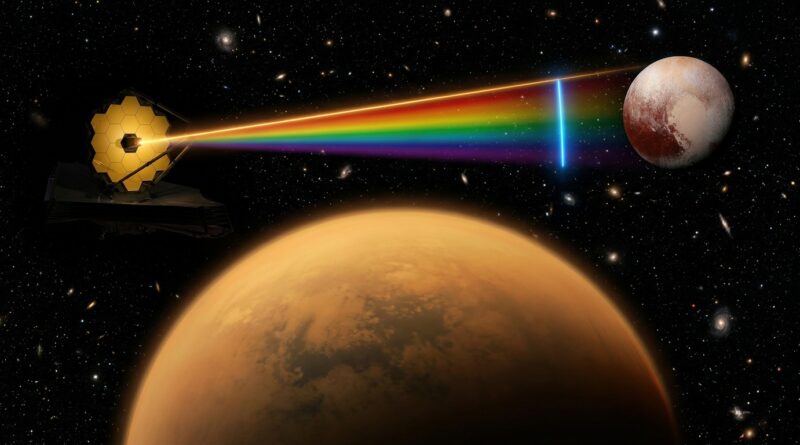
James Webb Just Found the Same ‘Impossible’ Chemical on Titan and Pluto
If you are tired of space headlines that promise an “impossible discovery” and then dissolve into jargon, you are not alone. The fresh puzzle here is actually worth your attention. James Webb picked up the same odd chemical fingerprint on Titan and Pluto, two worlds that really should not be making the same atmospheric signal. Titan is a thick, hazy moon with active chemistry around Saturn. Pluto is a frozen dwarf world far beyond Neptune, with a thin atmosphere and a very different environment. So when Webb sees a matching spectral clue on both, scientists have to stop and ask a simple question. What are we missing? The short version is that this is not proof of aliens, hidden oceans, or a broken telescope. It is a live chemistry mystery. And it is a good example of how to tell the difference between empty hype and a genuinely weird result that could change how we understand icy worlds.
⚡ In a Hurry? Key Takeaways
- James Webb detected the same unexplained infrared chemical signal on Titan and Pluto, even though current models say those worlds should not match this neatly.
- When you see a “mystery molecule” story, look for three things first: repeated detection, independent follow-up, and whether scientists call it an unidentified spectral feature instead of claiming a firm discovery.
- This is valuable because it is a real open question in planetary science, not a solved story dressed up for clicks.
What James Webb actually found
Webb does not usually “see” chemicals the way you might spot a bottle on a shelf. It measures light. More specifically, it looks at how molecules absorb and emit certain wavelengths, especially in infrared light. That creates a pattern, a bit like a barcode. Scientists compare those barcodes to lab data and computer models to figure out what is present.
In this case, Webb found a matching spectral feature, basically a recurring signal in the light, in observations of both Titan and Pluto. The reason people are calling it “impossible” is not that the telescope broke the laws of physics. It is that the current chemistry playbook does not offer a neat, satisfying explanation for why both places would show the same fingerprint.
That matters because Titan and Pluto are not twins. They are not even close cousins in the usual planetary-science sense.
Why Titan and Pluto are such an odd pair
Titan is a chemistry lab with weather
Titan, Saturn’s largest moon, has a thick nitrogen-rich atmosphere, methane, organic haze, clouds, rain, rivers, and lakes made of hydrocarbons. It is one of the most chemically active places in the solar system. Sunlight and energetic particles constantly break apart molecules high in the atmosphere, and those pieces recombine into more complex compounds.
Pluto is cold, thin, and far quieter
Pluto also has nitrogen and methane around it, but its atmosphere is much thinner and more fragile. It freezes out and changes with Pluto’s seasons and distance from the Sun. It is a much colder, dimmer, and less active setting overall.
So if both worlds are showing the same mystery signal, scientists have a few possibilities to consider. Maybe the same molecule really is forming in both places through a pathway we do not yet understand. Maybe different molecules are creating a confusingly similar spectral feature. Or maybe the signal comes from a broader class of complex organics, not a single clean chemical species.
What “spectral ghost signal” means in plain English
This phrase sounds spooky, but the idea is pretty simple. A telescope sees a feature in the spectrum that clearly seems to be there, yet scientists cannot confidently pin it to a known molecule under the expected conditions.
Think of it like hearing the same ringtone in two different houses. You know the sound is real. But when you look around, none of the phones you expected to find are there. That leaves you with a few options. There is a phone model you do not know about. A different device is mimicking the sound. Or your assumptions about what devices are in the house were wrong.
That is where Webb is so useful. It is sensitive enough to catch these odd details, especially in cold, distant environments where older instruments struggled.
Why scientists are not rushing to name the chemical
This is the part that often gets lost in social media posts. Detection is one thing. Identification is another.
A spectral match has to survive a lot of scrutiny. Researchers need to check instrument calibration, compare multiple observations, test alternative molecules, and use laboratory spectra collected under conditions that resemble Titan and Pluto as closely as possible. That last part is harder than it sounds. Very cold temperatures and weird atmospheric mixes can make molecules behave differently than they do in simpler lab setups.
So the careful phrase is not “Webb found a new impossible molecule.” It is more like “Webb found a real signal that our current chemical models do not explain well.” That is less flashy, but much more interesting.
What could explain the James Webb mysterious chemical signal Titan Pluto puzzle
1. A shared molecule from an overlooked pathway
Titan and Pluto both contain nitrogen and methane. Under radiation, those ingredients can make a surprising range of organics. It is possible there is a reaction route that works in both places, even if the surrounding environments look very different on paper.
2. Complex haze particles, not a simple gas
Sometimes the spectral feature may come from larger organic particles or haze materials instead of a single tidy molecule. Titan is famous for haze. Pluto has hazes too, though thinner and less dramatic. If similar particle structures form in both atmospheres, that might produce a matching infrared clue.
3. Two different chemicals that look alike to Webb at first pass
Spectral features can overlap. One world might host one compound, while the other hosts a cousin molecule with a similar pattern in the observed range. Follow-up work can help separate those possibilities.
4. The models need updating
This may be the biggest lesson. Scientists use photochemical models to predict what sunlight, radiation, pressure, and temperature should do to an atmosphere over time. If Webb keeps finding signals the models miss, that is a sign the models are incomplete, not that science has failed.
Why this is not just another overhyped space mystery
There are a few signs that make this worth following.
First, the worlds involved are scientifically rich and already known for complex chemistry. Second, the telescope involved is Webb, which has the sensitivity to reveal subtle atmospheric features. Third, the mismatch is specific. It is not “space is weird.” It is “these two environments should not line up this way under current expectations.”
That kind of tension is where useful science happens. Not when everything is neat, but when the data refuses to fit the box.
How to read stories like this without getting fooled
If you want a simple filter for future anomaly stories, use this checklist.
Ask whether the signal was repeated
One odd blip is interesting. Repeated observations are much stronger.
Check the wording
If researchers say “unidentified spectral feature,” they are being careful. If a headline says “scientists discover impossible chemical,” that is probably the headline writer doing cartwheels.
Look for comparison with models
The best stories explain why the result is surprising relative to existing theory. Surprise without context is usually just noise.
Watch for lab follow-up
Many of these mysteries move forward when chemists recreate cold atmospheric conditions on Earth and test candidate molecules directly.
What happens next
The next step is not a dramatic reveal. It is patient detective work. Scientists will compare more Webb spectra, test more candidate chemicals, refine atmospheric models, and likely bring in lab experiments to simulate Titan-like and Pluto-like conditions.
Other telescopes and future missions could help too. Titan, in particular, is headed for more attention in the coming years because it is one of the best places in the solar system to study prebiotic chemistry, meaning chemistry that may resemble some early steps toward life without being life itself.
And Pluto remains a gold mine because it keeps refusing to act like a simple frozen leftover from the outer solar system.
At a Glance: Comparison
| Feature/Aspect | Details | Verdict |
|---|---|---|
| Worlds involved | Titan has a thick, active atmosphere. Pluto has a thin, frigid one. | Their differences make the matching signal genuinely puzzling. |
| What Webb found | A matching infrared spectral feature, not yet cleanly tied to a confirmed molecule. | Real signal, incomplete explanation. |
| Why it matters | It suggests missing chemistry, overlapping compounds, or haze behavior current models do not fully capture. | Worth watching. This is the kind of anomaly that can sharpen science. |
Conclusion
The best part of this story is that it is still open. We are not looking at a tired headline inflated past recognition. We are watching a real-time puzzle form around the James Webb mysterious chemical signal Titan Pluto result. That helps readers right now because it shows what a live scientific mystery actually looks like. Careful wording. Strange data. No neat answer yet. By breaking down why the same spectral ghost signal on Titan and Pluto should not fit our current chemistry playbook, we get something rare on the internet. A space mystery that earns the label. And once you know how to read clues like this, you will be much better at spotting future “anomaly” stories that are actually worth your time.