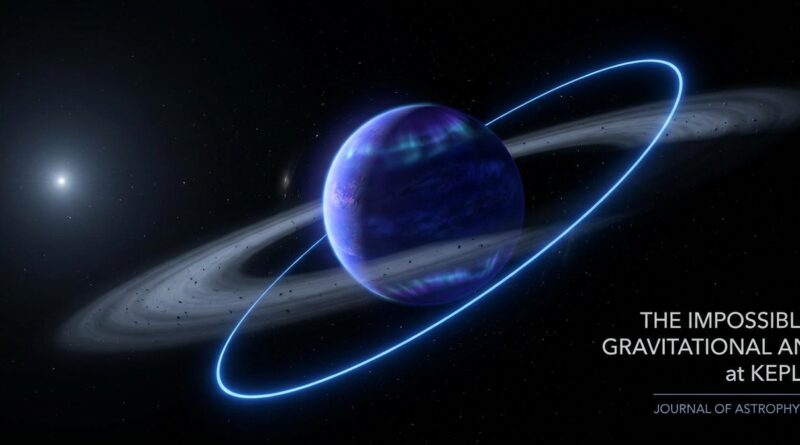
The Planet That Shouldn’t Exist: Astronomers Find a ‘Wrong‑Side’ World That Breaks All the Rules
You have every right to be annoyed by the phrase “scientists are baffled.” Most of the time, it is a lazy shortcut. It tells you nothing about what was actually measured, what rule got broken, or why astronomers are taking the result seriously. This mysterious new exoplanet discovery breaks planetary formation rules in a very specific way. The planet seems to exist in an orbital setup that standard models say should be unstable, unlikely, or flat-out hard to build in the first place. That is the real story. Not vague wonder. Not headline drama. A planet has shown up on the wrong side of our expectations, and the data appear solid enough that astronomers now have to explain it instead of dismissing it. That matters because planets are supposed to form in pretty orderly ways. When one does not, it can expose a hole in the textbook, and those holes are where science gets interesting fast.
⚡ In a Hurry? Key Takeaways
- This planet is not “weird” in a vague sense. It appears to sit in an orbit or system layout that normal planet-formation models do not expect.
- When you read future updates, look for three things: how the planet was detected, how certain the orbit is, and which theory the researchers say it challenges.
- The value here is that this is a measurement-driven mystery, not internet noise. It is a real scientific problem astronomers can test.
What does “shouldn’t exist” actually mean?
It does not mean the planet is magical, fake, or breaking physics.
It means the planet seems to break our current story of how planets normally form and settle into stable systems.
Astronomers have a few broad expectations. Planets form in a spinning disk of gas and dust around a young star. That tends to produce fairly organized outcomes. Orbits usually line up in a common plane. Giant planets usually form in places with enough material to build them. And over time, unstable arrangements tend to crash, get ejected, or smooth themselves out.
So when researchers find a world in a place, orbit, or orientation that does not fit those expectations, the phrase “shouldn’t exist” is shorthand for something more precise. Our best models did not predict this setup easily.
What may be “wrong-side” about this planet?
The phrase can point to a few different kinds of rule-breaking, and all of them are a big deal.
1. It may orbit the “wrong” way
Some exoplanets travel in a direction badly misaligned with their star’s spin, or even in a retrograde orbit compared with the system’s original disk. That is like finding a car driving the wrong way on a one-way street, then learning it has somehow been doing that for ages without crashing.
If that is the case here, astronomers have to explain how it got flipped. Did another giant planet scatter it? Did a companion star torque the orbit over millions of years? Did the whole system form in a more chaotic environment than we thought?
2. It may exist where planet formation should be very hard
Some planets are too massive, too close, too far, or around the wrong type of star for standard models to feel comfortable. If a world turns up where there should not have been enough building material, that is a direct challenge to formation theory.
3. It may survive in an orbit that should be unstable
This is another possibility. In multi-star systems or tightly packed planetary systems, gravity can make certain regions dangerous. A planet found there is not impossible by the laws of nature, but it is a problem for the usual step-by-step story astronomers tell.
Why astronomers care so much
Because planets are supposed to be the end result of a process. If the end result looks wrong, then one of three things is happening.
First, the measurements could be off. That happens, and good researchers always check for it.
Second, the planet may have had a violent history. Migration, collisions, scattering, and stellar interactions can rearrange a system after it forms.
Third, the models are missing something important.
That third option is the exciting one. Not because scientists enjoy being wrong, but because a stubborn outlier is often how a field gets better. One strange planet can force better simulations, better observations, and a better grasp of how common solar systems really come together.
How do astronomers know this is not just another bad headline?
This is where the real conversation gets better than the clickbait.
A serious exoplanet claim usually rests on hard measurements such as:
- Transit data, where a planet dims its star as it passes in front.
- Radial velocity data, where the star wobbles because of the planet’s gravity.
- Direct imaging, in rare cases.
- Timing variations or orbital modeling in more complicated systems.
The key is that astronomers are not staring at fuzzy lights and guessing. They are fitting data to models, checking error bars, and trying to rule out boring explanations first. A true cosmic rule-breaker is not declared lightly.
The part most headlines skip: which rule got broken?
This is the question readers should ask every single time.
When you see coverage of a mysterious new exoplanet discovery breaks planetary formation rules, translate it into plain English:
- Did it break a formation rule?
- Did it break an orbital stability rule?
- Did it break a migration rule?
- Did it break expectations for the kind of star it orbits?
Those are very different problems.
One means “we do not know how it was built.” Another means “we do not know how it stayed there.” Another means “we may be underestimating how chaotic young planetary systems can be.”
What scientists are likely debating right now
If the discovery holds up, the debate is probably not “is space weird?” Everyone already knows space is weird.
The debate is more technical, and more interesting.
Was the planet born there?
If yes, theorists need a new formation pathway or a much looser version of an existing one.
Did it migrate?
Many giant exoplanets probably formed farther out and moved inward. Migration can solve some mysteries, but not all. In some cases it creates new problems, especially if the orbit is tilted or extreme.
Did another object shove it into place?
A second planet, a brown dwarf, or a companion star can scramble a system over time. That can produce “wrong-side” worlds, but it requires the right gravitational history.
Are we seeing a rare survivor?
Sometimes the answer is not that a system is impossible. It is that it is incredibly uncommon, and we have finally caught one that survived the chaos.
Why this matters beyond one weird planet
Because exoplanet science has moved past simple counting.
At first, every planet around another star was news. Now the field is mature enough that the most valuable finds are often the awkward ones. The systems that do not fit. The worlds that expose our blind spots.
Think of it this way. If you only ever saw neat, predictable planetary systems, you might assume the universe likes order. But each confirmed oddball tells us nature is willing to improvise. That affects how we think about solar system histories, habitable worlds, and even how unusual our own neighborhood may be.
How to read the next update like a pro
You do not need a PhD to follow this story sensibly. Just keep an eye on a few clues.
Look for the detection method
If the orbit is the shocking part, ask how that orbit was measured. Different methods give different strengths of evidence.
Check whether the paper says “candidate” or “confirmed”
That one word matters. A candidate is promising. A confirmed world has survived more scrutiny.
Watch for follow-up observations
The first discovery paper often raises the mystery. Later observations are what tighten the case.
Notice whether the language gets more specific
“Scientists baffled” is weak. “Planet appears on a retrograde, highly misaligned orbit in a system where formation models predict alignment” is useful.
So, is this a crisis for astronomy?
No. It is something better.
It is a stress test.
Good science is not a tidy pile of facts that never changes. It is a process for handling surprises. A planet that seems to sit on the wrong side of the rules does not break astronomy. It gives astronomy work to do.
And frankly, that is more fun than another recycled story built on rumors, politics, or grainy mystery footage. This is a real puzzle with numbers attached.
At a Glance: Comparison
| Feature/Aspect | Details | Verdict |
|---|---|---|
| What is “wrong” with it? | Its orbit, location, or system geometry appears to clash with standard planetary formation or stability models. | A real scientific anomaly, if the measurements hold. |
| Why the buzz? | This is not just “space is strange.” It points to a specific gap in how astronomers think planets are built or moved. | Worth following beyond the headline. |
| What should readers watch next? | Confirmation status, follow-up measurements, and whether researchers favor migration, scattering, or a new formation pathway. | The next data release will matter more than the first burst of hype. |
Conclusion
This is why the story is worth your attention now, not six months after the internet has turned it into a slogan. A rigorously documented planet in an orbit or configuration that standard formation theories simply do not predict is exactly the kind of clean, unsettling mystery that deserves a close look. It puts readers inside the real scientific discussion while it is still fresh. Not the watered-down version. Not the rumor mill. Just data, models, and a stubborn object that refuses to fit. At a time when many people are tired of recycled UFO clips and vague anomaly talk, a genuine cosmic rule-breaker is a reminder that reality is still stranger than our best textbooks. Better yet, this is a mystery you can follow from day one as evidence builds, theories compete, and astronomy does what it does best when the universe says, very politely, “you missed a spot.”