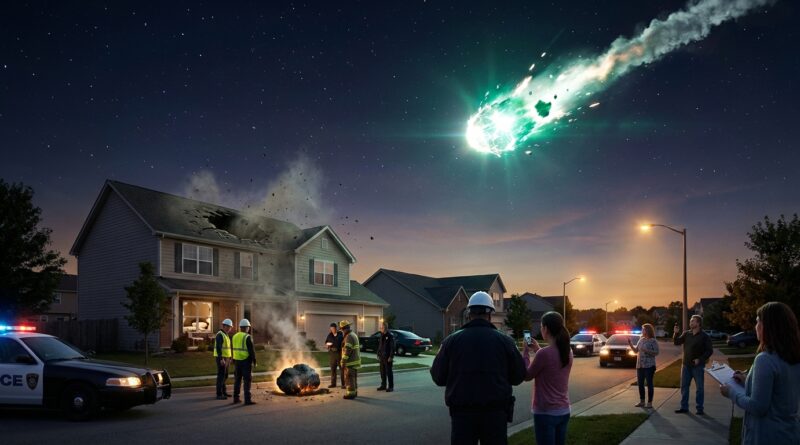
The Week the Sky Turned Hostile: Why 2026’s Fireball Surge Has Meteor Hunters Whispering ‘Cosmic Cluster’
If it feels like the sky has been acting weird lately, you are not overreacting. A lot of people have had that same uneasy feeling after seeing bright green streaks on social media, hearing delayed booms on doorbell cameras, or reading about a meteor that crashed through a Texas bedroom ceiling. That is not normal everyday stuff. Early 2026 really has brought a strange burst of big, bright fireballs, and even longtime meteor watchers are raising an eyebrow. The big question is simple. Are we just noticing them more because every porch has a camera now, or is Earth actually moving through a busier patch of space debris? The honest answer is that nobody knows for sure yet. But there is enough unusual activity, from Texas to Germany and beyond, that the idea of a possible cosmic cluster is getting serious attention.
⚡ In a Hurry? Key Takeaways
- The 2026 fireball surge meteor hits house in Texas story is part of a wider run of unusually bright bolides, and experts agree the pattern looks statistically odd.
- If you see a fireball, save your camera footage, note the exact time, direction, sound delay, and report it quickly to meteor tracking groups.
- Do not grab possible fragments with bare hands or trespass to hunt them. Safe reporting and careful documentation matter more than speed.
Why people are whispering about a “cosmic cluster”
“Cosmic cluster” is not a formal disaster label. It is more of a shorthand for a possibility. The idea is that several of these recent fireballs may not be totally random one-off events. They could be part of a denser stream of debris, a broken-up parent object, or a temporary stretch of space where Earth is running into more large fragments than usual.
That does not automatically mean danger is rising in some movie-style way. Space is still mostly empty. But when multiple rare, bright bolides show up close together in time, scientists start checking whether the numbers are just bad luck, better reporting, or a real pattern.
What happened in Texas
The event getting the most attention is the meteor that reportedly punched through a house near Houston, ending up after a violent entry through the roof and ceiling. That story spread fast because it hits a nerve. Most of us can accept “shooting star.” A rock from space landing in someone’s bedroom feels very different.
And to be fair, it is different. Meteors almost always burn up high in the atmosphere. The ones that survive and reach the ground as meteorites are much rarer. The ones that strike a home are rarer still.
When a rock does make it down, it often arrives after a dramatic fireball phase. People may see a bright flash first, then hear a boom several seconds later. That delay matters. Light reaches you almost instantly. Sound does not. So the classic “flash then house-rattling blast” pattern fits a genuine bolide surprisingly well.
Why this one felt so unsettling
It was personal. A meteor in the sky is a spectacle. A meteor in a bedroom is a violation. It turns a distant astronomy story into something that can break plaster, scatter insulation, and send people checking their ceilings in the middle of the night.
That is also why this case matters for readers. It reminds us that eyewitness reports, security footage, and fast local documentation are not just curiosities. They are useful data.
The European fireball that added to the mystery
Then came the European reports. A bright fireball over Germany and nearby areas lit up the sky, produced loud booms, and reportedly dropped fragments around a town. On its own, that would already be notable. Added to the Texas event and other bright bolides over the US and Europe, it starts to look like more than a weird week.
This is where professionals get careful. One cluster of viral videos is not proof of a global spike. But when separate observation networks, dashcams, weather cameras, and infrasound detections line up, it becomes harder to shrug off as simple internet hype.
Is this really unusual, or are cameras just everywhere now?
This is the right question. We do live in the age of constant sensors. Doorbell cams, dashcams, all-sky observatories, and smartphones catch events that would have gone unnoticed 20 years ago. So yes, better detection absolutely inflates the feeling that fireballs are suddenly everywhere.
But that is not the whole story. Some observers who track bolides for a living have said the recent run looks weird even after accounting for better reporting. Not proof. Just enough to justify taking the pattern seriously.
Three things can be true at once
First, social media makes every fireball feel bigger.
Second, modern cameras catch many events that older generations would have missed.
Third, 2026 may still be producing an above-normal number of very bright events.
Those points do not cancel each other out. They fit together.
What could be causing the surge
There are a few realistic possibilities.
1. A fragmented parent body
A larger asteroid or comet may have broken apart in the past, leaving a trail of chunks on similar orbits. Earth could be crossing a thicker section of that trail now.
2. Random clustering
Humans are good at spotting patterns, sometimes too good. A run of dramatic events can happen by chance, especially when the whole world is recording the sky.
3. Seasonal observing bias
Certain times of year simply produce better chances to spot bright meteors, depending on weather, darkness, and where more observers are located.
4. A real temporary uptick in larger bolides
This is the version that has meteor hunters paying attention. Not panic. Attention. A short-term rise in larger fragments entering Earth’s atmosphere would be unusual, but not impossible.
What to do if you witness a fireball
If you see one, your best move is to become a good witness, not a dramatic one.
Write down the basics right away
Memory gets messy fast. As soon as it is safe, note:
- Exact time, down to the minute if possible
- Your location
- Direction you were facing
- Color, brightness, and whether it broke apart
- How long it lasted
- How many seconds passed before any boom or rumble
Save the footage before it gets overwritten
This is a big one. Doorbell cams, dashcams, and security systems often auto-delete clips. Export the file immediately. Keep the original if you can. Do not just post a compressed version to social media and call it a day.
Look for indirect evidence too
Sometimes the meteor itself is off-camera, but the flash shows up as a sudden change in shadows or brightness. Audio can also capture delayed booms. That still helps.
Report it to a real tracking network
Good places include the American Meteor Society, the International Meteor Organization, and local astronomical societies or university departments. Reports from multiple locations help experts estimate the flight path and possible fall zone.
If you think you found a meteorite, do this first
This part matters because excitement can ruin the evidence.
Do not assume every black rock is from space
Slag, roofing material, industrial leftovers, and plain old Earth rocks fool people all the time.
Photograph it before moving it
Take clear pictures in place. Include something for scale. Get wide shots and close-ups.
Use gloves or a clean bag
If it really is a meteorite, skin oils and contamination can make lab work harder. A clean plastic bag or aluminum foil is better than stuffing it in your pocket.
Record exactly where it was found
Location matters almost as much as the object itself. Note the address, coordinates if possible, and whether it was embedded, sitting on the surface, or found after a fresh impact mark.
Do not trespass
This should be obvious, but “meteor fever” makes people silly. Stay on public land or get permission.
How regular people can actually help the investigation
This is the part I like most. You do not need a telescope, a physics degree, or a bunker full of sky maps. You can still help.
Build a simple observation kit
Keep these handy:
- Your phone with location services on
- A note app or paper notebook
- A way to export security footage quickly
- A compass app
- A flashlight and gloves if you are checking outdoors after dark
Talk to neighbors fast
If a fireball passes over your area, nearby cameras may have caught it from different angles. Ask before footage is erased. People often do not realize their system recorded anything useful.
Compare timestamps carefully
Even a difference of a few seconds can matter when reconstructing a path. If one camera clock is wrong, make a note of that too.
Share facts, not fear
“Possible meteor over our area at 8:42 PM, did anyone catch video facing west?” is helpful. “The sky is attacking us” is not.
Should you be worried?
Worried in the everyday sense? Not really. Interested and alert? Yes.
The odds of a meteor hitting your house are still extremely low. You are much more likely to deal with hail, a falling tree limb, or a plumbing leak. But because this run of events may be more than random noise, it is worth paying attention without sliding into doom-scrolling.
Think of it like severe weather awareness. You do not panic because thunderstorms exist. You keep your phone charged, know what you are looking at, and report what you see when it matters.
Why scientists need public help right now
Bright fireballs happen fast. They can cross the sky in seconds. Professional camera networks do great work, but they do not cover every street, field, and suburb. Citizen reports fill the gaps.
That matters even more during a possible surge. The more accurate reports experts collect, the faster they can figure out whether 2026 is truly odd or just feels odd. Good public data can help identify fall zones, recover fragments, compare orbital clues, and test whether multiple events might share a common source.
At a Glance: Comparison
| Feature/Aspect | Details | Verdict |
|---|---|---|
| Texas house strike | A rare case where a surviving meteorite reportedly damaged a home, turning a sky event into a direct ground impact story. | Highly unusual and a major reason the 2026 surge has people paying attention. |
| European fireball with fragments | Bright visual event, sonic booms, and possible debris field reports in Germany added weight to the idea of a broader pattern. | Strong supporting case that this is not just one isolated headline. |
| Public response | Doorbell cams, dashcams, eyewitness notes, and careful reporting can help reconstruct paths and recover meteorites. | Useful right now. Regular people can genuinely help the investigation. |
Conclusion
The smartest way to look at the 2026 fireball surge meteor hits house in Texas story is not as proof that the sky has gone rogue. It is a live mystery. And that is exactly why it matters. This story helps the Anomal community right now because it turns a headline scare into an active investigation you can participate in. We can connect the Texas bedroom strike, the fragment-dropping European fireball, and the wider run of bright bolides without drifting into panic. Better still, you now know what to do when the next daylight flash or midnight boom happens. Save footage. Write down the details. Report it well. Handle any possible fragments carefully. That turns you from an anxious spectator into a useful witness, and maybe even a real collaborator in figuring out whether 2026 is just noisy, or something genuinely strange is passing overhead.