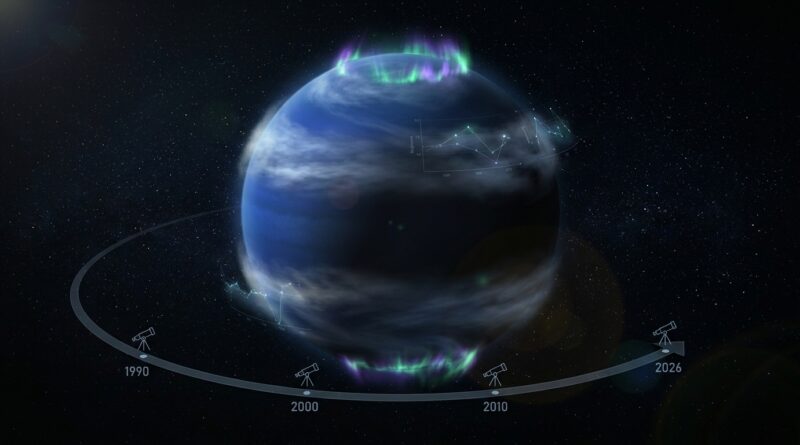
Neptune’s Vanishing Clouds And ‘Wrong’ Seasons: The Planet That Started Acting Strange Again
If you have tried to figure out what is going on with Neptune lately, you have probably run into the same annoying pattern. One headline screams that Neptune’s clouds are vanishing. Another says its seasons are behaving “wrong.” Then the actual explanation gets buried under chemistry terms, telescope notes, and a lot of dramatic writing. Here is the plain-English version. Neptune really has been acting oddly, and not just once. Over the last few years, astronomers saw many of its usual bright clouds fade away, especially after a long period when they were easier to spot. That was surprising because the timing did not neatly match what scientists expected from Neptune’s painfully slow seasons. The bigger story is that this is not one random blip. Neptune has a long record of strange weather swings, bright storms, dark spots, and cloud changes that scientists still do not fully understand. So yes, something real is happening. No, it does not mean the solar system is breaking.
⚡ In a Hurry? Key Takeaways
- Neptune’s clouds really did fade dramatically in recent years, and the change did not line up as neatly with expected seasonal patterns as scientists hoped.
- When you see a “Neptune is acting strange” headline, check whether it is about clouds, storms, dark spots, or seasonal brightness. Those are related, but not the same thing.
- This is scientifically valuable, not alarming. Neptune’s weird behavior helps researchers test how giant-planet weather and solar influence actually work.
What actually changed on Neptune?
The simplest version is this. Neptune’s visible cloud cover dropped a lot.
Using years of images from Hubble, the Keck Observatory, and amateur astronomers, researchers noticed that Neptune looked much less cloudy than it had in the previous part of the record. The bright white clouds that often stand out in pictures became unusually scarce.
That matters because Neptune is not a static blue marble. It has active weather. Methane ice clouds can form high in the atmosphere. Big storms can appear and drift. Dark vortices can show up and then fade. So when the cloud activity drops across years, scientists pay attention.
The surprising part was not just that clouds vanished. It was that the timing looked off.
Why people keep saying Neptune’s seasons are “wrong”
Neptune does have seasons, but they are almost comically slow. One trip around the Sun takes about 165 Earth years. That means each season lasts a bit over 40 Earth years.
So if you are expecting a neat Earth-style pattern, forget it. Neptune does everything in slow motion.
Scientists expected long-term seasonal sunlight changes to affect the atmosphere. More sunlight over time can change the chemistry in the upper atmosphere. That can then change haze and cloud production lower down. Fair enough.
But the cloud decline that got everyone’s attention seemed to track the Sun’s 11-year activity cycle more closely than Neptune’s giant seasonal calendar. In other words, the clouds appeared to be more abundant a couple of years after stronger solar ultraviolet output, then much weaker after solar activity dropped.
That is the “wrong seasons” part people are reacting to. It is not that Neptune has stopped having seasons. It is that the latest cloud behavior may be responding to a different rhythm than the one most readers assume.
So is it really the Sun?
Maybe. But “maybe” is doing honest work here.
One leading idea is that ultraviolet radiation from the Sun changes Neptune’s atmospheric chemistry. That chemistry may help create hazes or particles that make cloud formation easier later on. Because the planet is so cold and so far away, even subtle changes can have visible effects over time.
The catch is that Neptune is messy. Internal heat, vertical mixing, winds, and local storms all matter too. Scientists can see the pattern. They are still sorting out the mechanism.
The bigger mystery is that Neptune has been weird for decades
This is the part many quick news pieces skip.
Neptune has a history of making astronomers revise their expectations. Voyager 2 flew by in 1989 and saw the Great Dark Spot, plus bright, fast-moving clouds. Later, that particular dark spot disappeared. New ones formed in other years. Bright cloud features have come and gone. Global brightness has shifted. Storm systems have shown up where models did not strongly expect them.
So the recent Neptune vanishing clouds unexplained phenomenon is best seen as the latest chapter in a long-running story. Neptune is not suddenly becoming strange. It is reminding us that it has always been hard to predict.
Why this was such a surprise if Neptune is already known for wild weather
Because “wild weather” and “long-term trend” are different things.
A single bright storm popping up is weather. A multi-year decline in cloud activity across the planet is closer to climate behavior, at least in the loose, planetary-science sense.
That is why astronomers got excited. They were not just seeing another pretty storm. They were seeing a broad shift across time, one that might connect Neptune’s atmosphere to solar activity or to some slower internal cycle we do not fully understand yet.
What scientists think is happening inside the atmosphere
Here is the non-jargony version.
Neptune’s atmosphere is mostly hydrogen, helium, and methane. The methane helps give the planet its blue color because it absorbs red light. High in the atmosphere, conditions can produce hazes and icy clouds. Sunlight, especially ultraviolet light, can change molecules there. Those changes may eventually affect how easily clouds form.
Now add Neptune’s own heat from inside the planet, plus strong winds. Very strong winds, in fact. You get a complicated system where sunlight is only one part of the story.
Think of it like this. The Sun may be adjusting the oven setting a little, but Neptune is also stirring the soup from within.
Does this mean something big for the whole solar system?
Probably not in the scary sense. Yes in the scientific sense.
There is no sign that Neptune’s fading clouds are a warning that the solar system is unstable or that all the planets are suddenly changing in some dramatic chain reaction. That is internet overreach.
What it does mean is that our outer solar system is still full of active, subtle processes we are only beginning to track properly. Neptune is so far away that even getting regular, high-quality observations has been a challenge. Once you start stacking years of telescope data, patterns appear that were invisible before.
That is a big deal. It tells us giant planets can react to small inputs in ways that are delayed, indirect, and hard to model.
Why the delayed response matters
One of the more interesting details is the lag. The cloud changes do not seem to happen at the exact same time as the changes in solar activity. There appears to be a delay of roughly a couple of years.
That is useful because delayed responses often reveal process chains. Something happens first, then chemistry changes, then haze levels shift, then cloud formation changes. If the response were immediate, the explanation would likely be simpler.
Instead, Neptune is giving scientists a puzzle with several steps.
Could the clouds come back?
Yes. In fact, there have already been signs that some cloud activity started returning after the low point.
That does not mean the mystery is solved. It actually reinforces the idea that Neptune goes through cycles, and that we need long-term monitoring to understand them. A one-year snapshot can fool you. A decade starts to teach you something.
Why amateur astronomers matter here
This is one of those nice space stories where backyard observers are not just spectators.
Because Neptune changes over long stretches, even images from skilled amateur astronomers can help fill gaps between major telescope campaigns. When professionals combine those records with Hubble and Keck observations, the timeline gets stronger.
What to watch for in future Neptune headlines
If you want to read the next wave of updates without getting lost, use this checklist:
1. Is the story about clouds or storms?
Cloud cover can decline overall while individual storms still appear. Those are different signals.
2. Is it about seasonal sunlight or the solar cycle?
Those are not the same. Neptune’s seasons are very long. The Sun’s activity rises and falls on a much shorter cycle.
3. Are scientists claiming certainty?
Be careful if a headline makes the explanation sound settled. It is not settled. The evidence for a pattern is good. The full cause is still being worked out.
4. Is there a long timeline?
If an article only talks about one new image, it may miss the bigger point. Neptune makes more sense when you look across decades.
Why this story is worth your attention
Because it is a good example of how science usually works in the real world. Not with one dramatic discovery that ties everything up, but with a lot of patient watching, small surprises, and patterns that only emerge after years.
The recent Neptune vanishing clouds unexplained phenomenon is interesting precisely because it is subtle. It teaches us to notice slow changes, not just flashy events.
At a Glance: Comparison
| Feature/Aspect | Details | Verdict |
|---|---|---|
| Recent cloud changes | Neptune’s bright visible clouds dropped sharply over several years, then showed hints of partial return. | Real and worth watching |
| “Wrong seasons” idea | The timing did not cleanly fit simple expectations based only on Neptune’s very long seasons, and may line up better with the Sun’s shorter activity cycle. | Plausible, but not final |
| Big-picture meaning | This looks like a useful atmospheric mystery, not a threat or cosmic alarm bell. | Scientifically important, not alarming |
Conclusion
The best way to read Neptune news right now is to resist the extremes. It is not “nothing.” It is also not “the planet has gone off the rails.” Neptune’s clouds really did fade in a way that caught scientists off guard, and the timing raised a real question about whether solar activity is shaping the planet’s atmosphere more than expected. But the deeper value is in the longer story. Today the feeds are full of bite-sized Neptune hot takes, but almost nobody is stitching the recent strange and unexpected reports into the decades-long pattern of odd behavior scientists have been tracking. Once you see that bigger picture, the latest mood swing makes more sense. It satisfies the immediate curiosity, and it gives you a better framework for thinking about slow, subtle anomalies in our own solar system instead of chasing one-off viral oddities.