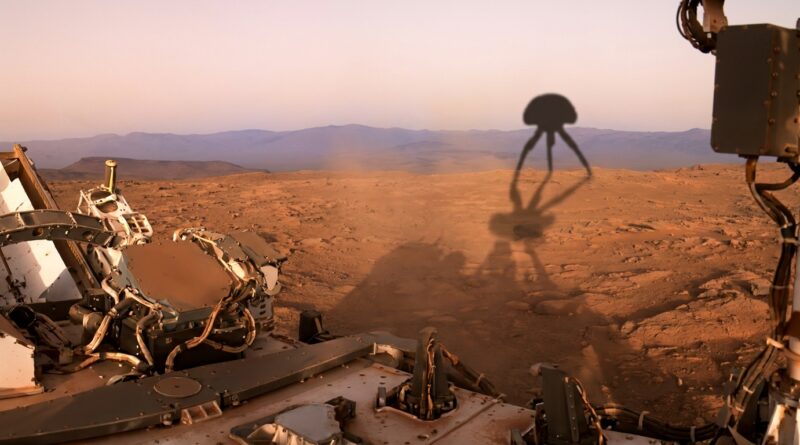
The Tripod In The Martian Sky: Did Curiosity Really Catch Something Moving On Mars?
If you are exhausted by endless UFO reposts and fuzzy clips that fall apart the second you look closely, you are not alone. The mysterious tripod object mars curiosity rover image feels different because it seems to appear in one Curiosity frame, then vanish less than a minute later. That is exactly the kind of thing that grabs people fast. One side says it is obviously just rocks and shadows. The other says we are staring at proof of something intelligent on Mars. Neither reaction is very satisfying if you actually want answers. The good news is that this is the sort of mystery you can examine without needing a PhD in planetary science. You just need a calm process. When you slow down and compare the images, camera timing, compression artifacts, and Martian wind conditions, the picture gets more interesting, but also more grounded. Weird? Yes. Solid proof of life? Not even close. Worth a serious look? Absolutely.
⚡ In a Hurry? Key Takeaways
- The “tripod” in the Curiosity image is real as a visual feature in one frame, but there is no strong evidence yet that it was a machine, creature, or artificial structure.
- Your best move is to compare adjacent frames, check image scale, and ask whether lighting, dust, or compression could create a temporary shape before jumping to big conclusions.
- This is a great case study in how to investigate space anomalies carefully, because one odd image can be intriguing without proving intelligent life.
What actually happened?
The claim is simple. A new image from NASA’s Curiosity rover appears to show a small tripod-shaped object on the Martian surface. In a nearby frame taken less than a minute later, that object seems to be gone.
That gap is what gives the story its punch. If the shape was only a trick of light, why does it look so distinct? If it was a solid object, where did it go so quickly?
Those are fair questions. But “fair question” is not the same as “extraordinary proof.” Mars imaging is full of odd moments because the rover cameras deal with distance, dust, uneven terrain, digital compression, and changing angles. A shape that looks crisp to us on social media can be much less dramatic when you examine the original context.
Why people are so split on this image
This story lands right in the middle of two very human habits.
1. We love patterns
Our brains are built to recognize shapes fast. Faces in clouds. Animals in wallpaper. Castles in rock formations. That tendency, called pareidolia, is not stupidity. It is normal human perception doing what it does best.
2. We distrust easy dismissals
People also get annoyed when every strange image is waved away in ten seconds with, “just a rock.” That frustration is understandable. Sometimes quick debunking is lazy too.
So the right approach is neither blind belief nor smug dismissal. It is image forensics, plain and simple.
How to investigate the mysterious tripod object mars curiosity rover image
If you want to know whether this is truly unusual, start with a few boring questions. Boring is good. Boring is where the truth usually lives.
Check the frame sequence
The first thing to ask is whether the two images were taken from exactly the same angle, with the same zoom, the same exposure, and the same processing. “Less than a minute later” sounds dramatic, but even tiny changes in camera position or image stitching can make a small object disappear into the background.
On Mars, perspective is everything. A pebble-sized upright shard seen edge-on in one frame may become almost invisible in the next if the rover or mast shifted even slightly.
Look at the pixel scale
How big is the object really? In many viral Mars claims, the dramatic object turns out to be only a handful of pixels wide. That matters. Once a feature is that small, sharpening and compression can create misleading edges and make a random shape look engineered.
If something looks like a precise tripod only when heavily cropped, that weakens the case that it is a true structured object.
Ask what the wind can do
Mars has a thin atmosphere, but it still has wind. Enough to move dust, sand, and in some cases very light debris. Could a delicate bit of rock, crust, or rover-related debris have shifted? Possibly. Could a tiny dust devil or gust briefly expose and then cover a feature? Also possible.
That is less cinematic than alien machinery, but it fits what we already know about the Martian surface.
Watch for compression and stitching artifacts
This is the big one. Rover images often go through onboard processing, transmission limits, and public rendering pipelines. Artifacts can create edge halos, false contrast, or little geometric oddities. A thin upright shape with “legs” can sometimes be the digital system trying its best with very little visual information.
That does not mean every anomaly is fake. It means digital images are interpretations of light, not perfect windows.
Most likely explanations, from ordinary to extraordinary
Rock fragment or ventifact
This is the most grounded explanation. Mars is full of strange-looking rocks shaped by erosion. A three-pronged or balanced-looking fragment is not impossible at all, especially when seen at low resolution.
Lighting plus shadow
A small protrusion can look freestanding if the shadow lines up just right. In one frame, the contrast may outline a “tripod.” In the next, the light angle or exposure shifts and the illusion breaks.
Loose debris or dust-coated material
If the object was real and did move, it may have been a tiny piece of natural debris. It does not have to be biological or mechanical to be transient.
Image artifact
If the shape only appears in one frame and cannot be confirmed from adjacent shots or alternate processing versions, artifact jumps higher on the list.
Artificial object or intelligent life
This is the least supported explanation at the moment. It is not “impossible” in the broad science-fiction sense. It is just not where the evidence points right now. A single ambiguous image is not enough.
What makes this case interesting anyway?
Even if the tripod shape turns out to be a rock, artifact, or short-lived visual trick, the case still matters. Why? Because it is a perfect lesson in how extraordinary claims spread.
One cropped image gets shared. People add circles, arrows, and dramatic music. Soon the conversation is no longer about the raw evidence. It is about team identity. Believers versus skeptics. That is where real analysis usually dies.
A better habit is to ask, “What would I need to see next?” For this case, that means full-resolution originals, frame-to-frame comparison, metadata, and ideally views of the same spot from a different angle.
How to keep your feet on the ground while your mind stays open
There is a sweet spot here. You do not need to become the person who scoffs at every anomaly. You also do not need to treat every odd pixel as a signal from another civilization.
Try this simple checklist when a space image goes viral:
- Find the uncropped source if possible.
- Check for earlier and later frames.
- Estimate the object’s actual size.
- Look for alternative angles or instrument views.
- Ask whether ordinary geology or imaging quirks fit the facts first.
That process will not make mysteries less fun. It makes them more fun, because now you are actually investigating instead of just reacting.
So, did Curiosity really catch something moving on Mars?
Maybe it caught something that appears to move. That is not the same thing as catching a moving machine, a life form, or a built structure.
The safest reading is this: Curiosity recorded a brief, unusual visual feature that deserves scrutiny. The current evidence supports several ordinary explanations more strongly than any extraordinary one.
That may sound less exciting, but it is still pretty cool. Mars keeps handing us puzzles. Some turn into major discoveries. Others teach us how easily eyes and cameras can be fooled.
At a Glance: Comparison
| Feature/Aspect | Details | Verdict |
|---|---|---|
| Object appearance | Tripod-like shape appears distinct in one Curiosity frame but is not clearly present in a nearby follow-up image. | Interesting anomaly, but not self-proving. |
| Most likely cause | Small rock fragment, shadow effect, temporary exposure of debris, or digital artifact from processing/compression. | Ordinary explanations fit better than alien or artificial ones. |
| Evidence needed next | Original files, metadata, adjacent frames, alternate angles, and scale analysis. | Necessary before making any strong claim. |
Conclusion
The conversation around the Mars tripod image is split between people dismissing it as pareidolia and people convinced it proves intelligent life. Neither camp has earned certainty yet. The best response is a clear, calm breakdown that treats the mystery with respect without throwing critical thinking out the airlock. If you take anything from this, let it be this: a weird image is a starting point, not a finish line. When you learn how to interrogate each pixel, compare frames, and test ordinary explanations first, you get better at handling every future “impossible” photo from space. That is the real value here. Curiosity first. Knee-jerk certainty last.