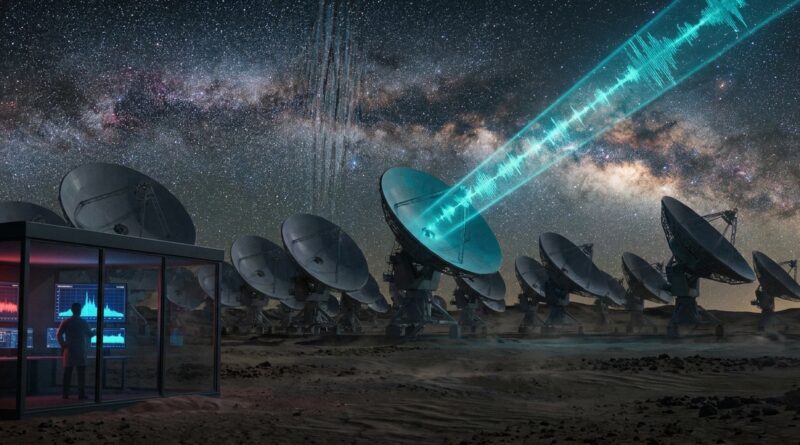
The Signal That Rose From Nowhere: Why A Deep-Space ‘Ghost Transmission’ Has SETI On Edge
You are not crazy for rolling your eyes at the latest “aliens?” headline. Most of them are either blurry UFO clips, recycled Wow! Signal stories, or headlines that make a routine telescope glitch sound like first contact. What people want is something rarer. One current, checkable mystery where real researchers are puzzled, the data is public, and nobody has to pretend every odd blip means E.T. just called. That is why this unexplained deep space radio signal 2026 case has people paying attention.
The short version is simple. A narrow radio signal appeared in deep-space survey data, passed several of the first filters that usually catch local interference, and then refused to behave like the usual junk from satellites, aircraft, ground transmitters, or instrument noise. It is not proof of alien life. Not even close. But it is exactly the kind of anomaly serious SETI teams are built to find. More important, it gives us something better than hype. It gives us a real test case for how modern radio astronomy decides whether a “ghost transmission” is nonsense, nature, or something we do not yet understand.
⚡ In a Hurry? Key Takeaways
- This unexplained deep space radio signal 2026 is interesting because it survived several normal interference checks, but it is still not evidence of aliens.
- When you see the next “we heard aliens” story, ask three things first: was the data public, was it independently checked, and did the signal repeat?
- The real value here is not fear or hype. It is having one solid anomaly with enough detail to judge for yourself.
Why this one feels different
Most weird radio stories fall apart fast. The source turns out to be a microwave oven, a passing satellite, a bad cable, a harmonics problem, or a software artifact. That is not cynicism. That is just how often radio astronomy gets fooled.
This case has scientists on edge for a more boring, and therefore more interesting, reason. The signal seems to break several of the rules that fake detections usually follow.
It was narrowband. That matters because many human-made transmissions are narrowband, but so are some of the exact artificial-looking targets SETI searches for. It also showed a frequency drift pattern that was not an obvious match for fixed local interference. On top of that, it showed up in a part of the pipeline where known contamination sources had already been heavily filtered.
None of that makes it alien. It just moves it from “ignore this” to “keep checking.” In science, that is a big step.
What a modern SETI pipeline actually does
If you have never looked at how a SETI or radio astronomy search works now, it is much less romantic than movies suggest. Nobody hears a spooky tone in headphones and gasps. It is mostly software, statistics, and endless elimination.
Step 1: Gather a mountain of raw radio data
Big dishes or arrays sweep patches of sky and capture huge frequency ranges. The amount of information is absurd. You are not looking at one “signal.” You are looking at oceans of data broken into tiny frequency bins over time.
Step 2: Hunt for outliers
Software scans for things that stand out. Maybe a signal is unusually narrow. Maybe it appears to drift in frequency. Maybe it is bright compared with the background noise. The software flags candidates by the thousands or millions.
Step 3: Throw almost everything away
This is the real work. Known satellites get removed. Terrestrial interference gets filtered. Repeat patterns from local electronics get tossed. Signals appearing in the wrong telescope beams are often rejected. If a candidate pops up everywhere at once, that is usually bad news, not good.
Step 4: Check whether the sky seems to matter
A real astronomical or possibly artificial extraterrestrial source should relate to where the telescope is pointed. If the signal stays put when the telescope moves away, it is probably local. If it vanishes and returns only when the telescope points back, people start paying attention.
Step 5: Ask the hardest question
Can anyone else see it?
This is where many exciting claims die. No repeat, no confirmation, no case.
So what did this “ghost transmission” do?
Based on the current reporting around the unexplained deep space radio signal 2026, the reason it has survived the first wave of debunking is that it appears to combine several awkward traits at once.
- It sits in a narrow frequency range rather than smearing across a wide band.
- It does not line up neatly with the usual catalog of known radio interference sources.
- Its apparent drift pattern is strange enough to avoid an easy “that is clearly local” dismissal.
- It arrived through a pipeline designed to be hostile to false positives.
That last point is the big one. Scientists do not get nervous because something looks magical. They get nervous because a system built to kill weak claims has failed to kill this one yet.
Why scientists are cautious, and why you should be too
It is tempting to jump from “unexplained” to “unexplainable.” That jump ruins good science.
There are still plenty of ordinary possibilities on the table. An uncataloged satellite. A reflection path no one expected. An edge-case processing bug. A natural astrophysical source behaving in a way we have not seen before. Radio astronomy is full of surprises that looked impossible right up until someone found the missing piece.
If you follow space mysteries, you have seen this pattern before in other fields too. A result looks like the rules have broken, then months later the real story turns out to be just as interesting, just less cinematic. That is part of why pieces like The Sun’s Magnetic Field Just Broke The Script: Are We Living Through A One‑Off Stellar Anomaly? resonate. The real tension is not “is it aliens?” It is “which rule are we misunderstanding?”
What gets flagged as “impossible” in the first place?
In everyday language, impossible means “this cannot happen.” In radio astronomy, it usually means something softer. It means “this should not survive all our normal explanations.”
A candidate starts looking impossible when it does things like:
- appear only when a specific sky target is observed
- show a clean narrowband shape uncommon in natural broadband sources
- drift in frequency in a way consistent with relative motion, but not with easy local causes
- fail to appear in side channels where local interference usually leaks through
- show enough signal strength to stand out, but not in a way that screams instrument error
Notice what is missing from that list. “Sounded spooky.” “Went viral.” “Had a dramatic nickname.” Those things mean nothing.
The question everyone really wants answered
Is this an alien transmission?
Right now, no responsible scientist would say that.
What they can say is narrower and more honest. This is an unresolved anomaly that has not yet been explained by the usual suspects. That is enough to matter. You do not need to inflate it beyond that.
Think of it like finding footprints in wet cement outside your house. You do not announce a monster. You first rule out your neighbors, the delivery driver, the raccoon, and your own memory. But you also do not ignore the footprints just because most weird footprints turn out to be mundane.
How to judge the next “we heard aliens” headline
This is the practical part, and it is the reason stories like this are worth your time.
1. Ask if the data is open
If nobody can inspect the signal, you are being asked to trust a vibe. That is not enough.
2. Ask if independent teams checked it
One telescope can be fooled. Two different systems agreeing is much stronger.
3. Ask whether it repeated
Repeatability is the line between curiosity and a serious case.
4. Ask what was ruled out
Good reports will tell you which interference sources were tested and how.
5. Ask whether the language is careful
Scientists saying “candidate,” “anomaly,” or “unresolved” is a good sign. Headlines screaming “proof” are usually doing the opposite of science.
Why this mystery has struck a nerve
People are tired of being sold old stories as new ones. Fair enough. The Wow! Signal is fascinating, but endlessly recycling it as if it just happened helps no one. What makes this unexplained deep space radio signal 2026 story worth watching is that it is fresh enough to follow in real time and technical enough to reward people who want more than buzzwords.
That is the sweet spot. A mystery that is alive, but not locked behind hype.
At a Glance: Comparison
| Feature/Aspect | Details | Verdict |
|---|---|---|
| Signal type | Reported as a narrowband deep-space radio candidate with unusual drift behavior | Interesting enough to investigate, not enough to claim origin |
| Most likely first explanation | Undetected interference, processing artifact, or rare natural source | Still the smart default position |
| Why people care | It appears to have passed several normal rejection filters in a modern SETI pipeline | A real anomaly, worthy of careful attention |
Conclusion
This is the kind of story space fans have been asking for. Not another muddy rumor. Not another recycled mystery dressed up as breaking news. One verifiable anomaly, checked by serious people, with enough technical detail to let readers think clearly instead of just react. That helps the community right now because it gives everyone one solid case to focus on instead of a hundred bad ones. And by showing how a modern SETI and radio astronomy pipeline works, what gets flagged as impossible, and where this new signal breaks the rules, it gives you a better filter for every future “we heard aliens” claim. That is the real win. It turns vague curiosity into informed curiosity, and makes room for the best part of science. Not certainty. Honest, careful wonder.