The Star That Wouldn’t Die: Did Astronomers Just Find a Real-Life ‘Black Hole Star’?
You are not imagining it. Space headlines have become a blur of “impossible galaxy,” “monster black hole,” and “JWST breaks physics again.” It is exciting, but it is also exhausting if all you want is a straight answer. The latest claim is one of the strangest yet. Some of the James Webb Space Telescope’s “little red dots” might not be normal young galaxies at all. They could be something more exotic: a black hole star, sometimes called a “dark star” cousin or a “quasi-star” type object, depending on the model. In plain English, that means a giant star-like object with a growing black hole buried inside it. Is that real? Maybe. Proven? Not yet. But it is a serious idea, and astronomers are interested because it could help explain how supermassive black holes showed up so absurdly early in cosmic history. That is why this story matters more than the usual splashy space-news cycle.
⚡ In a Hurry? Key Takeaways
- Right now, “black hole star James Webb little red dots” is an interesting scientific idea, not a confirmed discovery.
- If you see a headline claiming astronomers definitely found a star wrapped around a black hole, check whether the source says “preprint,” “candidate,” or “model fit.” Those words matter.
- The value of this claim is huge. If true, it could help explain how giant black holes grew so fast in the early universe, but several more ordinary explanations are still on the table.
First, what are the “little red dots”?
These are compact, very distant-looking objects spotted by the James Webb Space Telescope, often in the early universe. They appear red because their light has been stretched by cosmic expansion, and because JWST is tuned to see infrared light very well.
The weird part is not just that they are red. It is that some of them seem too bright, too compact, or too odd in their spectra to fit neatly into the simple bucket of “young galaxy full of ordinary stars.” Some appear to carry signs of active black holes. Others do not behave the way many astronomers expected early galaxies to behave.
So now there is a growing pile of candidates that do not feel fully explained. That is where the black-hole-star idea comes in.
So what is a black hole star?
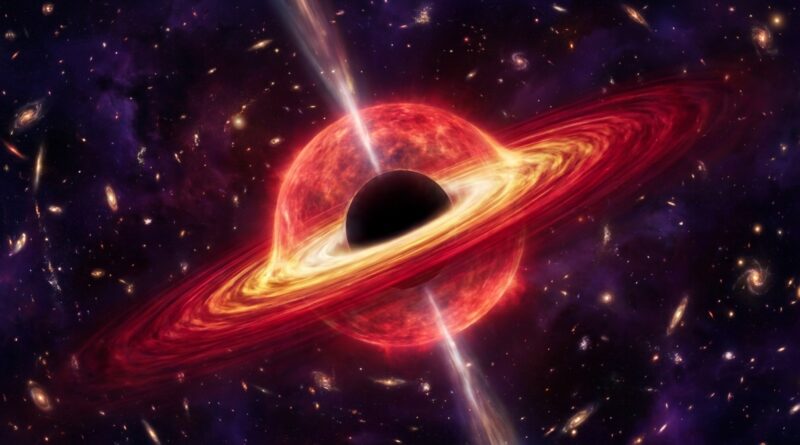
The short version is simple. Imagine a huge ball of gas, star-like in shape, with a black hole growing at its center. Instead of the object being powered mainly by normal nuclear fusion, a lot of the energy comes from matter falling into the black hole inside.
That sounds backward, because we usually think of black holes as things that destroy stars. Here, the suggestion is almost the opposite. The outer layers of gas can remain puffed up and bright while the black hole inside feeds.
It is not a normal star. It is not a normal black hole either. It is more like a temporary cosmic hybrid.
Why doesn’t the whole thing just collapse immediately?
Because the feeding black hole can release enormous amounts of energy. That energy pushes outward on the surrounding gas. In theory, this outward pressure can support a giant envelope around the central black hole for a while.
Think of it less like a neat solid object and more like a very unstable arrangement. A hungry core in the middle. A bloated, glowing shell around it. Lots of gas moving around. Not tidy. Not long-lived on cosmic timescales. But maybe long-lived enough for JWST to catch some examples.
Why are astronomers even considering this?
Because the early universe has handed them a headache.
We keep finding evidence that some supermassive black holes got big very fast. Too fast, at least by the cleanest and simplest growth stories. If black holes started small, from the deaths of the first stars, and then grew at ordinary rates, some of the giant black holes seen early on become hard to explain.
A black hole star could be a shortcut. It gives you a way to start with a much heavier “seed” black hole. Instead of beginning as a lightweight and slowly bulking up, the black hole might get a head start while hidden inside one of these giant star-like cocoons.
That is the real reason this idea is getting attention. It is not just because the object is weird. It is because it might solve a long-running growth problem.
How would one of these things form?
This is the part where the details get technical fast, so here is the friendly version.
Early in cosmic history, huge clouds of gas existed in dense regions. In some models, rather than fragmenting into lots of normal stars, a giant cloud might collapse in a more direct way. That could create an enormous central object. If conditions are right, a black hole forms in the center while a massive envelope of gas remains around it.
The black hole starts eating. As it feeds, it releases radiation. That radiation heats and supports the outer layers, at least for a time. The object glows and may mimic some features of a galaxy or an active black hole, depending on distance and how you observe it.
Eventually the arrangement would likely break down. The envelope gets blown away, collapses, or is consumed. What remains could be a much larger black hole than you would expect from ordinary star death alone.
Is this the same thing as a “dark star”?
Not exactly, though headlines often blur these ideas together.
A “dark star” in one famous theoretical idea is powered partly by dark matter interactions rather than normal fusion. A “quasi-star” is a giant envelope around a black hole. A “black hole star” headline may mix these concepts, or use a loose label for a star-like object connected to a central black hole.
That does not mean the reporting is useless. It just means you should be careful. Different researchers may be talking about related but not identical models.
If you have been confused by that, good. It means you noticed a real problem in the coverage.
What did JWST actually see?
JWST did not take a picture labeled “one black hole star, please.” What it saw were faint, distant objects with certain colors, brightness levels, sizes, and spectral fingerprints.
From those clues, astronomers build models. They ask: does this object fit best with a normal galaxy, a dusty galaxy, an active galactic nucleus, a direct-collapse black hole scenario, or something more exotic like a quasi-star style object?
Some recent papers argue that a subset of little red dots may fit the black-hole-star idea surprisingly well. That is very different from saying the case is closed.
Why spectra matter so much
A spectrum is basically light split into its component wavelengths. It can reveal what elements are present, how hot the object is, whether gas is moving fast, and whether there may be a black hole actively feeding.
For these candidates, the argument often comes down to whether the spectrum looks more like starlight, black hole accretion, or an unusual mix of both.
That mix is what makes people pay attention.
What are the simpler explanations?
Before anyone starts rewriting textbooks, astronomers will try hard to kill the exotic explanation first. That is how science should work.
Some little red dots could turn out to be:
- small but intense young galaxies with lots of stars forming
- dusty systems that distort the colors
- active galactic nuclei, where a black hole is feeding in a more familiar setup
- objects whose distances or masses were estimated a bit off
That last point matters. With very distant objects, a small shift in redshift estimate or model assumptions can change the story a lot.
So if you see “astronomers found an impossible object,” mentally translate that to “astronomers found something our current first-pass model may not explain neatly yet.” That is usually closer to the truth.
Why this could matter for the origin of cosmic monsters
Supermassive black holes are the monsters at the centers of galaxies. Some weigh millions or billions of times the mass of the Sun. The puzzle is that a few seem to have reached ridiculous sizes very early, when the universe was still young.
There are only a few broad ways out of that puzzle. Either black holes started bigger than we thought, grew faster than we thought, or our measurements and assumptions need work.
A black hole star idea helps with the first option. It gives nature a way to build a chunky starting black hole quickly. That would make the later giant black holes less shocking.
If true, these odd JWST sources would not just be curiosities. They would be snapshots of a missing growth stage.
What should a normal reader watch for in future coverage?
Three things.
1. Is the paper peer reviewed?
A preprint can be excellent, but it has not finished the normal stress test yet. A lot of the fast-moving conversation around black hole star James Webb little red dots is happening at the preprint stage.
2. Are astronomers saying “is,” or “could be”?
This sounds picky, but it is the whole game. “Could be” means a serious candidate. “Is” means the evidence is strong enough that most competing explanations have been pushed aside. We are not there.
3. Is there follow-up from multiple teams?
One team finding a weird fit is interesting. Several groups, using different methods, reaching similar conclusions is what starts to move an idea from intriguing to convincing.
My grounded take on the claim
This is not nonsense. It is also not a done deal.
The idea sits in a very believable part of science. The physics is not magic. It grows out of real attempts to explain fast black hole growth in the early universe. JWST has also clearly found objects that are forcing astronomers to think harder.
But a weird object in astronomy often spends some time wearing several possible labels before one survives. That is normal. It is not failure. It is how the field works.
So yes, take the claim seriously. Just do not mistake “serious” for “settled.”
At a Glance: Comparison
| Feature/Aspect | Details | Verdict |
|---|---|---|
| What JWST found | Compact, distant “little red dots” with unusual brightness and spectral traits | Real observation, but interpretation is still open |
| Black hole star idea | A giant star-like gas envelope surrounding a growing central black hole | Plausible model, not confirmed discovery |
| Why people care | Could explain how supermassive black holes got huge so early in cosmic history | Potentially important if follow-up evidence holds up |
Conclusion
The smart way to read this story is with curiosity in one hand and a brake pedal in the other. The black-hole-star label is catchy, and it points to a real scientific idea worth watching. But we are still in the stage where astronomers are testing models against puzzling JWST data, not unveiling a settled new class of object. That matters, because the internet is already flattening all the uncertainty into big dramatic claims. For readers who care about anomalies, this is exactly the sweet spot. It lives right on the border between established physics and the possibility that we are missing a key chapter in the story of how cosmic monsters formed. If you keep that frame in mind, you can cut through the hype, follow the evidence as it develops, and join the conversation from a place of confidence instead of confusion.