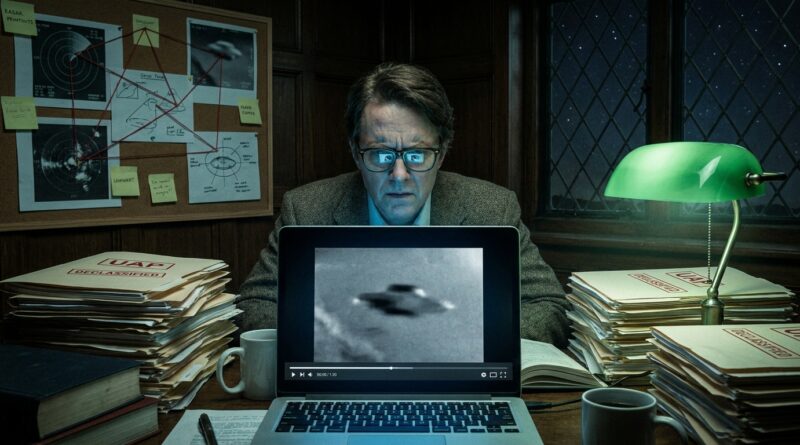
The Day The UFO Files Went Public: Inside The Declassified UAP Archive That Still Makes No Sense
You can be forgiven for thinking the UFO files “went public” and then somehow vanished into the fog again. Most people saw a headline, maybe a shaky clip on social media, then got buried under hot takes from people who either believe everything or dismiss everything. That is frustrating. Especially now, because the declassified UAP files 2026 unexplained cases are not one neat dump with a giant answer inside. They are a slow, messy release of PDFs, briefing slides, sensor summaries, pilot accounts, and short videos that raise just as many questions as they answer.
The useful part is this. You do not need a clearance badge or a physics degree to read them more carefully than most TV panels do. Once you know what to look for, things start to sort themselves into categories. Some cases weaken under scrutiny. Some stay odd. And a few remain stubbornly unexplained even after you account for bad angles, missing metadata, and military jargon.
⚡ In a Hurry? Key Takeaways
- The 2026 declassified UAP releases are real, but they are fragmented, heavily filtered, and still leave several cases unresolved.
- Start with metadata, sensor type, witness wording, and redactions before you decide whether a case is compelling or ordinary.
- The biggest value is not “proof.” It is learning how to separate strong cases from recycled internet noise.
What actually got released in 2026?
The public picture is less dramatic than “the government opened the vault,” but more important than that phrase makes it sound.
Across 2026, U.S. agencies quietly pushed out a rolling batch of declassified material. That included case summaries, internal memos, radar and infrared references, mission reports, briefing decks, and short video clips. Some were tied to military encounters. Others appeared in records systems after review requests and scheduled declassification.
This matters because the archive is not one single master file. It is a patchwork. Different agencies wrote for different audiences, using different standards. That is one reason the whole thing still makes no sense to casual readers. One report sounds clinical. Another sounds vague. A third is missing the one page you actually want.
Why the archive feels so confusing
Three things trip people up right away.
1. The language is dry on purpose
Most official UAP writing is built to avoid overclaiming. You will see phrases like “unable to resolve,” “insufficient data,” or “object demonstrated unusual signature characteristics.” That does not always mean something extraordinary happened. Sometimes it means the available data was poor. Sometimes it means analysts were being careful.
2. Redactions break the story
A report may describe an event clearly, then black out location, altitude, platform type, and timing. Those missing pieces are not minor. They are often the exact details you would use to rule out balloons, aircraft, drones, atmospheric effects, or sensor glitches.
3. Social media strips away context
A 12-second clip by itself can be almost useless. The context around it is everything. Was it shot in IR or visible light? Was there radar? Was the camera zoomed? Was the object moving, or was the platform moving? Did multiple witnesses agree?
This is why a lot of people who say a case is “obviously explained” or “obviously alien” are often reacting to fragments, not the file itself.
The cases people keep missing
A handful of the declassified UAP files 2026 unexplained cases stand out, not because they prove anything final, but because they hold up better than the usual blurry nonsense.
Multi-sensor encounters
These are the gold standard. If a case includes visual observation, infrared, radar, and a written mission report, it deserves more attention than a lone clip with no chain of custody.
Several 2026 releases describe objects that were not just seen, but tracked across more than one system. That does not make them alien. It does make them harder to wave away casually. If one sensor can be fooled, maybe two can too. But once multiple systems and trained observers line up, the burden gets heavier for easy explanations.
Cases with cautious but unusual witness wording
One thing worth watching is how military and intelligence personnel describe motion. They are usually trained to avoid dramatic language. So when a report says an object “held station against prevailing wind,” “departed at high rate,” or “displayed no visible means of propulsion,” that wording matters.
Not because it is magic, but because it suggests the observer was trying to be restrained.
Files with missing conclusions
Some of the strangest material in the archive is not the weirdest video. It is the report that ends without a satisfying explanation. No grand reveal. No clear ruling. Just a case file that moves from observation to review and stops at “unresolved.”
That tells you something important. Even after internal review, not every case collapsed into “camera artifact” or “conventional aircraft.”
How to read a UAP file without getting fooled
You do not need to become a forensic analyst overnight. Just build a simple checklist.
Check the sensor first
Ask what you are actually looking at. Infrared footage can make ordinary things look bizarre. Range, zoom level, lock mode, and image stabilization can all create misleading impressions.
If the file does not tell you the sensor type, be careful. A dramatic clip with missing technical context is entertainment before it is evidence.
Look for corroboration
Was there radar support? Another observer? Audio from the crew? A written summary made close to the event? Corroboration is what separates a spooky video from a stronger case.
Pay attention to witness verbs
Words like “appeared,” “seemed,” and “possibly” are caution flags. So are exact words like “tracked,” “merged,” or “reacquired,” which suggest a more concrete technical process.
The difference between “the object accelerated” and “the object appeared to accelerate” is huge.
Study what is redacted
People usually focus on what is blacked out, but the pattern matters too. If platform names, collection methods, and exact coordinates are removed, that often tells you the military cares more about protecting capabilities than explaining the event to you.
That does not prove a cover-up of nonhuman craft. It does explain why these records so often feel incomplete.
Separate “unexplained” from “unexplainable”
This is the big one. An unexplained case is simply a case without enough information for a solid conclusion. That is very different from saying no normal explanation could ever exist.
Good readers stay in that tension.
What the archive seems to suggest, and what it does not
It suggests that some U.S. personnel encountered objects or signatures they could not confidently identify, even after review. It suggests that sensor confusion, classification rules, and bureaucratic fragmentation all make the public record worse. And it suggests there are more interesting cases in the system than the average person realizes.
It does not give a clean answer to the biggest question. There is no single PDF in the 2026 release stack that says, “Here is what UAP are.” Anyone claiming otherwise is overselling it.
That may feel disappointing, but it is also honest. The archive is valuable precisely because it shows the mess as it is.
A better way to follow this story
If you want to stay grounded, pick a few cases and go deep instead of doom-scrolling through hundreds of claims. Read the primary documents. Save copies. Compare summaries against the original wording. If a clip gets famous, ask whether the posted version is cropped, stabilized, slowed, or missing telemetry.
That is also why niche case studies can help. For example, The Lake That Glows After Midnight: Why Newly Declassified Orb Videos Have UAP Researchers Obsessed is useful because it shows how one set of orb footage can attract intense attention while still needing careful frame-by-frame skepticism.
So why does it still make no sense?
Because the archive is doing two things at once.
It is revealing that some events were genuinely hard for officials to explain. And it is revealing how bad official records can be for public understanding. Both are true.
That is why people walk away with opposite conclusions. Believers see unresolved anomalies. Skeptics see incomplete evidence. The files support both reactions, depending on the case.
The trick is not to force every document into one worldview. It is to grade each case by the quality of the data attached to it.
At a Glance: Comparison
| Feature/Aspect | Details | Verdict |
|---|---|---|
| Single video clip | Often short, dramatic, and shareable, but frequently missing sensor settings, range, and surrounding context. | Interesting, but weak on its own. |
| Multi-sensor case file | Combines witness reports, radar, IR, timing, and mission documentation. | The strongest kind of unresolved case. |
| Heavily redacted report | May hint at something unusual, but key location, platform, or method details are hidden. | Useful, but frustrating and limited. |
Conclusion
The best thing about the 2026 releases is not that they settle the mystery. They do not. The best thing is that they give ordinary readers something solid to work with at last. This helps the Anomal community today because U.S. agencies have quietly pushed out a rolling wave of UAP files in 2026, including more than a hundred declassified documents, videos and mission reports that the public is barely seeing beyond quick headlines. By surfacing specific, verifiable cases from those releases and teaching readers how to interrogate sensor data, redactions and witness language for themselves, we get a practical way to separate signal from noise in one of the most confusing modern mysteries, instead of waiting for some future big disclosure that may never come.