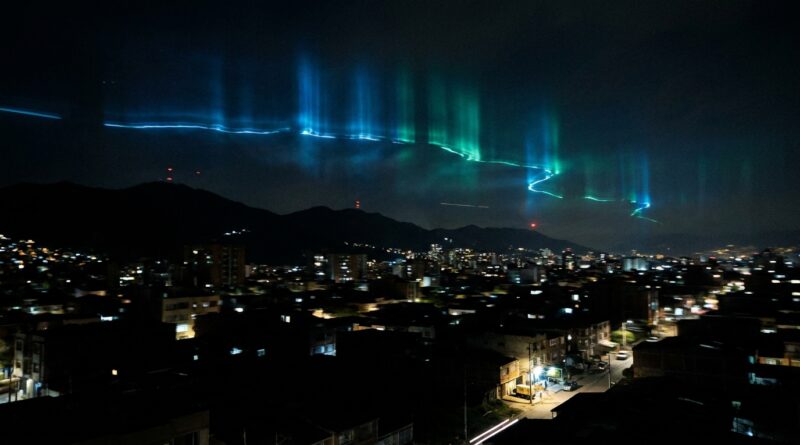
The Earthquake Lights That Tracked The Fault Line: Are We Finally Catching A Pre-Quake Signal In Real Time?
If your social feed is full of “UFO over Colombia” clips right now, the frustration is real. A strong earthquake hits, people post flashes and glowing streaks in the sky, and within minutes the internet splits into two annoying camps. One says it is obvious proof of something otherworldly. The other says it is all panic, power lines, or bad video compression. The truth is more interesting than either shortcut. Reports of earthquake lights are not new, and they are not just internet folklore. For decades, researchers have logged strange luminous events near fault zones before, during, or just after major quakes. That does not mean every bright flash is a pre-quake warning. It does mean the recent earthquake lights Colombia witnesses reported deserve a careful look. If the videos line up with timing, location, and known fault activity, we may be watching one of those rare cases where an unexplained sky phenomenon is tied to real geology, not recycled clickbait.
⚡ In a Hurry? Key Takeaways
- Yes, earthquake lights are a real reported phenomenon, but not every Colombia sky flash is solid evidence of a quake precursor.
- If you are reviewing clips, check the timestamp, location, weather, and whether power grid damage could explain the glow before sharing it as proof.
- The safest takeaway is practical. Treat unusual lights during a quake as a reason to focus on aftershock safety first, mystery second.
What people in Colombia are actually seeing
The current buzz centers on eyewitness reports and phone footage captured around a powerful earthquake in Colombia. In several clips, the sky appears to pulse, glow, or flash in odd patches. Some lights seem fixed near the horizon. Others look like brief bursts, almost like distant transformers blowing or sheet lightning with no clear storm.
That mix is exactly why this gets messy so fast. A single phrase like “strange lights” can cover several very different things. Electrical grid failures can light up low clouds. Substation arcs can create dramatic blue or green flashes. Camera sensors can exaggerate brightness and color, especially in dark conditions. But there is also a smaller, stranger category that researchers have spent years trying to sort out. True earthquake lights.
What are earthquake lights, exactly?
Earthquake lights are unusual luminous phenomena reported near seismic activity. They have been described as floating glows, flashes, flame-like forms, or colored lights near the ground or in the sky. Reports go back centuries, but the modern scientific discussion picked up when better records, photographs, and satellite tools became available.
The key point is this. Scientists do not treat earthquake lights as pure myth. They are controversial, yes, but they are not laughed out of the room anymore.
Why some researchers take them seriously
One of the more cited ideas is that stress building in certain rock types can activate electrical charges. Those charges may travel through the ground and ionize air near the surface, producing visible light under the right conditions. Another idea involves piezoelectric effects or electrical disruptions tied to fault rupture.
None of this is settled science. But it is enough to move the topic from “tabloid nonsense” to “rare geophysical event worth documenting carefully.”
Why skeptics still have a point
Skeptics are not wrong to ask hard questions. Most videos of supposed earthquake lights are captured in chaotic moments. People are scared. Power systems are failing. Weather can be changing. Phones are shaking. Compression artifacts are everywhere. If you want clean evidence, an earthquake is about the worst time to collect it.
That is why the Colombia case matters only if multiple reports line up across time and place, especially near the fault line or rupture zone.
The fault line clue is the part worth watching
The most interesting claim in episodes like this is not that there were lights. It is that some reports appear to track the fault area itself. If that holds up, it matters.
Why? Because random drones, fireworks, or isolated electrical faults do not usually form a pattern that maps onto seismic structure. A cluster of lights near the path of rupture, or appearing in sequence across a stressed zone, is much harder to brush aside.
That does not prove prediction. It does suggest a physical process connected to crustal stress or the quake itself.
Real-time signal or just aftermath noise?
This is the big question. Were these lights seen before the main shaking, during it, or only after infrastructure started failing? Timing is everything.
If the strongest clips happened after transformers blew and neighborhoods lost power, the case weakens. If independent witnesses in different locations reported glows just before or during the first shaking, especially away from obvious urban electrical sources, the case gets stronger.
How to judge the Colombia clips without falling for hype
You do not need a seismology degree to do a basic credibility check. You just need to be a little stubborn about evidence.
1. Check when the video was recorded
Upload time is not enough. A clip posted at 3:00 a.m. may have been recorded hours earlier, or years earlier. If the original phone file metadata is missing, confidence drops.
2. Check where the camera was pointed
Was the glow near a city, industrial area, or known power substation? If so, an electrical explanation rises fast on the list.
3. Check the weather
Low clouds can turn ordinary electrical flashes into giant sky events. A modest ground-level burst can look apocalyptic if the cloud ceiling reflects it back.
4. Look for multiple angles
One video can mislead. Three videos from different neighborhoods, all time-matched, are much more useful.
5. Separate “odd” from “predictive”
This is important. Even if the lights are real and quake-related, that does not mean they can reliably predict an earthquake in a way that helps public warning systems today.
What past cases tell us
Historical cases from places like Japan, Peru, Italy, Mexico, and China have kept this topic alive. In some events, witnesses described sheet-like glows or hovering lights near active faults. In others, cameras caught brief flashes during major shaking.
The pattern that shows up again and again is rarity. Earthquake lights are not a standard feature of every big quake. They seem to be unusual, possibly linked to specific geology or fault settings. Some studies have suggested they may be more common near rift environments or near-vertical fault structures, though that is still debated.
That makes the current earthquake lights Colombia unexplained sky phenomenon story worth saving, cataloging, and comparing. Not because it proves a grand theory overnight, but because good cases are uncommon.
So, are we finally catching a pre-quake signal in real time?
Maybe, but not in the way social media wants.
If by “signal” you mean a strange physical effect linked to crustal stress, there is a real possibility that some earthquake lights fit that description. If by “signal” you mean a reliable public warning tool that tells us a quake is coming in time to evacuate, we are nowhere near that standard.
Think of it like this. Smoke can be a sign of fire. But not every haze means your house is burning, and not every fire gives useful warning smoke before it spreads. Earthquake lights may turn out to be a genuine side effect of certain seismic processes without becoming a practical prediction system.
Why this story keeps getting flattened into “scientists baffled” nonsense
Because that headline shape is easy. It asks you to choose between mockery and belief. Real science is slower and more annoying than that. It needs timestamps, locations, instrument readings, grid failure reports, weather data, witness consistency, and ideally satellite or seismic correlation.
That is less flashy than “aliens over fault zone,” but it is also how weird things become useful knowledge instead of just another viral clip.
What the Anomal community should do with cases like this
Document first. Argue later.
If you are tracking the Colombia reports, save original uploads, note the claimed location, compare them against official quake timing, and flag likely electrical explanations without pretending that settles every case. A grounded archive is far more valuable than a thousand hot takes.
The sweet spot here is curiosity with standards. You do not have to sneer at witnesses, and you do not have to call every flash a precursor.
At a Glance: Comparison
| Feature/Aspect | Details | Verdict |
|---|---|---|
| Eyewitness reports | Multiple people describe unusual glows or flashes around the earthquake window, which makes the event worth checking seriously. | Promising, but needs verified timing and location. |
| Possible ordinary causes | Power grid failures, substations, low-cloud reflection, lightning, and camera artifacts can all mimic an unexplained sky phenomenon. | Strong alternative explanations for some clips. |
| Scientific value | If reports cluster along the fault line and occur before or during shaking, they could add to the long-running earthquake light record. | Genuinely worth documenting, not proof of prediction yet. |
Conclusion
The best way to talk about the Colombia lights is also the least dramatic. Some of what people filmed may turn out to be ordinary electrical fallout from a major quake. Some of it may fit the old, stubborn pattern of earthquake lights that science still does not fully explain. That is exactly why this story matters. It helps the Anomal community today because it goes beyond the lazy “scientists baffled” framing that is already flooding social feeds. By focusing on one fresh, verifiable cluster of reports around a specific seismic event and comparing it with decades of under-reported earthquake light research, we give readers a grounded way to talk about a genuinely strange pattern without surrendering to hoaxes or debunker snark. It keeps the conversation where Anomal thrives, right on the fault line between serious science and the human urge to see meaning in the sky.