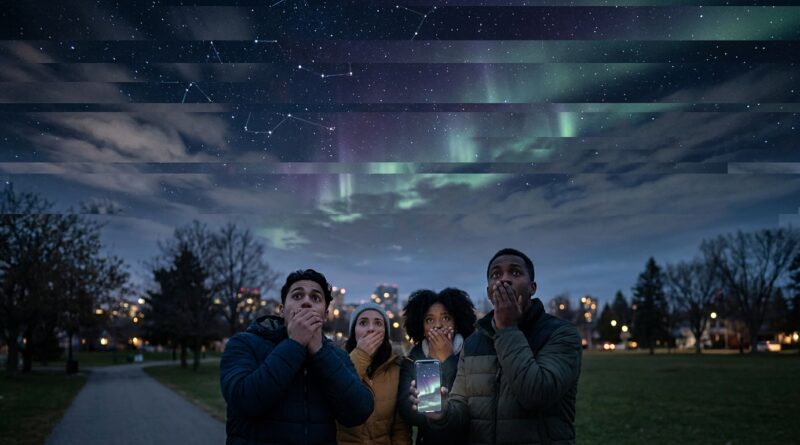
The Sky That Glitched For Everyone: Inside The New Wave Of ‘Shared Reality Break’ Reports
If you are tired of every strange-sky story turning into either “obvious fake” or “definitely aliens,” you are not alone. That frustration is exactly why these new reports feel different. People in different places, often total strangers, are describing the same oddly specific event: the sky appears to jump for a split second, like a frame skipped in a video, while buildings, trees, streets, and people stay locked in place. Clouds seem to slide. Stars seem to snap a few degrees and snap back. Then it is over. The key point is not that one blurry clip exists. It is that clusters of witnesses are comparing notes within hours and finding eerie overlap. A mysterious glitch in the sky shared by multiple witnesses deserves more than eye-rolls, but it also deserves more than blind belief. The useful middle ground is careful comparison, calm skepticism, and better evidence collection before the internet turns every odd second into a myth.
⚡ In a Hurry? Key Takeaways
- These reports are unusual because multiple witnesses often describe the same sky-only “jump” while the ground remains stable.
- If you see one, save the original video, note the exact time, location, direction you were facing, and ask nearby witnesses to write what they saw before comparing stories.
- Most cases will likely have ordinary explanations like phone processing, atmospheric layers, or perception glitches, but a small number may still be worth serious review.
Why this case is getting more attention
Most viral sky clips die fast once someone points out bad compression, edited footage, or a dramatic caption doing all the work. This wave of reports is sticking around for a different reason. The descriptions are oddly consistent.
People are not just saying, “I saw something weird.” They are saying the upper visual layer of the world seemed to shift while the lower layer did not. That is a very specific claim. And specific claims are easier to test.
That matters. When witnesses independently describe the same pattern, investigators have something to work with. Not proof. But a starting point.
What people are actually reporting
The common pattern
Across forums, local groups, and message threads, the reports tend to share a few details:
- The event lasts less than a second, sometimes just a blink.
- The sky appears to “slide,” “snap,” or “jump.”
- Clouds, stars, or the whole sky dome seem affected.
- Ground objects like rooftops, poles, trees, and roads appear steady.
- More than one person in the same area sometimes notices it at once.
That last part is why this is not easy to shrug off as one person being tired, anxious, or suggestible.
Why the “ground stayed still” detail matters
If someone says their whole field of view jolted, that could point to eye movement, balance disruption, or a camera wobble. But if they insist only the sky layer moved, the question changes.
Now we have to ask whether the effect came from cloud motion, atmospheric refraction, rolling-shutter weirdness, stabilization software, or a perception quirk that affects broad, low-detail areas differently than high-detail foreground objects.
The boring explanations that can look surprisingly dramatic
Here is the part nobody loves, but it is important. Strange does not always mean impossible. Sometimes it means “you just have not met the technical explanation yet.”
1. Phone camera stabilization errors
Modern phones do a lot of work behind the scenes. They stabilize footage, sharpen edges, reduce noise, blend frames, and sometimes rebuild parts of a scene to look smoother than reality. When the sky is a large, soft, low-detail background and the ground is full of crisp edges, software can treat them differently.
The result can look like the clouds slipped a frame while the rest of the world stayed put.
2. Compression artifacts
Once a clip gets uploaded, downloaded, reposted, screen-recorded, and re-encoded, it can start inventing little visual crimes of its own. Broad areas like blue sky and faint cloud bands are especially vulnerable.
A tiny glitch in one frame can become a dramatic “jump” when viewed on loop.
3. Layered cloud movement
Sometimes two cloud layers move at different speeds and directions. If one layer is faint and the light is right, your brain can read the whole sky as one sheet until a contrast shift suddenly reveals the split.
That can feel less like weather and more like a bad edit.
4. Atmospheric refraction
Heat gradients and air-density changes can bend light in strange ways. We usually notice this near roads, horizons, or over water, but subtle versions can affect how parts of the sky appear, especially around dusk or dawn.
This does not explain every report. It does belong on the list.
5. Eye and brain timing issues
Human vision is not a live stream. It is a fast reconstruction project. Your eyes jump constantly in tiny movements called saccades, and your brain smooths over those jumps so the world feels stable.
Most of the time, that system is brilliant. Occasionally, under fatigue, stress, low light, migraine aura, or sudden attention shifts, it can produce a weird “scene update” feeling. If several people are watching the same low-detail sky at the same moment, they may even react similarly to the same visual cue.
Why some cases still bother skeptics
Even after you account for camera tricks and human perception, a few reports still stand out. Usually, they have three things going for them.
Multiple independent witnesses
Not “my friend agreed after I told him.” I mean separate people using similar language before they compare notes.
Useful environmental details
Exact time. Weather conditions. Direction faced. Whether airplanes were visible. Whether the witness was walking, driving, or standing still.
Original files
Not a reposted clip with dramatic music. The original video, with metadata if possible, gives investigators a fighting chance to rule out editing, stabilization bugs, or upload damage.
This is where the phrase mysterious glitch in the sky shared by multiple witnesses stops being clickbait and starts becoming a testable claim.
How to investigate one of these reports without fooling yourself
You do not need a lab coat. You just need a method.
Start with the timeline
Write down the exact date and local time as tightly as possible. A one-minute window is good. A ten-second window is better. Then check whether anyone else in the same town or region posted about it around that time.
Lock down witness statements early
If several people saw it, ask each person to write what they saw on their own first. That avoids the usual story-merging problem where one confident witness accidentally edits everybody else’s memory.
Check the sky in layers
Look at high clouds, low clouds, aircraft trails, star positions, and horizon glow separately. A lot of “the whole sky moved” cases turn into “one layer shifted and my brain grouped the rest with it.”
Inspect the video file, not just the post
If there is video, compare the original file to the uploaded version. Step through frame by frame. Look for:
- Stabilization warping around edges
- Rolling shutter wobble
- Compression blocks in flat sky areas
- Foreground objects remaining pixel-stable while the background smears
Check outside data
Look at weather radar, satellite cloud maps, local flight paths, and astronomy apps if stars were involved. None of these will solve every case, but they help clear away noise.
What to do if you witness one yourself
If this happens to you, the best thing you can do is turn a spooky moment into a clean record.
- Note the exact time immediately.
- Record your location.
- Say out loud which direction you are facing while filming.
- Keep filming before and after the event if possible.
- Do not apply filters or edits.
- Ask nearby people what they saw before describing your own version.
- Save the original file in more than one place.
Also, be honest about your own condition. Were you exhausted? Driving? Looking through glass? Coming out of bright indoor light? That is not embarrassing. It is useful data.
Could this be a social-media feedback loop?
Yes. That is always possible.
Once a weird visual idea enters public conversation, people begin to notice things they might have ignored before. That does not mean they are lying. It means attention shapes reporting. If I tell you to watch for a “sky skip,” your brain now has a label ready when it sees one.
But that cuts both ways. A feedback loop can inflate a weak pattern. It can also help reveal a real one by connecting scattered witnesses who would otherwise stay silent.
So, is reality actually glitching?
Probably not in the sci-fi sense. At least, not based on what we have so far.
But that does not make the reports worthless. Quite the opposite. These cases sit in a useful middle zone. They are odd enough to deserve documentation, and ordinary enough that good analysis can still get traction.
That is the sweet spot if you care about truth.
At a Glance: Comparison
| Feature/Aspect | Details | Verdict |
|---|---|---|
| Witness overlap | Multiple people in the same area sometimes report the same split-second sky jump. | Most interesting part of the story. Worth documenting carefully. |
| Video evidence | Often vulnerable to phone stabilization, rolling shutter, and upload compression, especially in flat sky regions. | Helpful only if the original file is available. |
| Likely explanation mix | A combination of perception effects, atmospheric conditions, and software artifacts can explain many cases. | Skepticism is fair, but dismissal is premature in the strongest multi-witness reports. |
Conclusion
A lot of readers are burned out on recycled UFO clips and obvious fakes, and honestly, that reaction makes sense. But these shared sky-glitch reports hit a different nerve because they come with a pattern, not just a punchline. The smart response is not to panic and not to sneer. It is to compare timestamps, study cloud layers, inspect the original files, and separate witness memory from online myth-building. That gives believers and skeptics something solid to work with. Maybe most of these cases will end up being camera processing, atmospheric quirks, or the strange little shortcuts of human vision. Maybe a few will resist easy answers. Either way, a grounded investigation has real value. It gives people who quietly saw the same thing a way to speak up, and it gives careful doubters a structured case to push against. That is how you make progress when something genuinely strange seems to peek through the noise.