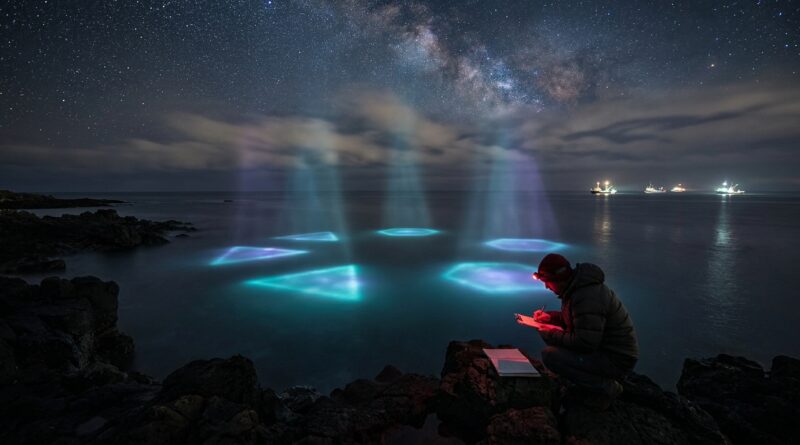
The Ocean That Glows Back: Inside The New Wave Of ‘Unexplained Underwater Lights’ Baffling Scientists
It is maddening to watch something strange happen over the water, reach for your phone, and end up with a blurry smear that convinces nobody. That is exactly why the recent surge in reports of the unexplained underwater lights phenomenon matters. People from coastlines, lakeshores, ferry routes, oil platforms, and beach towns are describing the same basic thing. Glowing shapes below the surface. Vertical columns of light rising through dark water. Silent flashes that move, pause, and vanish before anyone can get proper instruments on them. Some cases will turn out to be boats, bioluminescence, military activity, fishing gear, or plain old misjudgment at night. But not all reports fit neatly. The real story is not just whether these lights are mysterious. It is that witnesses now have a chance to do something useful. If enough people document what they saw in the same practical way, patterns can start to appear across places and seasons.
⚡ In a Hurry? Key Takeaways
- The unexplained underwater lights phenomenon is getting more reports worldwide, but most sightings still lack the basic details needed for serious study.
- If you witness one, record time, exact location, tide, weather, direction, color, movement, sound, and nearby vessel activity before the memory fades.
- Do not chase lights into the water. Your safest and most valuable tool is careful observation from shore or a stable boat position.
Why this wave of reports feels different
People have always told stories about odd lights at sea. What feels new is the volume and the overlap. Reports from very different places are starting to sound strangely similar.
Witnesses often describe a cool blue, green, or white glow under the surface. Some say it moved against waves or current. Others report a light that seemed to rise in a column, then wink out with no splash and no obvious source. A few mention multiple lights acting in formation.
That does not mean aliens. It does mean the pattern is worth treating seriously.
The trouble is that night over water is a giant illusion machine. Distance is hard to judge. Reflections can float where they should not. A light onshore can seem to hover offshore. Even experienced sailors get fooled sometimes.
What scientists think might be going on
Scientists are not baffled because glowing water is impossible. They are baffled because most reports arrive stripped of context. Without timestamps, tide data, local vessel traffic, moon phase, and camera metadata, even a sincere report is hard to test.
Common natural explanations
Bioluminescence is the big one. Tiny marine organisms can create eerie glows when disturbed by waves, fish, propellers, or currents. In the right conditions, the ocean can look almost electric.
There are also fish schools, jelly blooms, and plankton slicks. Some can appear as moving patches or trails. Moonlight on chop can make light seem submerged when it is not.
Human-made explanations
Fishing boats, underwater work lights, harbor operations, submersibles, remotely operated vehicles, and military exercises can all create odd effects. So can illuminated buoys and reflected shore lighting.
Then there are the camera problems. Phones overexpose bright spots in darkness. Digital zoom turns small lights into weird blobs. Image stabilization can make a fixed point look like it is drifting.
The cases that stay open
Some reports still do not sit comfortably in those boxes. That is where good witness habits matter. A mystery stays a mystery if all we have is a dramatic clip and a caption saying, “What is this?”
Why viral videos usually fail the test
Most viral clips give us almost none of the basics. No exact place. No time to the minute. No shot showing the horizon. No reference points. No local conditions. No follow-up.
It is a bit like taking a photo of a warning light on your car dashboard and asking a mechanic to diagnose the whole engine from that one image. Maybe. Usually not.
If the Anomal community wants this subject taken seriously, the standard has to improve. Quietly. Consistently. Without turning every light over water into proof of something exotic.
What to record if you see strange lights under water
This is the part that actually helps. If you witness the unexplained underwater lights phenomenon, your goal is not to become a hero. Your goal is to become a useful witness.
The first 60 seconds
Open your camera, but do not only film the light. Start with a wide shot that includes shoreline, stars, buildings, buoys, or the horizon. Say the time out loud. Say your location out loud too.
Then note these points:
- Exact date and local time
- Location as precisely as possible, GPS if available
- Direction you are facing, using a compass app if you have one
- Weather, cloud cover, rain, fog, wind
- Water conditions, calm, choppy, swell, breaking waves
- Tide stage, rising, falling, high, low
- Moon phase and where the moon is in the sky
- Color of the light, blue, green, white, orange, mixed
- Shape, point, bar, column, patch, orb, line
- Movement, steady, darting, rising, sinking, pulsing
- Sound, silent, humming, splashing, engine noise nearby
- Nearby boats, ships, piers, divers, helicopters, drones
If you can keep filming
Pan slowly to include landmarks. Zoom only after you have a stable wide shot. If possible, film for longer than feels necessary. Many useful clues show up before and after the “main” moment.
If you are with someone else, have them write notes while you film. Two witnesses doing different jobs is far better than two people both making shaky videos.
Use your phone like a notebook
Open a notes app right after the event and type what you saw in plain language. Memory changes fast. What felt obvious at the time can get fuzzy in ten minutes.
A simple witness checklist you can save right now
Here is a practical field checklist. Copy it into your phone before your next beach walk or night fishing trip.
- Stay safe and do not enter the water.
- Record exact time.
- Capture a wide video first.
- State location and direction out loud.
- Note tide, weather, and moon.
- Describe color, shape, and movement.
- Listen for sound and record it if possible.
- Check marine traffic apps for nearby vessels.
- Take a second clip with reference objects in frame.
- Write a short account immediately after.
How to cut through hoaxes and honest mistakes
Not every strange light is a fake. But not every strange light is unknown either.
Look for obvious human sources
Check if there is a harbor, offshore platform, bridge, ferry lane, or fishing fleet nearby. Many “submerged” lights are actually reflections from distant sources seen at a low angle.
Check local conditions
Bioluminescence often follows known blooms and disturbance patterns. Tides and surf matter. So do recent storms. A calm, black sea behaves very differently from choppy water full of foam.
Compare accounts carefully
If several witnesses report the same event, compare what matches before focusing on what sounds dramatic. Shared details like direction, duration, and color are usually more useful than emotional reactions.
Where citizen witnesses can actually help science
This is where things get exciting in a grounded way. A single clip may not prove much. A hundred well-documented reports from different coasts might.
Patterns could emerge by season, moon phase, tidal cycle, or proximity to shipping routes. Maybe the answer ends up being rare marine biology. Maybe unusual industrial activity. Maybe several different causes getting mixed together online.
That is still progress.
The best part is that this does not require expensive gear. A smartphone, compass app, tide app, and disciplined note-taking can go a long way.
What gear helps, without getting carried away
Useful, simple tools
A phone with decent low-light video is enough to start. Add a small tripod if you can. A red-light flashlight helps preserve night vision. Tide and marine traffic apps are worth having on your home screen.
Nice to have
Binoculars, a power bank, and a basic external microphone can improve results. A real camera with manual settings is great if you already own one, but it is not required.
Not recommended
Do not buy expensive paranormal gear because a social post told you to. Start with better habits, not bigger gadgets.
Safety first, always
This should be obvious, but strange lights make people do dumb things.
Do not swim toward them. Do not launch a kayak into dark water alone. Do not trespass onto rocks, piers, or restricted coastline at night. If you are on a boat, keep your bearings and avoid drifting while distracted.
Your report is useful only if you get home safely.
At a Glance: Comparison
| Feature/Aspect | Details | Verdict |
|---|---|---|
| Most likely causes | Bioluminescence, vessel lights, reflections, underwater work activity, camera artifacts | Many sightings will have normal explanations |
| What makes a report valuable | Precise time, place, tide, bearing, weather, color, movement, sound, and reference video | Good documentation matters more than dramatic footage |
| Best response for witnesses | Observe safely, record systematically, compare with known conditions, share responsibly | This is how a real grassroots dataset begins |
Conclusion
The unexplained underwater lights phenomenon does not need more breathless captions. It needs better witnesses. That is good news, because it gives the Anomal community something concrete to do right now, not someday. Instead of just chasing viral clips, you can record the details that make sightings useful: time, tide, bearing, weather, sound, color, motion, and local context. That helps cut through hoaxes, honest mistakes, and the weird tricks that darkness and water play on the eyes. It also helps people feel less alone when they see something they cannot explain. If enough careful observers use the same checklist across different coastlines, a real pattern might emerge. And if that happens, scientists and serious investigators will have something better than rumors to work with. Start simple. Stay safe. Write things down. Sometimes the most important discovery is not the light itself, but the fact that someone finally documented it well.