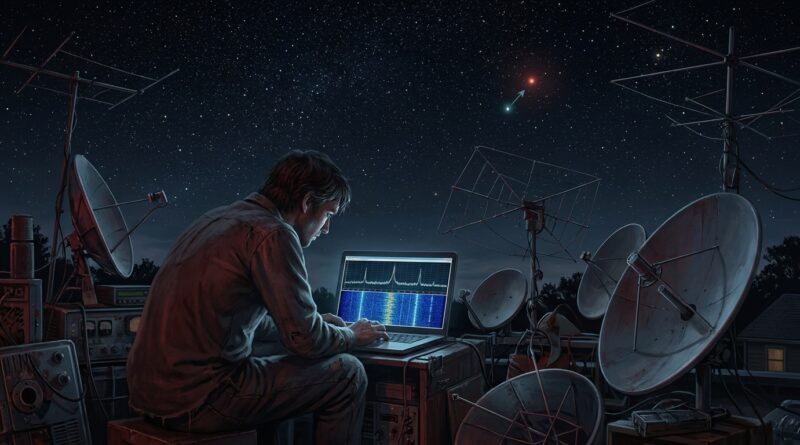
The Star That Started Tapping Back: Amateur Astronomer Claims A ‘Reply’ From Teegarden’s System
If you have ever tried to figure out whether a strange space signal is real, you already know the problem. The internet turns every odd blip into either “proof of aliens” or “obvious nonsense” in about six minutes. That is exhausting. It also makes it harder to spot the rare cases that actually deserve calm, serious attention. A new claim about a Teegarden’s Star unexplained repeating radio signal has landed right in that messy middle. An amateur astronomer says a narrowband, repeating signal appears to be coming from the direction of Teegarden’s system, a nearby red dwarf with exoplanets that has long been on the list of interesting places to watch. That does not mean we have a message from another civilization. Not even close. But it does mean we have the kind of fresh anomaly worth following carefully, because this is exactly how real discoveries and embarrassing false alarms often begin.
⚡ In a Hurry? Key Takeaways
- A claimed Teegarden’s Star unexplained repeating radio signal is interesting, but it is far from confirmed and could still be interference, equipment error, or a natural source.
- Before getting excited, ask for the basics: raw data, observing times, frequency details, repeat observations, and whether other telescopes can see the same thing.
- The safest way to read stories like this is to stay curious, not committed. Early anomalies often disappear under better testing.
What is being claimed here?
The core claim is simple. An amateur observer says they detected a narrowband radio signal that repeats and appears to come from the direction of Teegarden’s Star system.
That matters because narrowband signals are unusual in nature. Most natural radio sources spread energy across a wider range of frequencies. A tight, narrow spike can look more artificial, which is why SETI researchers pay attention to them.
But there is a giant catch. Earth is noisy. Very noisy. Satellites, aircraft, ground transmitters, electronics, bad shielding, software mistakes, and even ordinary devices can all create signals that look spooky at first glance.
Why Teegarden’s Star gets people excited so quickly
Teegarden’s Star is a small red dwarf only about 12.5 light-years away. In cosmic terms, that is practically next door. It also has planets that have been discussed as potentially interesting from a habitability point of view.
So when people hear “repeating radio signal” and “nearby star with planets” in the same sentence, their brains sprint ahead. Understandably so. Most of us want the story to be true. That is exactly why discipline matters here.
What would make this a serious scientific story?
For a claim like this to move from exciting chatter to real evidence, a few things need to happen.
1. The raw data has to be available
Not just a screenshot. Not just a graph on social media. The actual observing data matters. Other people need to inspect it, process it independently, and check whether the signal survives different analysis methods.
2. The observing setup has to be clear
What antenna was used? What receiver? What software? What time was the observation made? What was the exact frequency and bandwidth? Was Doppler drift measured? Was the telescope tracking the star or just passing over it?
If those details are fuzzy, confidence should drop fast.
3. The signal has to repeat under controlled follow-up
“Repeating” is a helpful word only if the pattern holds up. A one-night oddity is interesting. A signal that returns on schedule, or appears again when multiple observers point at the same target, is much more important.
4. Other telescopes need to check
This is huge. If a second, independent setup sees the same thing at the same coordinates and frequency range, the story changes. If nobody else can reproduce it, the odds swing back toward local interference or data error.
What usually goes wrong in stories like this?
Most false alarms do not fail because someone is foolish. They fail because radio astronomy is hard.
Local interference
This is the biggest suspect in almost every early signal claim. A transmission from Earth can bounce, drift, fade, and masquerade as something celestial.
Side lobes and off-axis pickup
Telescopes do not only hear what they are pointed at. Signals can sneak in from the side. That can make a terrestrial source seem linked to a star by accident.
Software processing mistakes
Filters, averaging, calibration, and frequency correction can create patterns that look meaningful. A bug or wrong assumption can turn noise into a “signal.”
Natural astrophysical sources
Not every strange radio event is man-made. Some stars, flares, and plasma effects can behave in surprising ways. Weird does not automatically mean intelligent.
How to read a Teegarden’s Star unexplained repeating radio signal claim without getting played
Here is the practical framework I wish more people used.
Ask: Is the claim directional or truly source-locked?
“From the direction of Teegarden’s Star” is not the same as “proven to originate at Teegarden’s Star.” Direction is the start, not the finish.
Ask: Is the signal narrowband and drifting in a way that fits a distant source?
A real extraterrestrial candidate would likely show frequency drift caused by relative motion between source and receiver. But that drift can also be mimicked, so it is a clue, not proof.
Ask: Did the signal disappear when the telescope moved off target?
This is one of the basic checks. If the signal stays no matter where the telescope points, that is bad news for the alien theory.
Ask: Has anyone outside the original observer confirmed it?
Independent confirmation is the dividing line between a curious report and a real event.
Ask: Are the people involved sounding careful or theatrical?
Scientists and careful amateurs usually talk in annoying, cautious language. That is a good sign. Big emotional claims with little data are usually a bad sign.
Why an amateur claim should not be dismissed out of hand
It is easy to hear “amateur astronomer” and tune out. That would be a mistake. Amateur observers have a long history of spotting comets, supernovae, variable star changes, and all sorts of useful anomalies.
The issue is not whether the observer is amateur or professional. The issue is whether the methods, notes, and data are strong enough for others to test.
In fact, this is one reason stories like this are healthy for the community. They remind people that discovery often starts with someone noticing a weird thing and being careful enough to document it.
What should happen next?
If this claim is going to mature into something meaningful, the next steps are pretty straightforward.
Immediate follow-up observations
Multiple observers should point at Teegarden’s system as soon as possible, especially using different equipment in different locations.
Blind checks against known interference sources
The reported frequency should be compared with databases of common terrestrial and satellite transmissions.
Release of observing logs
Time stamps, sky position, receiver settings, and signal plots should be shared in enough detail for others to reproduce the analysis.
Try to make it fail
This is the part people hate, but it is the most important. Good science tries to break the claim. If the signal survives that, then people should pay much closer attention.
Why people get emotionally hijacked by signal stories
Because the idea is powerful. A possible reply from another star scratches a very old human itch. We want company. We want a moment that changes history. We want something cleaner and grander than another shaky clip on social media.
That emotional pull is real. The trick is not to pretend you do not feel it. The trick is to notice it, then slow down anyway.
That is the habit worth building for every future “we found a signal” moment. Stay open. Stay skeptical. Keep both hands on the wheel.
So, is this likely aliens?
Right now, no responsible person should say that.
Is it interesting? Yes. Is it worth checking? Absolutely. Is it unusual enough to deserve more than eye-rolling? Also yes.
But “interesting enough to investigate” is a very different statement from “we got a reply.” Most candidate signals die under follow-up. That is normal. It is not a buzzkill. It is how the process works.
At a Glance: Comparison
| Feature/Aspect | Details | Verdict |
|---|---|---|
| Signal type | Reported as narrowband and repeating, which is why it caught attention in the first place | Interesting, but not rare enough on its own to prove anything |
| Evidence strength | Currently based on a single amateur claim unless independent datasets appear | Weak for now. Needs raw data and outside confirmation |
| Most likely next outcome | Either reproducible follow-up that raises the stakes, or a routine explanation like interference or processing error | Too early to call. Treat as an unresolved anomaly, not a breakthrough |
Conclusion
This is why the Teegarden’s Star unexplained repeating radio signal story matters, even before we know the ending. It gives people a live example of how a strange claim should be handled in the real world. One observer notices something odd. The claim spreads. Emotions rise. Then the hard part begins. Data checks, repeat observations, independent verification, and lots of boring attempts to prove it wrong. That process helps the community today because it shows, step by step, how a single amateur report can turn into either a landmark discovery or a textbook false alarm. And either result is useful if we learn from it. Readers get a front row seat to a fresh, still-unresolved anomaly instead of another recycled Roswell argument, plus a practical checklist for the next time someone says, “We found a signal.” Ask what was seen, who confirmed it, what data is public, and what simpler explanation has been ruled out. That is how you stay curious without being credulous.