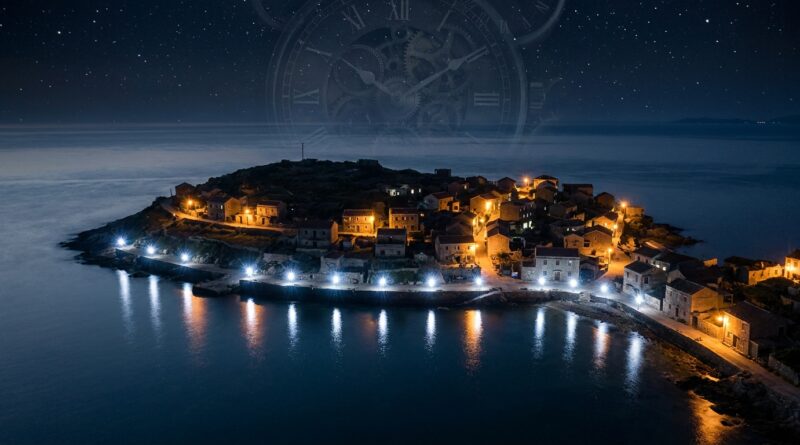
The Island That Refused To Sleep: Why One Remote Village Is Suddenly Haunted By ‘Clockwork Night’
If you lived on a tiny island and every night seemed to run the same eerie script, you would be frustrated too. That is what makes this story hard to shrug off. Residents describe a calm, ordinary place by day, then a strange switch after sunset. Lights flash in sync over the water. Home power stutters. A low mechanical hum appears, then seems to travel through the village as if it knows the route. People are losing sleep, tempers are short, and the worst part may be feeling ignored.
What makes this case so interesting is not just the weirdness. It is the repeatability. A repeating nighttime phenomenon island unexplained lights and power glitches case gives investigators something they almost never get in real time: a pattern that might be tracked, tested, and challenged. That matters. A one-off spooky story is easy to dismiss. A scheduled one is different. It gives locals, researchers, and careful enthusiasts a chance to compare witness reports, power data, weather conditions, marine traffic, and audio recordings night after night until the picture starts to sharpen.
⚡ In a Hurry? Key Takeaways
- This looks notable because the reports repeat on a schedule, with overlapping lights, power glitches, and sound.
- The smartest next step is disciplined logging. Time stamps, video, weather, grid behavior, and witness locations matter more than dramatic claims.
- Residents should treat the event as both a mystery and a safety issue. Rule out electrical faults, marine hazards, and health impacts while the stranger possibilities are still being studied.
Why this island case stands out
Strange-light stories are common. So are ghost tales, humming sounds, and local rumors. What is less common is when several things appear together, over and over, in one small place.
That combination is what gives this report weight. If the flashes over the water happen near the same time each night, and power glitches inside homes happen in the same window, and the hum is heard along a similar path, then we are no longer dealing with just nerves or storytelling. We are dealing with a pattern.
Patterns can be checked. That is the whole game here.
Three broad explanations worth taking seriously
1. A mundane but unusual local cause
This is still the first place to start. Offshore work vessels, faulty electrical equipment, timed industrial systems, marine beacons, drone activity, atmospheric conditions, or a grid problem could create a mix of light, sound, and power issues.
That may sound less exciting, but it is important. Some of the strangest cases turn out to be very real problems with very earthly causes. Corroded transformers, bad grounding, timed load switching, or equipment on boats can do surprising things, especially in remote coastal places where sound and light travel oddly at night.
2. Multiple normal causes that only look connected
This happens more often than people think. A distant boat or offshore platform could explain the flashes. A weak local electrical system could explain the power dips. Temperature inversion over water could carry a hum in a way that makes it seem mobile.
Put those together, and a village may feel like it is being “visited” by one moving force, when really three separate things are lining up at the same hour.
3. A genuine high-strangeness event
Yes, this remains on the table. When a case repeats, includes many witnesses, and has no obvious profit motive, it gets more interesting for serious anomaly researchers. Not because it proves anything paranormal on day one, but because it gives observers a live target to test.
That is rare. And useful.
What “clockwork night” really gives investigators
The phrase sounds dramatic, but the real value is practical. If events repeat, people can prepare before sunset instead of reacting after the fact.
That changes everything.
- Cameras can be pointed in known directions.
- Audio recorders can start early and run long.
- Residents can note exact times of power flickers.
- Observers can spread out and compare what they saw from different angles.
- Marine and flight traffic can be checked against the same timeline.
This is how a mystery stops being just a story and starts becoming a case file.
How to investigate without fooling yourself
Build a simple nightly log
Do not trust memory at 2 a.m. Use a shared log and keep it boring. Boring is good. Boring gives you evidence.
- Date
- Exact time, down to the minute or second if possible
- Observer name and location
- What was seen or heard
- Direction of the event
- Weather, wind, and tide conditions
- Whether home power flickered
- Any boat, aircraft, or vehicle visible nearby
Use more than one device
A single phone video proves very little. Several synchronized recordings from different spots are much better. If possible, use phones, a basic tripod, and one simple audio recorder. Even a cheap setup can help if the time stamps are right.
Talk to the power company, not just social media
If homes are glitching at the same times, utility records could matter a lot. Voltage dips, line faults, switching events, or transformer issues may leave traces. If there is no matching grid activity, that is interesting too.
Do not throw out the ordinary details
People often skip the “boring” factors because they want the weird part. That is a mistake. Weather, shipping routes, fishing schedules, harbor lighting, and local maintenance work can make or break a case.
Why the moving hum is such a big deal
The sound report may turn out to be the most useful clue. Light can be deceptive over water. Sound can be deceptive too, but in different ways.
A hum that seems to move “on a track” suggests a few possibilities. It could be a real moving source, like a vessel, generator setup, or vehicle. It could also be a fixed source whose sound is being bent and carried by nighttime air layers, making it seem to travel street by street.
That means locals should map where the hum is heard strongest and weakest. If ten homes all hear it in sequence, that sequence may reveal the direction of the source. Even basic maps can help a lot here.
The human side of the story matters too
Sleep loss changes how people feel and what they can handle. It makes fear sharper. It makes neighbors argue. It makes every creak feel loaded with meaning. So while the mystery gets the headlines, the immediate problem is exhaustion.
Residents need two tracks running at once. One is investigation. The other is harm reduction.
- Check surge protection and home wiring
- Report repeated electrical issues to utility crews
- Avoid going alone to dark shore areas during active events
- Use ear protection if the hum becomes physically distressing
- Keep children away from waterfront observation spots at night
Even if the final answer is strange, safety still comes first.
What makes this useful for readers outside the village
You do not need to live on the island to learn from it. This is the kind of modern case that helps enthusiasts get better. It pushes people away from recycled UFO clips and century-old folklore and toward something more grounded. Real place. Real schedule. Multiple overlapping effects. No clear money grab.
That is exactly the sort of case where disciplined curiosity can actually help. If enough careful observers compare notes, a small local event can become a serious data set. And if similar reports start popping up elsewhere, this island may end up looking less isolated than it seems.
At a Glance: Comparison
| Feature/Aspect | Details | Verdict |
|---|---|---|
| Repeatability | Reports suggest the lights, hum, and power issues return in a similar nighttime window. | Most important reason to take the case seriously. |
| Possible normal explanations | Marine traffic, grid faults, atmospheric sound travel, beacons, drones, or timed equipment could explain some or all effects. | Still the best starting point for investigation. |
| Research value | A live, repeating case with multiple witnesses offers a rare chance for structured fieldwork and crowd-sourced evidence gathering. | High value, even if the final answer is ordinary. |
Conclusion
This is why the island’s “clockwork night” matters. Not because every strange flash must be a UFO or every hum must be supernatural, but because this is the kind of fresh, unfolding case that rewards careful thinking. A brand new clockwork haunting gives the community something incredibly useful right now: a rare, modern case that appears to repeat on a schedule, in a real place, with multiple overlapping anomalies and no obvious profit motive. That is gold for serious enthusiasts. It helps readers move beyond recycled headlines and old ghost stories and start thinking like field investigators in 2026. Log the events. Compare ordinary causes with high-strangeness ones. Watch for patterns across places, not just within one village. If the island story is small, disciplined reporting will show that. If it is the first sign of a bigger pattern of nocturnal anomalies, disciplined reporting may be what helps the rest of us notice in time.