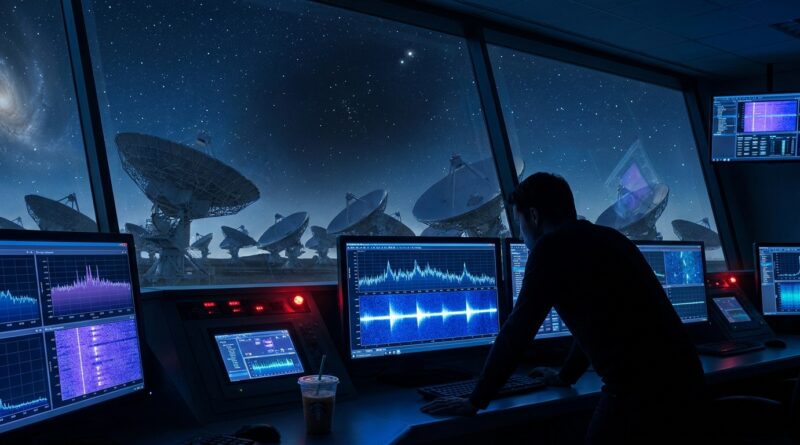
The Signal That Blinked Off The Map: Did Earth’s Quietest Radio Dead Zone Just Start Whispering Back?
If you have ever rolled your eyes at another “mystery signal from space” headline, you are not alone. Most of us have been trained by years of overhyped stories to expect the exciting part to vanish the second actual scientists show up. That is why this one is worth a calmer look. A patch of sky near Sculptor, long treated as a radio dead zone, has started producing a repeating, pattern-rich signal that does not line up neatly with the usual suspects. It does not fit known satellite interference. It does not behave like a standard pulsar. It also does not look like a classic fast radio burst. That does not mean aliens. Not even close. But it does mean astronomers may have found something genuinely unusual, and the smart move now is to separate “odd” from “proven” before the internet turns a real science puzzle into another shouting match.
⚡ In a Hurry? Key Takeaways
- The mysterious repeating space radio signal 2026 story is interesting because the burst repeats with structure and currently does not match known local interference or common deep-space sources.
- Before taking any “contact” claims seriously, look for independent confirmation from multiple telescopes, a published analysis, and a clean ruling-out of Earth-based radio noise.
- This is a good mystery, not a solved one. The safest takeaway is curiosity with brakes on.
What actually happened?
Radio astronomers surveying a quiet region near the constellation Sculptor picked up a repeating burst with internal patterns. That matters because this area had a reputation for being pretty dull in radio terms. Not cursed. Not magical. Just quiet.
The new signal stands out for three reasons. First, it repeats. Second, the bursts have enough structure that researchers do not want to write them off as random noise. Third, it does not cleanly match the fingerprints of the sources astronomers usually check first.
Those first checks are boring, but they are the whole game. Is it a satellite? A ground transmitter? Radar spillover? A pulsar? A magnetar? A fast radio burst from a distant galaxy? So far, the answer appears to be “none of the above,” at least not in any straightforward way.
Why this signal is getting attention
Space is noisy, and Earth is worse. That is the first thing to remember. Every serious radio detection has to fight through a swamp of human-made junk. Phones, satellites, aircraft systems, military transmissions, old hardware, reflections in the atmosphere, and plain bad data can all create fake drama.
So when a team says a signal from a supposedly empty region is repeating and still does not fit known patterns, that gets attention for a simple reason. Weird is common. Weird that survives the obvious explanations is not.
Repeating changes the story
A one-off blip is easy to lose in the mess. A repeating source gives astronomers something far more useful. It gives them a chance to point other telescopes at the same place, at the right time, and ask, “Do you see it too?”
That is how a curiosity becomes a case.
Pattern-rich is better than random
When researchers say “pattern-rich,” they do not necessarily mean a coded message. It can simply mean the burst has timing, spacing, drift, or frequency behavior that looks organized enough to study.
Think of it like hearing a knock in your house. One random thump could be pipes. A repeating knock in a recognizable rhythm is harder to ignore.
What it probably is not
Right now, the early reports suggest it does not fit three popular bins.
Not a known satellite
Satellites have recognizable paths, frequencies, and interference habits. Researchers know this territory well because satellites ruin plenty of observations. If this signal does not track with known orbital hardware, that removes one very common explanation.
Not a standard pulsar
Pulsars are rotating neutron stars that act like cosmic lighthouses. They can be wonderfully regular. But their signatures are familiar enough that astronomers usually spot them quickly. If this burst is repeating without fitting the normal pulsar profile, something else may be going on.
Not a classic fast radio burst
Fast radio bursts, or FRBs, are intense flashes of radio waves, often from far beyond our galaxy. Some repeat. But they also tend to have known timing and frequency features. If this Sculptor-region source falls outside those patterns, researchers may be looking at a cousin, a new subtype, or something we have not classified yet.
What would have to happen next for this to become a big deal?
This is the part that keeps you grounded when social media starts yelling “contact.” A strange signal becomes scientifically important only after it clears several hard checkpoints.
1. Independent confirmation
Another telescope, ideally in another place, needs to see it. Better yet, several telescopes should detect it. One instrument can be fooled. A network is much harder to fool.
2. Better localization
Scientists need to pin down where the signal is actually coming from. “Somewhere near Sculptor” is not enough. They want a much tighter sky position, which could then be checked against known galaxies or other objects.
3. A full interference audit
This means ruling out local radio contamination with painful thoroughness. It is not glamorous, but it is necessary. The history of odd signals is full of cases where the exciting answer lost to a microwave oven, a satellite reflection, or a calibration mistake.
4. Published data others can inspect
A preprint helps. A peer-reviewed paper helps more. Raw or semi-raw observational data, timing information, and methods matter because other teams need to test the claim.
5. Multiwavelength follow-up
If astronomers can check the same source in X-ray, optical, gamma-ray, or infrared wavelengths, they may find a matching object or event. That can turn a ghostly radio burst into a real astrophysical source with a name and a story.
So, aliens?
No responsible person should jump there. “Unknown” is not code for “artificial.” It usually means “we do not have enough clean evidence yet.”
If you have seen this movie before, good. Skepticism is healthy. The trick is not becoming so cynical that you miss a real discovery, or so excited that you believe the first dramatic thread you read.
This is the same basic skill readers need when following other weird science stories. If you liked the way researchers are trying to separate signal from hype here, you may also like Earth’s 26‑Second Heartbeat Just Got Stranger: New Theory Ties The Mystery Hum To 2026 Solar Storms, which is another good example of how a spooky headline can hide a much more interesting real explanation.
How to follow the story without needing a physics degree
You do not need to read equations to track whether this is maturing into a serious discovery. Watch for a few plain-English signs.
Look for the words “independent detection”
That phrase is gold. It means another team saw the same thing without relying on the original instrument.
Check whether the source gets a stable designation
Once astronomers become confident a signal is real and recurring, it often gets cataloged more formally. That is a clue the case is moving from rumor to record.
Notice whether the headlines get more boring
Funny enough, that is often a good sign. Real science gets less cinematic as the evidence improves. The screaming headlines usually come first. The useful details come later.
Prefer observatory statements over viral clips
If a claim is real, the telescope team, a university, a research consortium, or an astronomy alert network will usually say something concrete. Anonymous accounts posting “they are hiding the truth” are not a source.
Why a dead zone matters
The phrase “dead zone” sounds dramatic, but in practice it means astronomers did not expect much there. That is useful because a signal popping up in a quiet patch can be easier to notice against the background.
It also raises a basic scientific question. Was the area truly quiet until now, or did earlier surveys miss an intermittent source that only wakes up under certain conditions? Repeating but irregular cosmic objects can hide for years if nobody is looking at the right cadence or frequency range.
The most likely outcomes
Here are the realistic paths from here.
Outcome 1: A messy Earth-based explanation
This happens a lot. Not glamorous, but always possible.
Outcome 2: A known phenomenon behaving in a new way
This is often how science actually moves forward. Not “we found aliens,” but “we found a pulsar-like or FRB-like source doing something our models did not predict.” Still exciting.
Outcome 3: A genuinely new class of radio transient
This is the sweet spot for astronomers. A new category of object or event would be a real discovery, even if it sounds less flashy than the internet wants.
At a Glance: Comparison
| Feature/Aspect | Details | Verdict |
|---|---|---|
| Source behavior | Repeating, pattern-rich bursts from a region long considered radio-quiet | Genuinely interesting |
| Known explanations | Does not neatly match satellites, standard pulsars, or classic FRB profiles so far | Unresolved, needs more checks |
| Public hype risk | High chance of “alien signal” claims before independent confirmation arrives | Stay curious, stay skeptical |
Conclusion
This is exactly the kind of mystery space stories are best at when handled well. It is fresh, it is unresolved, and it gives everyone a chance to watch science do the slow, careful work that headlines usually skip. The mysterious repeating space radio signal 2026 story is worth following not because it proves anything wild today, but because it shows what a genuinely odd signal looks like before the facts harden. If you keep your filter simple, wait for independent detections, published analysis, and better source tracking, you can enjoy the high-strangeness without falling for the usual nonsense. That is the real value here. Not just this one signal, but a reusable way to think clearly the next time the internet starts screaming about contact again.