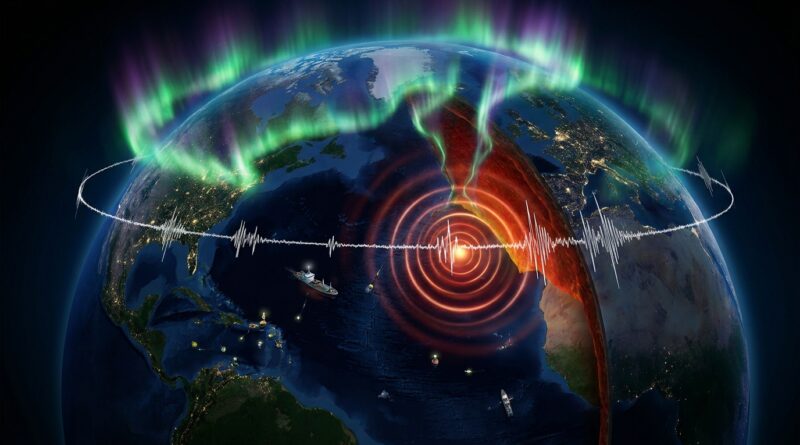
Earth’s 26‑Second Heartbeat Just Got Stranger: New Theory Ties The Mystery Hum To 2026 Solar Storms
If you are tired of seeing the Earth’s “26-second heartbeat” turned into spooky clickbait, fair enough. Most people first hear about this weird signal through a dramatic post that skips the one thing that matters, which is what scientists actually know. The short version is this. Yes, researchers have recorded a faint repeating seismic pulse roughly every 26 seconds. No, that does not mean the planet is alive, waking up, or about to crack open in 2026. What has changed is that a new round of discussion is trying to connect this long-running mystery to stronger solar activity and possible geomagnetic effects expected around the current solar maximum. That is interesting. It is not settled. The good news is the real story is still fascinating without the nonsense. Here is the plain-English version of the earth 26 second hum new 2026 solar storm theory, what is measured, what is guessed, and what you should ignore.
⚡ In a Hurry? Key Takeaways
- The 26-second hum is a real repeating signal picked up by some seismometers, but the new 2026 solar storm link is still a theory, not a proven cause.
- If you want the least-hyped way to follow this story, watch for peer-reviewed seismic and geomagnetic studies, not viral clips or “Earth is sending a warning” posts.
- There is no public evidence that this hum means a disaster is coming. Treat it as an open science question, not a survival alert.
What is the 26-second hum, really?
The phrase “Earth’s heartbeat” makes it sound bigger and stranger than it is. In practice, researchers are talking about a tiny, repeating signal seen in seismic data. Think of it less like a drumbeat you could feel and more like a faint pattern buried in background measurements.
This signal has been discussed for years. Some reports traced it to a pulse around every 26 seconds, often strongest in certain regions or under certain conditions. That alone is enough to spark a lot of theories, because repeating patterns in nature always make people ask the same question. What is causing it?
And that is where things get messy. Scientists have proposed ocean waves, volcanic activity, atmospheric effects, instrument sensitivity, and localized geologic sources. None of those ideas has fully closed the case.
Why people are talking about it again now
The renewed buzz comes from the idea that stronger solar activity might be making subtle Earth signals easier to spot, or in some cases might help drive them. We are in a very active stretch of the Sun’s cycle, with more solar storms, geomagnetic disturbances, and aurora events than usual. That has pushed some researchers and a lot of internet commentators to ask whether space weather could be tied to this old seismic mystery.
That is the core of the earth 26 second hum new 2026 solar storm theory. Not that the Sun “created” the hum out of nowhere in 2026, but that upcoming or ongoing solar storm conditions could affect Earth systems in a way that either triggers, amplifies, or reveals the signal more clearly.
What the new 2026 solar storm theory is actually saying
The cautious version
The most reasonable version of the theory goes like this. Solar storms can disturb Earth’s magnetic field. Those geomagnetic changes can induce currents in the ground, affect the ionosphere, and create tiny knock-on effects in instruments and natural systems. If a seismic pulse already exists, periods of strong solar activity might change how clearly it shows up in the data.
The bolder version
A more aggressive version claims solar storms could directly help generate the 26-second pulse through electromagnetic coupling with Earth’s crust, oceans, or atmosphere. That is a much bigger claim, and right now it needs much better evidence.
In plain English, the careful idea is “the Sun may influence measurements or conditions.” The jumpy social media idea is “the Sun is making Earth thump every 26 seconds as a warning.” Those are not the same thing.
What measurements are solid?
A few things are on firm ground.
1. Solar storms are real and measurable
We can track solar flares, coronal mass ejections, geomagnetic storms, and changes in Earth’s magnetic environment very well. Space weather is not a fringe topic. It is monitored constantly because it matters for satellites, radio, navigation, and power systems.
2. The repeating seismic signal has been reported before
This is not a brand-new TikTok mystery. Variations of the 26-second signal have appeared in scientific discussion for years. That means there is a real observation underneath the hype, even if the cause remains debated.
3. Correlation is not proof
This is the biggest point people miss. If a seismic signal appears during a period of high solar activity, that does not automatically mean the Sun caused it. Earth is noisy. Oceans, weather, geology, and human activity all leave fingerprints in data.
What the likely explanations still are
Even with fresh attention on solar storms, older explanations have not gone away.
Ocean wave action
This remains one of the more grounded ideas. Ocean waves can create persistent microseisms, which are tiny vibrations produced by wave interactions and impacts along coastlines or continental shelves. A regular pulse could come from repeating ocean dynamics in specific areas.
Localized geology or volcanic activity
Some early discussions pointed to sources near the Gulf of Guinea or other geologically active regions. A steady source in one area can look mysterious until enough sensors pin it down.
Atmospheric and instrument effects
Sometimes the weirdest “Earth signals” turn out to be a mix of environmental noise and how instruments respond to it. That does not mean the data are fake. It means interpretation matters.
So can solar storms really affect seismometers?
Possibly, in limited ways. Strong geomagnetic activity can interfere with electrical systems and, in some cases, produce induced currents that show up in sensitive equipment. Researchers have long studied whether magnetic disturbances can contaminate or complicate seismic measurements.
That does not mean every strange pattern during a solar storm is fake. It means scientists have to separate three possibilities.
- A real seismic event in the Earth
- An indirect environmental effect linked to solar activity
- An instrumental artifact that only looks geologic
That sorting job is exactly why this is still a live investigation instead of a solved mystery.
Why the 2026 angle is getting overstated
The year 2026 sounds dramatic, so it spreads well online. But the Sun does not run on movie-trailer timing. Solar maximum is a period, not a magic switch flipped on one date. If researchers are connecting the hum to increased solar activity, they are usually talking about a broader window of elevated space weather, not one single doomsday moment.
That matters because “scientists are watching space weather through 2026” is very different from “Earth will start beating harder in 2026.” One is normal science. The other is headline dressing.
How to read this story without getting played by hype
Check what is being claimed
If a post says the hum is definitely caused by solar storms, that is too strong. If it says researchers are exploring a possible connection, that is much closer to the truth.
Look for actual data sources
Useful coverage will mention seismometers, geomagnetic observatories, wave models, or peer-reviewed papers. Bad coverage leans on phrases like “experts are baffled” and then never names the experts.
Watch for category mistakes
A magnetic disturbance is not automatically a seismic disturbance. A repeating pattern is not automatically a warning. And an unsolved question is not proof of anything supernatural.
What would count as convincing evidence?
For the solar-storm theory to move from interesting to persuasive, researchers would need to show a repeatable relationship between geomagnetic events and the 26-second signal across multiple instruments and locations.
Ideally, they would also need to rule out other likely causes like ocean conditions, local geology, and sensor noise. That means synchronized datasets, clean methods, and results that other teams can reproduce.
Until then, the theory stays where it belongs. On the table, not in the trophy case.
What regular readers should take away
You do not need to choose between “nothing to see here” and “Earth is sending us a coded message.” The sensible middle ground is better. There is a real scientific puzzle. It has been around for a while. New solar activity gives researchers a reason to look again with fresh tools and better comparisons.
That alone is worth paying attention to. A lot of good science starts exactly this way. Someone notices a stubborn pattern, old explanations only partly fit, and new conditions make the puzzle worth revisiting.
At a Glance: Comparison
| Feature/Aspect | Details | Verdict |
|---|---|---|
| The 26-second hum itself | A faint repeating seismic-style signal has been reported in real measurements for years. | Real observation, still unexplained. |
| 2026 solar storm connection | Possible link through geomagnetic effects or improved detectability during strong solar activity. | Interesting theory, not proven. |
| Public risk right now | No solid evidence that the hum predicts a disaster or signals an imminent geologic event. | Low reason for alarm. High reason for careful curiosity. |
Conclusion
The smartest way to look at the earth 26 second hum new 2026 solar storm theory is as a living science story, not a campfire story dressed up as research. There is a real signal. There are several plausible explanations. And the solar-storm angle is worth watching because it could help explain, amplify, or simply clarify something researchers have chased for a long time. But the gaps still matter. This piece helps the community today by taking a suddenly-trending anomaly that most outlets reduce to a spooky headline and turning it into a living investigation you can actually follow. That way, mystery lovers can stay curious, keep the wonder, and still avoid getting played by hype.