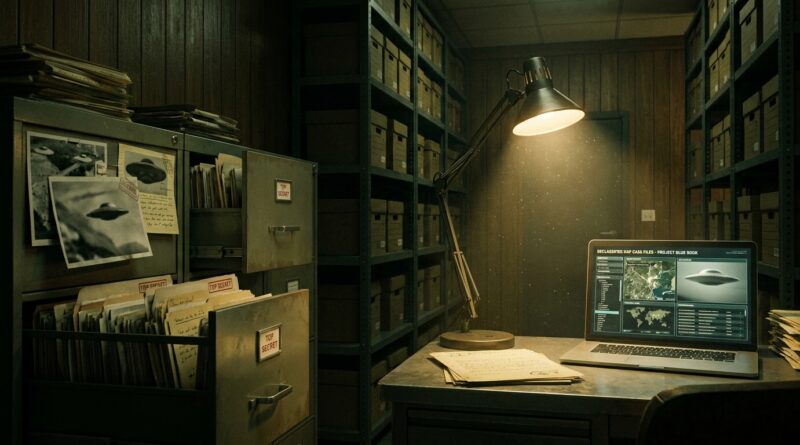
The Signal Hidden In Old UFO Files: Why A New UAP Archive Just Changed The Game Overnight
You are not crazy for being tired of UFO clickbait. Most “disclosure” stories follow the same script. Big promise, dramatic thumbnail, then a stack of old claims, cropped screenshots, and one fuzzy dot that could be anything. If you actually want to learn something, that stuff is useless. What changes the game is access to primary-source material you can read yourself. That is why this new UAP archive matters. Instead of asking you to trust a narrator, it puts old scientific papers, government memos, case files, and investigator notes back on the table where people can check them line by line. For anyone tracking the new uap archive declassified ufo documents 2026 wave, this is the signal hidden in the noise. The real story is not one explosive file. It is the sudden ability to compare many files at once, sort them by quality, and notice what holds up when the hype wears off.
⚡ In a Hurry? Key Takeaways
- A new UAP archive matters because it gives you primary-source UFO records, not recycled commentary.
- Start by sorting cases by data quality, witness credibility, and whether any instrument data backs the sighting.
- The safest way to avoid hype is to treat every “smoking gun” as unproven until the original documents support it.
Why this archive feels different
Most UFO news arrives as interpretation first, evidence second. That is backwards.
A useful archive flips that around. It lets the documents speak before influencers, TV guests, or anonymous accounts start filling in the blanks. That does not mean every file is amazing. A lot of them will be boring, incomplete, or clearly explainable. Good. That is how real research looks.
The reason this archive changed the game overnight is simple. Volume plus access. When enough declassified and semi-forgotten material appears in one place, patterns become easier to spot. A single case can mislead you. A hundred cases can teach you what weak evidence looks like, and what rare strong evidence looks like too.
What is actually in a useful UAP archive?
Not every “archive” deserves the name. Some are just link dumps. The valuable ones usually contain a mix like this:
Government records
These can include military sighting summaries, intelligence notes, internal letters, radar-related references, or project-era document scans. They are often dry. That is a good sign. Dry records tend to be closer to the source.
Scientific studies
This is where things get more interesting. Look for papers, conference proceedings, analyst reviews, and technical discussions about observation methods, atmospheric effects, or case evaluation standards.
Investigator files
These may include witness interviews, sketches, time logs, site notes, and correspondence. They are not automatically reliable, but they help you see how a case was built.
Media clippings with context
Newspapers alone are weak evidence. But they can help place a case in time, show what was claimed at the moment, and reveal how a story changed later.
The hidden signal in old UFO files
The signal is not “proof aliens are here.” That is the kind of sentence that ruins careful work.
The signal is that some older cases survive repeated review better than others. When you revisit a large body of declassified UFO documents, a few things tend to stand out:
- Cases with multiple independent witnesses age better than solo reports.
- Cases with radar, photo metadata, flight logs, or sensor context deserve extra attention.
- Cases reported close to the event are usually more useful than stories retold decades later.
- Cases investigated by people who documented what they could not confirm are often stronger than ones written like fan fiction.
That is the real overnight shift. The community now has a better shot at comparing old claims against a broader paper trail instead of debating screenshots on social media.
How to triage a case without becoming a full-time analyst
You do not need a clearance, a podcast, or a wall of red string. You need a simple filter.
1. Check for primary sources first
If a case is exciting but nobody links the original memo, report, scan, or study, slow down. Secondary summaries are fine for discovery. They are not enough for conclusions.
2. Score the witness
Ask basic questions. Was the witness trained to observe aircraft or sky conditions? Did they report quickly? Were they in a position to estimate distance or speed? Were they alone?
3. Look for instrument support
Radar, infrared, cockpit systems, satellite references, photographs with usable metadata, and audio logs all matter. None are perfect. Still, they are better than a memory alone.
4. Separate strange from unexplained
A strange story is not the same as a strong unexplained case. Sometimes a bizarre report collapses after one timeline check. Other times a plain-sounding report gets stronger the more paperwork you find.
5. Watch for chain-of-custody problems
If a document has been reposted, cropped, retyped, or quoted out of context for years, treat it carefully. The cleanest scan is usually the best place to start.
Why old files still matter in 2026
Because old does not mean useless. It often means neglected.
Many classic UFO collections were released in fragments, scattered across agencies, libraries, private research groups, and personal websites. That made serious comparison hard. A fresh archive can reconnect those fragments. Suddenly, a memo from one file can clarify a witness statement from another. A scientific critique written decades ago can explain why a popular case keeps getting misread today.
If this sounds familiar, it is worth revisiting The Day The UFO Files Went Public: Inside The Declassified UAP Archive That Still Makes No Sense. That piece captures the odd feeling many people had when supposedly public material still remained hard to search, hard to verify, and weirdly easy to lose in the fog.
What to ignore so you do not waste your weekend
This part matters just as much as the exciting stuff.
Ignore dramatic labels
“Best evidence ever” usually means “best marketing this week.”
Ignore cases with no timeline
If nobody can tell you when the event happened, who logged it, and when it entered the record, your odds of getting anything solid drop fast.
Ignore false certainty from either side
Some people call every light a spacecraft. Others insist every anomaly is solved before looking. Both reactions kill useful discussion.
A practical method for the Anomal community
If readers want to make this archive genuinely useful, here is a simple framework the community can use right now.
Create three buckets
Bucket 1: Low value. No primary source, weak witness, no instrument support.
Bucket 2: Worth tracking. Some original paperwork, credible witness, but missing important context.
Bucket 3: High-interest. Primary documentation, multiple witnesses or official involvement, and at least one independent support point such as radar, logs, or technical analysis.
Tag repeated patterns
Notice recurring details like altitude estimates, maneuver claims, missing times, weather conflicts, or repeated investigator names. Patterns often tell you more than any one headline does.
Save source links, not just screenshots
A screenshot is evidence of a screenshot. A document link is much better.
Leave room for “not enough data”
This is one of the healthiest habits in anomaly research. Not every case needs a winner. Sometimes the honest answer is simply that the file is interesting but incomplete.
What changed overnight, really?
Not the sky. The workflow.
Before, people were stuck reacting to whatever claim was trending. Now there is a better chance to work from the bottom up. Start with documents. Build from evidence. Compare cases across decades. See which stories gain strength under scrutiny and which fall apart.
That is a much bigger shift than one flashy revelation. It means the community can spend less time arguing over personalities and more time checking records.
At a Glance: Comparison
| Feature/Aspect | Details | Verdict |
|---|---|---|
| Primary-source depth | Includes scans, memos, study papers, and case files instead of just summaries | Most important reason the archive matters |
| Case triage value | Lets readers sort sightings by witness quality, documentation, and sensor support | Useful for separating signal from hype fast |
| Community impact | Gives Anomal readers a shared evidence base for discussion and pattern spotting | Strong long-term value if people stay disciplined |
Conclusion
This is why the new uap archive declassified ufo documents 2026 moment matters more than the latest viral clip. It gives curious readers something concrete to work with. A fresh, under-the-radar archive of scientific and government UFO studies is far more useful than another promise of instant disclosure. It gives the Anomal community a place to channel curiosity into actual source checking, and a practical way to triage cases by data quality, witness credibility, and instrument support. That keeps the conversation grounded in evidence. It helps readers spot the truly weird files earlier. And it protects everyone from the usual cycle of overhyped “smoking guns” that disappear a week later. If there is real signal hidden in the old files, this is how you find it. Calmly, carefully, and with the documents open in front of you.