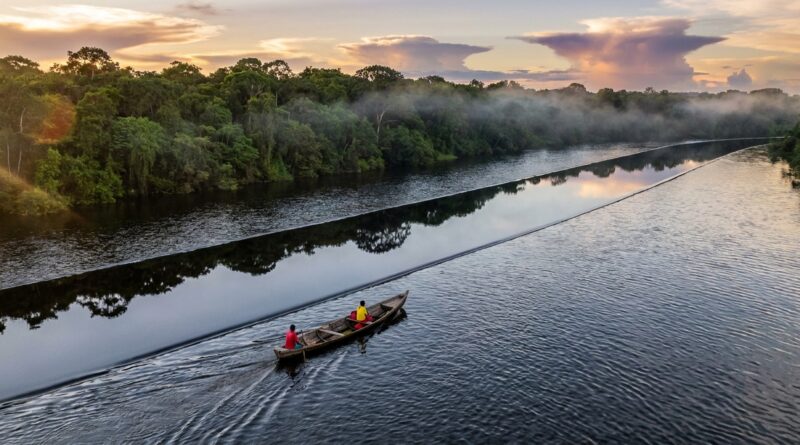
The River That Turned to Glass: Why A Sudden ‘Mirror Current’ In Brazil Has Scientists Baffled
When a river suddenly looks like polished glass, it is hard not to jump straight to wild theories. That is especially true when locals say boats felt oddly sluggish, as if the water had turned thicker overnight. Reports from Brazil about a strange stretch of the Rio Negro doing exactly that have left plenty of people fascinated, and honestly, a little annoyed too, because the clips look dramatic but the explanations so far are messy, incomplete, and not fully satisfying.
The good news is that this does not have to be filed under “impossible” just yet. A brazil river mirror water unexplained phenomenon can often sit in the uncomfortable middle ground between real physics and bad observation. Ultra-calm surface conditions, layered water with different temperatures or sediment loads, unusual wind shelter, or a surface film can all change how water reflects light and how boats move through it. None of those answers is a perfect fit on its own. But together, they give us a useful starting point. Better still, this is one of those rare mystery stories where ordinary people nearby can collect the kind of details that help scientists sort out what is illusion, what is fluid dynamics, and what might actually be new.
⚡ In a Hurry? Key Takeaways
- A “mirror river” does not automatically mean something supernatural. Calm surface layers, light angles, and water stratification can create startling effects.
- If you see it, record video from multiple angles, note the time, weather, GPS location, boat speed, and whether floating debris moves differently from the surface.
- Do not test it recklessly. Strange water behavior can mean hidden current changes, poor visibility, and navigation risk for small boats.
What people say happened on the Rio Negro
The core claim is simple enough. A normally choppy, dark, opaque stretch of river reportedly became strikingly smooth and reflective, almost like a giant mirror laid across the water. On top of that, some boaters said their craft seemed to slow down in the area, as if they were pushing through invisible syrup.
That combination is what makes this story so sticky. If it were only the mirror look, most scientists would first suspect weather, wind, or lighting. If it were only the boat drag, attention would shift to current, density, or submerged flow changes. Put both together, and no single easy answer neatly covers everything.
Why the surface might look like glass
1. Extremely calm water can look unreal
The simplest answer is often the best place to start. Water turns mirror-bright when the surface gets very smooth. Even tiny ripples usually scatter light and break reflections. Remove those ripples, and suddenly the jungle, clouds, and sky can appear sharp enough to feel fake.
That can happen when wind drops fast, when riverbanks block air movement, or when a sheltered layer of water sits under heavier or cooler air. You do not need magic. You need the right conditions at the right moment.
2. A thin surface layer can change the whole look
Rivers are not one uniform liquid. The top few millimeters matter a lot. Natural oils from plants, pollen, decomposing organic matter, or very fine sediment can damp small ripples and make the top skin of the water smoother than expected.
That does not literally turn the river to glass, of course. But visually, it can get surprisingly close.
3. Light angle can exaggerate everything
If the videos were taken near sunrise, sunset, or under a particular cloud cover, the angle of light may have amplified the effect. A dark river like the Rio Negro is especially good at dramatic reflections because it already absorbs a lot of light. When the surface smooths out, the contrast can become almost theatrical.
Why boats might feel like they are slowing down
1. Layered water can behave oddly
This is where things get more interesting. Rivers can develop layers with different temperatures, sediment loads, or dissolved material. If a boat is moving through water sitting on top of denser or differently moving water, drag can change in ways that feel wrong to the person at the tiller.
Oceanographers know a related effect called “dead water,” where a vessel loses speed because it generates internal waves between layers of different density. To the people on board, it can feel like the boat is mysteriously being held back.
That does not prove this is what happened in Brazil. But it is one of the more serious physics-based ideas on the table.
2. Current inversion or crossflow could fool boaters
A river surface may appear calm while subsurface water is moving in another direction or at another speed. If local flow patterns shifted because of tributary input, rainfall upstream, or a temporary eddy zone, boats could encounter resistance that feels out of proportion to what the eye sees.
The phrase “current inversion” sounds dramatic, but sometimes it just means the water at one depth is moving differently from the water above it.
3. Human perception is not perfect on featureless water
This part matters. When the water becomes mirror-smooth, it removes visual texture. Boaters often judge speed partly by how ripples, foam, or nearby surface debris move past them. Take that away, and motion can feel slower even if it is not. If the engine sound stays the same but the visual cues disappear, the brain can misread the situation.
What scientists are likely checking first
If researchers get good access to the area, they will probably start with the boring but useful stuff. Wind records. Water temperature at different depths. Flow speed across the width of the river. Turbidity. Surface chemistry. Satellite images. Rainfall upstream. Time-stamped videos from different observers.
That may sound less exciting than a mystery current from nowhere, but this is exactly how strange stories become solid science. Most real discoveries begin with careful elimination, not dramatic declarations.
Could this be something new?
Possibly new in the sense of “poorly documented” rather than “unknown to physics.” Nature produces odd combinations all the time. What makes them feel unprecedented is often that no one happened to measure them properly the last dozen times they occurred.
That is why this case matters. The Rio Negro is a real, mapped, studied river system. If something unusual did happen, it is testable. And if the reports are partly shaped by lighting, expectation, and social media compression, that is useful to know too.
If you witness something like this, here is how to document it properly
Start with the basics
Grab more than one clip. Film wide shots and close shots. Include the shoreline, the sky, nearby boats, and floating debris if you can. Say the date, local time, and exact location out loud in the video. Your phone may store this anyway, but spoken context helps.
Record environmental details
Note wind strength, cloud cover, rain, recent storms, and whether the phenomenon appeared suddenly or faded in and out. If you have a thermometer, even better. A simple surface temperature reading can help.
Test movement safely
If you are on a boat, do not perform stunts. But if conditions are safe, note your speed over ground from GPS and compare it to engine RPM. Watch a leaf, stick, or foam patch. Is it moving with the boat, against it, or at an angle? That tells researchers a lot about surface flow.
Use your phone well
Turn off beauty filters or video enhancement modes if possible. Lock focus and exposure if your camera allows it. Film for longer than you think you need. Ten shaky seconds rarely helps. A steady one-minute clip often does.
Keep the original file
This is a big one. Do not rely only on a repost to social media. Compression strips out detail and often removes metadata. Save the original video and screenshots of your map location and weather app at the same time.
What not to do
Do not assume a mirror-like river is safe to cross at speed. Calm-looking water can hide strong subsurface currents, debris, or depth changes. Do not dump dye, fuel, soap, or anything else into the water trying to “test” it. And do not edit clips heavily if you want experts to take them seriously.
The fastest way to turn a good observation into internet junk is to crop out context, add dramatic music, and repost it with no location or timestamp.
So what is the most likely explanation right now?
The most grounded answer is a mix, not a single silver bullet. A highly smoothed surface, probably helped by sheltered wind conditions or a surface film, likely created the mirror effect. At the same time, layered water or tricky local flow may have altered boat handling or at least made it feel that way.
That is not as flashy as “the river turned to glass.” But frankly, real fluid dynamics is weird enough on its own.
At a Glance: Comparison
| Feature/Aspect | Details | Verdict |
|---|---|---|
| Mirror-like appearance | Can be explained by ultra-smooth surface water, light angle, and possibly a thin surface film. | Plausible within known physics |
| Boats “slowing down” | Could involve layered water, hidden flow differences, internal wave drag, or even a perception error caused by loss of surface texture. | Possible, but needs measurement |
| Completely unknown phenomenon | No strong evidence yet that this breaks known science. The current problem is poor data, not proof of the impossible. | Unproven |
Conclusion
This is exactly the kind of mystery that earns attention because it sits in that frustrating, fascinating gap between what we think we saw and what we can actually prove. The Brazil river mirror water unexplained phenomenon is fresh, visually striking, and tied to a real river system anyone can find on a map. Better yet, it offers real value beyond the wow factor. It gives us a chance to unpack how a “mirror current” could happen using known physics, from surface damping and lighting to stratified layers and odd wave behavior. It also gives ordinary witnesses a practical role. With careful footage, timestamps, location data, and basic observations, curious bystanders can produce evidence that researchers can truly use. In a feed full of mystery clips that vanish after a day, that mix of curiosity and method is the part worth holding onto. If your local waterway ever starts acting strange, you now know how to watch it properly.