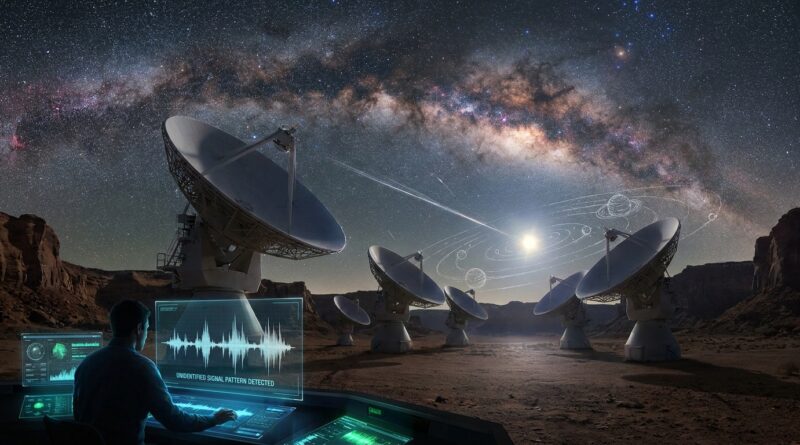
The Planet That Just Spoke Up: Why A New ‘Alien Radio Signal’ Has Astronomers Quietly Freaked Out
If you feel like every week brings a new “alien signal” headline, you are not imagining it. Most of them skip the part that actually matters. Was the signal narrowband or broad? Did it repeat? Did another telescope see it? Was it really coming from space, or from a satellite, a phone, or a glitch in the instrument? That is why this latest report of a mysterious radio signal from exoplanet territory has scientists interested, but still very cautious. The phrase “astronomers are puzzled” does not mean “ET is calling.” It means the signal has cleared a few basic filters and has not yet been explained away. That is a big difference. The interesting part is not the hype. It is the process. This is where modern astronomy gets real. Researchers now have better tools, better archives, and even help from citizen analysts to test whether a strange radio blip is natural, technological, or simply a very human mistake.
⚡ In a Hurry? Key Takeaways
- This new signal is interesting because it appears to come from the direction of an Earth-like exoplanet and has features that are not instantly easy to dismiss.
- The smartest way to judge any “alien signal” claim is to ask three things first: did it repeat, did independent instruments confirm it, and was local interference ruled out?
- No, this does not mean contact is close. It means astronomers have a candidate worth checking carefully, which is how real discoveries start.
Why this one got attention
Most strange radio detections die quietly. They turn out to be interference from Earth, instrument quirks, or known natural radio sources. So when a candidate survives the first round of checks, people inside astronomy start paying attention.
That seems to be the case here. The current buzz is about a recent, credible report of a radio signal detected from the direction of an Earth-like exoplanet system. That detail matters. “From the direction of” is not the same as “coming from the planet itself.” Telescopes often collect signals along a line of sight, and space is cluttered. You can be pointing at an exoplanet and still pick up something much closer to home.
Still, direction matters because it gives astronomers a target to test again. If the signal can be seen during repeat observations, especially when the planet is in view and not when it is not, the case gets stronger very fast.
What scientists actually mean by “puzzled”
This is the bit clickbait tends to flatten into nonsense.
When astronomers say they are puzzled by a signal, they usually mean one of a few things:
1. It does not match the usual junk
Radio telescopes are drowning in junk. Satellites, aircraft, ground transmitters, radar, and hardware noise all leave fingerprints. Scientists build filters for this stuff. A signal becomes interesting when it does not fit the obvious patterns.
2. It has some structure
A random burst is less exciting than a signal with a narrow frequency range, a drift pattern, timing structure, or some sign that it behaves like a transmission rather than static. That still does not prove intelligence. Nature can make very odd radio emissions too. But structure gives researchers something concrete to test.
3. It survives basic verification
If the team can show the signal was not present in control observations, was not seen in directions away from the target, and was not caused by known interference, then it moves from “internet rumor” to “real candidate.”
Why a mysterious radio signal from exoplanet systems is such a big deal
We have found thousands of exoplanets. Some are gas giants. Some are hellishly hot. A small number sit in the rough temperature range where liquid water could exist. So if a mysterious radio signal from exoplanet observations seems tied to a world that is rocky and roughly Earth-sized, people understandably sit up straight.
That does not mean life is likely there. It means the target is scientifically compelling. You are not just staring into the dark. You are looking at a place where conditions might, in principle, allow something interesting to happen.
What would make this candidate genuinely unusual
For a signal like this to move from “interesting” to “seriously important,” astronomers would want several boxes ticked.
Repeatability
The original Wow! signal from 1977 became famous precisely because it was so striking and so frustrating. It never repeated in a way that settled the case. That is why it remains a mystery, not a discovery.
If this new signal repeats under the same observing conditions, that changes everything. Repeatability is gold.
Independent confirmation
One telescope can be fooled. Two telescopes in different places seeing the same thing at the same time is far harder to dismiss.
A clean Doppler drift
Signals from space can shift in frequency because the source and Earth are moving. A drift pattern that matches an orbital or rotational source can be very informative. It still is not proof of technology, but it can help separate space-based origin from local interference.
Exclusion of known natural sources
Some planets and stars produce radio emissions naturally. Jupiter is the classic example. Its magnetic environment can generate powerful radio storms. Brown dwarfs can do weird radio things too. Before anyone says “technology,” astronomers have to work through the long list of natural possibilities.
Why Jupiter is the perfect reality check
If you want a good reminder that nature is fully capable of sounding strange, look at Jupiter. It can blast out intense radio waves linked to its magnetic field and its interaction with the moon Io. If we were seeing Jupiter from far away with incomplete data, some of those signals might look pretty odd at first glance.
That is one reason scientists stay careful. Space is not silent. It is noisy, active, and often bizarre in ways that have nothing to do with little green engineers.
How this compares with the Wow! signal
The Wow! signal is the benchmark because it had a few traits people dream about. It was strong, narrow, and surprising. But it had one fatal weakness. It did not come back in a way anyone could verify.
This new candidate is only “the next Wow! signal” if it combines surprise with follow-up success. Without that, it is just another unresolved blip. Interesting, yes. Historic, not yet.
The most likely explanations, in plain English
When a signal like this appears, there are usually three buckets.
1. Human interference
This is the boring answer, but it wins a lot. A surprising number of cosmic mysteries turn out to be something from Earth. Satellites are now such a big issue that they are a constant headache for radio astronomers.
2. Natural astrophysics
This is the second most likely bucket. Maybe the planet has a strong magnetic field. Maybe the star is active. Maybe plasma effects are doing something odd. Maybe another background object is fooling us.
3. Technology
This is the headline answer. It is also the hardest one to prove. Scientists do not avoid it because they are scared. They avoid jumping to it because extraordinary claims need brutal levels of evidence.
Why the new generation of observatories matters
This is where things get genuinely exciting.
Modern radio astronomy is much better than it was even a decade ago. Observatories can scan wider ranges of frequencies, store more raw data, compare observations faster, and use better software to sort true celestial signals from local contamination.
That means a mysterious radio signal from exoplanet observations today has a better chance of being tested properly than the Wow! signal ever did. We are still not close to easy answers, but we are much better at asking the right questions.
Citizen analysts are part of the story now
This is not just a job for giant telescopes and PhDs in dark control rooms.
Public data archives, open-source tools, and volunteer-led signal hunts mean skilled amateurs can help inspect patterns, flag repeat events, and compare candidate detections with known interference databases. That does not replace formal science. It does widen the net.
Sometimes the most valuable contribution is not finding aliens. It is spotting the boring explanation faster.
How to read future headlines without getting played
Here is the quick filter I use whenever a dramatic signal story appears.
Ask if it repeated
If not, keep your excitement in check.
Ask if another instrument confirmed it
If the answer is no, the case is still weak.
Ask whether the team published details
Real science gives other people enough information to challenge the claim.
Ask whether Earth-based interference was ruled out
This step is less glamorous than “alien megastructure,” but it is the step that matters most.
So how close are we really to detecting another technological civilisation?
Closer than we were 20 years ago. Not close in the movie sense.
We now have better exoplanet catalogs, stronger radio surveys, smarter software, and more ways to cross-check strange detections. That increases the odds of finding a real technosignature if one is out there and transmitting in a way we can detect.
But there is a harsh truth here. Space is huge. Civilisations may be rare, short-lived, quiet, using technologies we do not recognize, or simply nowhere near us. So the honest answer is that we are getting better at the search, not necessarily close to success.
At a Glance: Comparison
| Feature/Aspect | Details | Verdict |
|---|---|---|
| Signal source | Detected from the direction of an Earth-like exoplanet, but not yet proven to originate from the planet itself. | Interesting, but not confirmed |
| Comparison with Wow! signal | Like the Wow! signal, it has sparked interest because it is not instantly easy to explain. Unlike a true breakthrough, it still needs repeat detection and independent checks. | Promising candidate, not historic yet |
| Most likely outcome | Could still turn out to be interference or a natural radio process, especially if follow-up observations fail to reproduce it. | Caution strongly advised |
Conclusion
The smart response to this new report is not eye-rolling cynicism, and it is not “we found aliens.” It is careful curiosity. A credible, recent report of a strange radio signal from the direction of an Earth-like exoplanet has landed right in the middle of the science world and the UFO world, and both are already doing what they always do. One side says it is probably nothing. The other says it changes everything. The truth is more useful than either extreme. What makes this candidate worth watching is not that it proves a technological civilisation exists. It does not. It is that it appears to have done enough to escape the “obvious junk” bin, at least for now. That alone is interesting. The next step is the one that matters most. More observations, more checks, more attempts to break the claim. That is how astronomy works when it is being honest. And if you want to stay sane while the internet argues in circles, that grounded approach is still the best signal to follow.