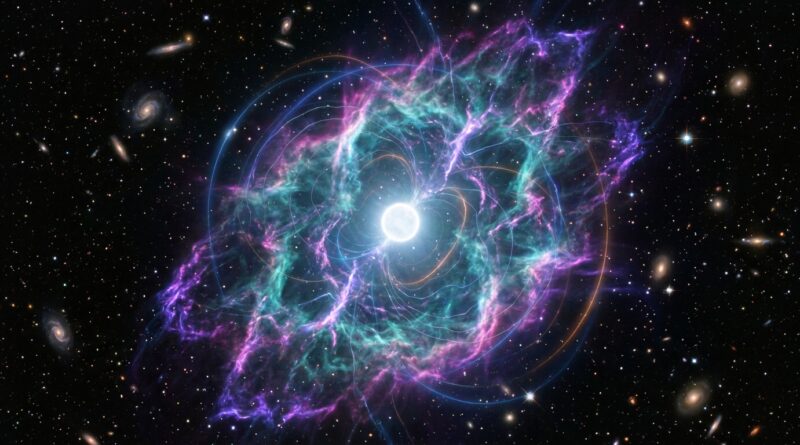
The Dead Star That Turned Back On: Why One Cosmic Corpse Is Firing a ‘Mystery Engine’ No One Can Explain
You are not wrong to roll your eyes at space “mystery” headlines. A lot of them boil down to “astronomers found something interesting, then mostly explained it by paragraph three.” This one is different. Researchers are looking at a dead star, the leftover core of a once-normal star, and it seems to be powering a huge shock wave it should not have enough energy to drive. By the usual rulebook, this object ought to be cooling off and fading into the cosmic background. Instead, it looks like it switched something back on. That is why astronomers are not just calling it unusual. They are openly talking about a “mystery engine.” That phrase matters, because scientists usually resist dramatic labels unless the evidence has already knocked out the boring explanations. No obvious accretion disk. No easy energy source. Just a stellar remnant acting like it still has unfinished business, and a growing pile of data saying the puzzle is real.
⚡ In a Hurry? Key Takeaways
- This mystery shock wave dead star discovery 2026 stands out because the star remnant appears to be powering a large shock structure with no clear fuel source.
- When you see follow-up coverage, watch for three clues: signs of hidden companion material, magnetic activity, or fresh high-energy emissions that could explain the engine.
- The value here is not hype. The research team has already ruled out some standard explanations, which makes this a rare, high-signal space anomaly worth tracking.
What actually happened
At the center of the story is a stellar corpse. Think of it as the compact leftover after a star has already gone through its dramatic phase. Normally, this kind of object is not supposed to be a powerhouse forever. It should lose energy, settle down, and gradually become less eventful.
But astronomers spotted something big around it. An enormous shock wave structure. In plain English, a shock wave in space is what you get when fast-moving material plows into surrounding gas and dust hard enough to create a cosmic traffic jam. That takes energy. Usually, lots of it.
The problem is simple to say and hard to solve. The dead star looks too small and too spent to be driving what researchers are seeing. It is like finding a parked car somehow creating a giant wake in the water.
Why scientists are calling it a “mystery engine”
This phrase is doing real work here. It does not mean “aliens,” and it does not mean scientists have no ideas at all. It means the observed effect is stronger than the known source should be able to produce.
In cases like this, astronomers usually test the standard suspects first.
Suspect number one: hidden feeding
One of the most common ways a dead star can look active is by stealing matter from something nearby. If gas spirals onto the remnant, it can form an accretion disk. That falling material heats up, shines brightly, and can power jets, outflows, or shocks.
That would have been the easy answer here. But the team says they do not see the signs they would expect from an accretion disk. If that holds up, a major explanation comes off the table.
Suspect number two: leftover blast energy
Maybe the shock wave is just old energy still moving outward from some past event. That can happen. Space is big, and old explosions can echo for a long time.
But the current interpretation suggests the structure is not just a fading relic. It looks like something is still feeding it, or at least recently did.
Suspect number three: we misjudged the star
This is the humbling option. Maybe the object is not quite what it seemed. Maybe it has a companion. Maybe its magnetic field is much stronger than expected. Maybe its spin is doing more work than anyone realized.
That is often how these stories end. Not with physics breaking, but with physics exposing a hidden detail we had not measured yet.
Why this is different from the usual overhyped “space mystery”
The best sign is what the researchers are not claiming. They are not pretending the answer is right around the corner. They are not stuffing the story with wild speculation. They appear to have done the first round of elimination and are being honest that the normal playbook is not enough yet.
That kind of honesty is rare, and useful. It tells you this is not just a neat image with a dramatic headline attached. It is an unresolved astrophysics problem with enough evidence behind it to make experts uncomfortable in a productive way.
How a dead star can still surprise us
Space has a habit of making categories sound cleaner than they really are. “Dead star” sounds final. In practice, many stellar remnants are more like hot wreckage than cold stones. They can spin fast, carry intense magnetic fields, interact with nearby gas, and in some cases flare or launch material.
So the phrase “turned back on” is not literal in the everyday sense. Nobody is saying a burnt-out sun simply restarted nuclear fusion like flicking a switch. What astronomers are saying is that something in or around this remnant is injecting fresh energy into its surroundings, and the visible shock wave is the clue.
What the shock wave tells astronomers
A shock wave is useful because it is not just pretty structure. It carries a record of violence. By studying its size, shape, brightness, and spectrum, scientists can estimate how fast material is moving, what it is hitting, and roughly how much power is needed to keep the whole thing going.
If those numbers stay high while the central object still looks underpowered, the puzzle gets sharper.
That is the heart of the mystery shock wave dead star discovery 2026. The engine and the effect do not seem to match.
The leading possibilities, in normal human language
1. A hidden companion is feeding it
This is still one of the safest bets in astronomy. A second object, perhaps dim or hard to separate, could be giving the dead star fresh material. If so, future observations may spot periodic motion, extra heat, or subtle changes in brightness.
2. Magnetism is doing the heavy lifting
Some compact remnants have magnetic fields so strong they can fling particles around at absurd speeds. If this object has an extreme magnetic setup, it might be able to power the shock more efficiently than expected.
3. We are catching a short-lived reactivation phase
Sometimes the universe behaves strangely because we happen to look at the right moment. A brief outburst, collision, or instability could make a fading remnant act lively for a while. That would make this a temporary state, not a permanent contradiction.
4. There is missing physics in the model
This is the option that gets people excited, carefully. Not “everything we know is wrong.” More like “our current models may be underestimating one process in extreme environments.” That is how science usually changes. Quietly at first, then all at once.
Why the Anomal community should care
This is exactly the kind of anomaly worth following. It is fresh. It is specific. It is not just a weird light in the sky with no context. It is a physically measurable mismatch between what a source should be able to do and what the surrounding structure says it has done.
That makes it much more valuable than vague “unexplained object” stories. You can watch the case develop through actual evidence. New spectra. Better imaging. Timing data. Revised energy estimates. Maybe even a complete reversal if a hidden companion turns up.
Either way, you learn something real about how astronomy works when the universe stops cooperating.
How to read future updates without getting fooled
Here is the practical part. If this story keeps spreading, a lot of outlets will oversimplify it. Some will jump straight to wild explanations. Others will overcorrect and act as if there is no mystery at all.
Watch for these signs in future coverage
Has the team found an accretion disk?
If yes, the mystery gets smaller fast. That would restore a familiar energy source.
Do new observations show a companion object?
A hidden stellar partner could explain a lot.
Are there X-ray, radio, or gamma-ray clues?
Those wavelengths often expose energetic processes invisible in ordinary light.
Did the estimated power of the shock wave change?
Sometimes the object stays the same, but the energy budget gets revised after better data.
Are scientists still using words like “unexpected” and “unexplained” in the paper itself?
That matters more than what a headline says.
What this says about science, not just space
One reason this story lands so well is that it shows science doing its job in public. A strange observation appears. Researchers test the obvious explanations. Some survive. Some do not. The team says, honestly, that there is still a gap between the model and the data.
That is not weakness. That is the system working.
The fun part is not pretending we already know the answer. The fun part is catching the moment when a tidy category breaks. A “dead” star is supposed to fade quietly. This one seems to be punching above its weight, and no one has pinned down how.
At a Glance: Comparison
| Feature/Aspect | Details | Verdict |
|---|---|---|
| Expected behavior of the dead star | A compact stellar remnant should mostly be cooling and fading unless it has a fresh energy source. | Current observations do not fit the quiet-fading picture. |
| Observed shock wave | The surrounding shock structure looks too large or too energetic for the visible source to power easily. | This is the core anomaly making astronomers pay attention. |
| Standard explanation check | Researchers have already pushed back on usual suspects, including an obvious accretion disk. | That is why the “mystery engine” label has real weight. |
Conclusion
This is worth your attention because it is not just another dramatic space headline. It is a fresh, high-signal anomaly: a small stellar remnant that by current physics should be fading quietly, yet appears to be driving an outsized shock wave with no visible fuel source. The team behind the discovery has already ruled out some of the usual suspects, including an obvious accretion disk, and is openly saying a “mystery engine” may be at work. That kind of blunt honesty is rare. For the Anomal community, this is exactly the sort of real-time puzzle that matters. You get to follow science while the answer is still genuinely unsettled, connect it to other cases where stars break expectations, and see how astronomers respond when the universe does something that should not be possible. Sometimes the best story in space is not a solved wonder. It is the one still refusing to behave.