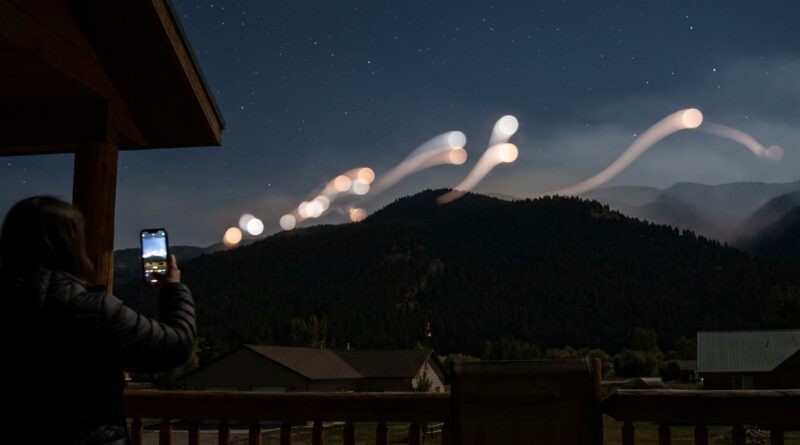
The Mountain That Glows After Dark: Why Mystery Orbs Over Wyoming Are Back And Stranger Than Ever
It is frustrating when a sighting is weird enough to grab your attention, but every explanation on offer feels wrong. That is exactly where people around Cody, Wyoming are right now. Reports of mystery orbs over Cedar Mountain Cody Wyoming describe silent lights rising from a ridge, hovering, splitting, merging, then sliding along the skyline with no obvious launch point, road traffic, or aircraft sound. If you have watched the clips and felt stuck between “it is probably nothing” and “it has to be aliens,” you are not alone. Most sky mysteries live in that uncomfortable middle. That is also what makes this case worth watching in real time. Unlike famous stories from decades ago, this one is happening now. That means witnesses can compare notes, check weather and flight data, revisit the same viewing spots, and test ideas while the trail is still warm instead of arguing over fuzzy legends long after the details are gone.
⚡ In a Hurry? Key Takeaways
- Right now, the Cedar Mountain lights do not have a confirmed single explanation, and the “easy” answers do not fully match the best witness descriptions.
- If you want useful evidence, record exact time, direction, weather, zoom level, and your location, then compare it with flight trackers, satellite passes, and local terrain.
- Stay on public land, do not chase lights into rough ground at night, and focus on collecting repeatable observations instead of forcing a dramatic conclusion.
Why these Wyoming orb reports are getting attention
A lot of strange-light stories fall apart fast. Somebody saw Venus through haze. A drone was closer than it looked. A medevac helicopter turned into a legend by the next morning.
That is not automatically what is happening here.
The reason people keep talking about the mystery orbs over Cedar Mountain Cody Wyoming is the behavior being described. Witnesses are not just saying, “I saw a light.” They are talking about multiple lights appearing over or near a ridge line, moving quietly, sometimes seeming to join together or break apart, then drifting away with no clear source.
That does not prove anything exotic. But it does push this beyond the usual one-line explanation.
The big problem with “boring” explanations
Boring explanations are often the right ones. That is just reality. The issue is that they still need to fit the details.
Drones
Drones are the first thing many people think of, and for good reason. They can hover, climb, change direction, and carry bright LEDs. But there are questions. How many drones? From where? Why are they repeatedly seen in that area? And if the lights are farther away than they appear, are hobby drones even practical at that distance and altitude, especially at night?
Also, many drone sightings include blinking navigation lights or obvious motion patterns. If witnesses are seeing large, steady glowing balls with odd grouping behavior, that can make the drone answer feel incomplete.
Vehicles on a ridge road
This is another classic explanation. Headlights on distant switchbacks can look bizarre after dark. They can appear to float, vanish, merge, or split when blocked by terrain. In fact, this is one of the first things investigators should check.
But again, the map has to cooperate. If there is no road at the apparent source point, or if the timing and movement do not match vehicle travel, then that idea weakens fast.
Aircraft
Planes and helicopters can look much stranger at night than people expect. A light moving toward you can seem stationary. Banking can make one light become two, then one again. Atmospheric haze can smear shapes.
Still, aircraft usually leave clues. Sound. FAA lighting patterns. A steady route. Transponder data, at least some of the time.
Stars, planets, or satellites
These explain a surprising number of reports, but probably not the strongest versions of this one. Celestial objects do not usually rise from behind a ridge, split in two, and drift low along the skyline in ways multiple observers can track against terrain features.
Why “wild” explanations feel tempting
This is the trap in every active sighting wave. If normal answers do not fit neatly, the mind jumps to the biggest answer available.
That is understandable. People want closure.
But “I cannot explain it yet” is not the same as “therefore it is paranormal, secret military, or non-human.” Good mystery reporting lives in the gap between those two statements. It is less flashy, but far more useful.
What might actually be happening
There are a few realistic possibilities worth testing before anyone declares victory.
Misjudged distance
This is huge. At night, distance is hard to judge. A small nearby light can look like a massive faraway orb. Or the opposite. If people are locking onto Cedar Mountain as the backdrop, the lights may actually be in front of it, behind it, or off to one side.
Terrain masking
Mountains and ridges play tricks. A moving light can vanish behind a rise, then reappear looking like a second object. Two lights can line up and seem to merge. One source can look like several depending on elevation changes and your viewing angle.
Atmospheric effects
Cool night air, dust, moisture, and temperature layers can distort brightness and shape. They can also make motion seem smoother or stranger than it really is. This does not explain every odd report, but it can make a normal light source look deeply weird.
Human-made activity that is not obvious from a distance
This can include ranch work, utility work, legal drone flying, off-road vehicles, camp lighting, or even coordinated hobby activity. The fact that locals cannot immediately identify the source does not mean there is no source. It just means nobody has pinned it down yet.
A practical field guide for investigating modern orb sightings
If you live near Cody or have your own local weird-lights story, here is how to make your observations actually useful.
1. Log the exact time
Not “around 9ish.” Use the exact minute and time zone. That lets others compare your sighting with aircraft data, satellite passes, weather shifts, and other witness reports.
2. Record your exact viewing location
Use your phone’s map pin or GPS coordinates. A sighting report without location is like a bug report without the device model.
3. Note the direction you were facing
Use a compass app. “Over the mountain” sounds helpful, but “bearing 278 degrees from the pullout” is much better.
4. Include landmarks in the video
Do not zoom in immediately. Start wide. Capture the ridge, trees, buildings, or power poles. Context matters more than a giant blurry glowing blob.
5. Say the details out loud while recording
Describe the time, place, direction, weather, and what changed. Your voice memo can save details you will forget later.
6. Check flight and satellite tools
Use public flight trackers, satellite pass websites, star map apps, and weather archives. None of these tools are perfect, but together they can knock out a lot of weak explanations.
7. Go back to the same spot
Repeat sightings are gold. If lights appear from the same place at similar times, that points to a pattern. Patterns are how mysteries become answers.
What locals should watch for next
If the Cedar Mountain lights continue, these are the details that will matter most:
- Do they appear on the same nights of the week?
- Do they show up at the same time window?
- Do they track along the same route relative to the ridge?
- Do they behave differently in wind, haze, or clear air?
- Are they visible from multiple separated viewpoints?
- Do they ever produce sound after a delay?
That last point is easy to miss. Sound can arrive later over distance. If witnesses pause and listen after the visual event, they may catch clues they missed in the moment.
How to avoid turning a real mystery into useless UFO noise
This part matters. Online mystery culture tends to ruin evidence.
People repost cropped clips. They strip away location and timing. Then everyone argues from a ten-second zoomed-in blob.
If you want this case to stay useful, keep the metadata attached. Save original files. Write down the date, time, and vantage point. Share the uncropped version first. If several witnesses are involved, compare notes before social media retelling smooths out the differences.
Small disagreements between witnesses are normal. They are not a problem. In fact, they can help reveal angle, distance, and timing.
Could it still be something extraordinary?
Yes. But that word needs discipline.
“Extraordinary” should mean the light behavior remains unexplained after basic checks, repeated observation, and location testing. It should not just mean “it looked creepy on my phone screen.”
The best outcome here is not proving a favorite theory. It is narrowing the list honestly.
At a Glance: Comparison
| Feature/Aspect | Details | Verdict |
|---|---|---|
| Drone explanation | Can explain hovering, coordinated movement, and bright lights, but may not fit all reports of silent long-range motion and repeated ridge appearances. | Possible, but not proven. |
| Vehicle or terrain illusion | A strong candidate if there are hidden roads, switchbacks, or lines of sight that create merge-and-split effects against the ridge. | Very plausible. Needs map and viewpoint testing. |
| Truly unexplained aerial phenomenon | Would require repeatable observations that rule out distance errors, local activity, aircraft, and atmospheric distortion. | Still on the table, but far from confirmed. |
Conclusion
The smart way to handle the mystery orbs over Cedar Mountain Cody Wyoming is to stay curious without getting sloppy. That balance is hard. It is also what makes this case worth following. Covering it now gives the community a chance to study a live mystery while details are fresh, compare sightings across different viewpoints, and build a practical playbook for future orb reports instead of recycling old stories with half the evidence missing. If these lights turn out to be something ordinary, good. We learn something real about how modern sightings fool us. If they do not, then careful notes, clear video, and shared pattern tracking are exactly how you keep a strange event from being forgotten, mislabeled, or dumped into the giant bin of generic UFO noise.