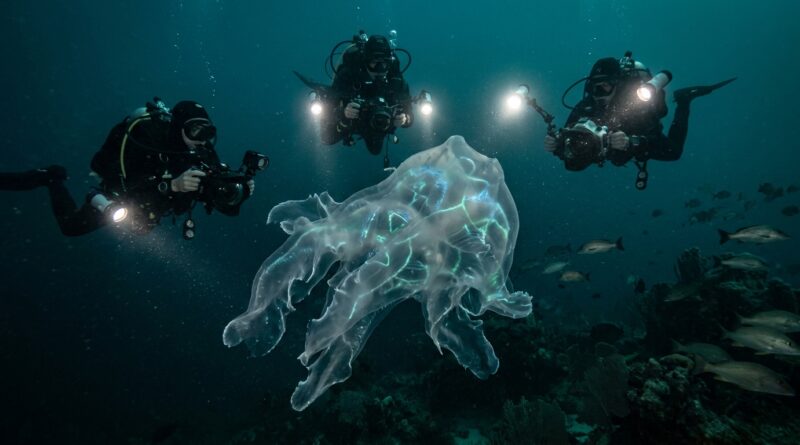
The Creature That Shouldn’t Be Here: Why Divers Off Florida Just Filmed an Unclassifiable Lifeform
If you are worn out by grainy sky videos and spooky stories that go nowhere, this one feels different. Divers off South Florida have reportedly filmed a translucent, shape-shifting organism that does not line up neatly with known jellyfish, salps, siphonophores, squid, or nudibranchs. That does not automatically mean “sea monster.” It does mean something more interesting to careful readers. We may be watching a real identification puzzle form in public, in real time. That is rare. The ocean is full of animals that look fake on camera, and South Florida waters are especially busy with drifting larvae, gelatinous colonies, and deep-water visitors pushed in by currents. But when trained eyes and local marine groups pause and say, “we are not sure yet,” that is the moment to pay attention. The best part is that regular people can now track the evidence as it develops instead of waiting years for a TV special to oversell it.
⚡ In a Hurry? Key Takeaways
- The unidentified marine life South Florida 2026 sighting looks unusual because the organism appears translucent, flexible, and hard to match to standard field guides.
- If you want to follow the case smartly, start with iNaturalist, regional marine-biology forums, and public ocean data instead of social media reposts.
- Do not touch or chase unknown sea life. Many gelatinous animals sting, tear easily, or become impossible to identify after disturbance.
What actually happened off South Florida?
Based on the early reports, a group of divers recorded a drifting organism with a body plan that seemed to change shape as it moved. Witnesses described it as translucent, soft-bodied, and difficult to classify from the footage alone. That last part matters more than the weird appearance.
The sea is full of animals that can fool even experienced observers. Some are nearly invisible in daylight. Some are not one animal at all, but a colony acting like one creature. Some only show up near the surface when currents, storms, temperature shifts, or nighttime light conditions push them into places people can see them.
So the honest first answer is simple. We do not know what it is yet.
Why this sighting has people taking it seriously
Most viral mystery clips fall apart fast. They are too blurry, too short, too edited, or too detached from any location data. This case seems more promising for three reasons.
1. The environment makes weird things possible
South Florida sits next to powerful current systems, reef zones, pelagic migration routes, and deep-water access. That means strange visitors can appear without breaking the laws of biology. Animals from offshore can show up where recreational divers usually expect familiar reef life.
2. “Unidentified” is not the same as “impossible”
Marine biologists use cautious language for a reason. Early uncertainty often means there is not enough information yet, not that nature has produced a monster. Good science starts with exclusion. Is it a jelly? A larval stage? A siphonophore colony? A damaged known species? A trick of refraction? Each option gets tested.
3. The footage may be only the start
If multiple divers, charter operators, or underwater photographers in the area report similar sightings in the next few days, the clip becomes more than a one-off curiosity. Patterns are what turn a strange video into a case worth tracking.
What could it be?
This is where excitement usually outruns evidence, so it helps to slow down.
A gelatinous drifter
The safest guess is still some kind of gelatinous marine organism. That broad group includes jellyfish, ctenophores, salps, pyrosomes, and siphonophores. Many of them are transparent. Many distort shape as they swim. Many look nothing like textbook drawings when filmed underwater.
A colonial animal
Some of the ocean’s strangest “creatures” are really groups of specialized bodies working together. Siphonophores are famous for this. They can look like a single animal, but they are more like a living team.
A juvenile or larval stage
This is one of the biggest reasons ocean identification gets messy. Young forms can look wildly different from adults. If the divers caught a life stage rarely seen by casual observers, even good identification tools may struggle at first.
A known species seen in unusual condition
Injury, partial predation, mating behavior, current stress, or camera angle can make a familiar organism look brand new. This is not a boring explanation. It is actually one of the most common reasons mystery sightings stay unsolved for a while.
Why the ocean keeps producing better mysteries than the sky
Space is dramatic, but the ocean is under-sampled, under-watched, and often physically hard to access. We have better maps of some distant surfaces than of stretches of seafloor close to major coastlines. That sounds absurd, but it is basically true.
And unlike a light in the sky, an unknown marine organism leaves more paths for real investigation. You can compare anatomy. You can track currents. You can check water temperature, salinity, and bloom events. You can ask nearby divers what they saw that same day. That gives this kind of case more traction than the average online mystery.
How people are already investigating it in public
This is where the story becomes useful, not just entertaining. If you want to follow the unidentified marine life South Florida 2026 case without getting buried in nonsense, there is a repeatable process.
Start with iNaturalist and photo databases
iNaturalist is one of the best places to begin because it mixes crowd input with knowledgeable reviewers. Search by location, date, and taxonomic group. You are not looking for a perfect match right away. You are looking for similar body shapes, textures, tentacle patterns, and movement styles.
Check public ocean data
Look at sea-surface temperature, current direction, recent storms, plankton bloom chatter, and unusual strandings. NOAA tools, buoy networks, and university dashboards can give helpful context. If a warm eddy or upwelling event moved through the area, that can explain why an offshore species appeared near divers.
Read specialist forums, not just viral threads
Marine-biology communities, dive science groups, and taxon-specific forums often do better work than big social platforms. They tend to ask the right boring questions. Exact location? Depth? Time of day? Water clarity? Animal size? Movement against current or with it? Was there stinging? Those details solve cases.
Preserve metadata
If original footage exists, the most valuable version is the least edited one. Cropped clips with dramatic music are fun for views and terrible for analysis. A stable full clip with date, depth, and camera details can be worth much more than a hundred reposts.
How to help without making the case worse
Citizen science is great until people start poking things.
If you dive
Keep distance. Film steadily. Get a size reference if possible. Record depth, water temperature, time, and location. Note whether the animal appears to propel itself or simply drift. Do not collect it unless you are part of a permitted scientific effort.
If you are online
Share the earliest source you can find, not the loudest account. Separate confirmed facts from guesses. If an expert offers a possible ID, do not frame that as a debunking attack. That is the process working.
If you just want the truth
Be patient. Ocean identification often takes a while, especially when footage shows an unusual angle, life stage, or damaged specimen.
What would count as strong evidence?
People often ask for “proof,” but it helps to be specific.
- Multiple independent videos from the same region
- Clear still frames showing body structure
- Depth, date, current, and temperature data
- Agreement from several specialists after comparison with known species
- A physical specimen, only if ethically and legally obtained
Until then, the most sensible label is still unidentified, not undiscovered and definitely not supernatural.
Why this case matters even if it turns out to be a known species
Some readers feel let down when a mystery gets explained. I think that misses the best part. A solved case is still a win if it teaches people how to watch carefully, document well, and follow evidence instead of hype.
And if the South Florida organism does turn out to be a known but rarely seen species, that is still a reminder that our local waters hold far more surprises than most people realize. The ocean does not need aliens to be strange.
At a Glance: Comparison
| Feature/Aspect | Details | Verdict |
|---|---|---|
| Visual oddity | Translucent body, shifting form, hard-to-read anatomy in diver footage | Interesting enough to investigate, not enough to classify yet |
| Most likely explanation | A gelatinous or colonial marine organism, possibly a rare life stage or unusual presentation of a known species | Best working theory for now |
| Best way for readers to help | Track original footage, use iNaturalist, compare with public ocean data, avoid sensational reposts | Useful and repeatable approach |
Conclusion
This is what makes the South Florida sighting worth your time. It is fresh, unresolved, and open to real investigation right now. Not ten years from now, after the story gets sanded down into a documentary script. Whether the organism ends up being a rare jelly-relative, a colonial drifter, an overlooked larval form, or something genuinely unexpected, the public can watch the science happen in the open. That is the real value here. Platforms like iNaturalist, open ocean-sensor networks, and marine-biology forums give ordinary readers a practical way to join the hunt on day one. And the bigger lesson is hard to ignore. The deep and the nearshore still hide things from us. Strange acoustic events, odd nudibranchs, and now this larger unknown all point in the same direction. We have mapped Mars with more confidence than some of the water just off our own coast. That should keep all of us paying attention.