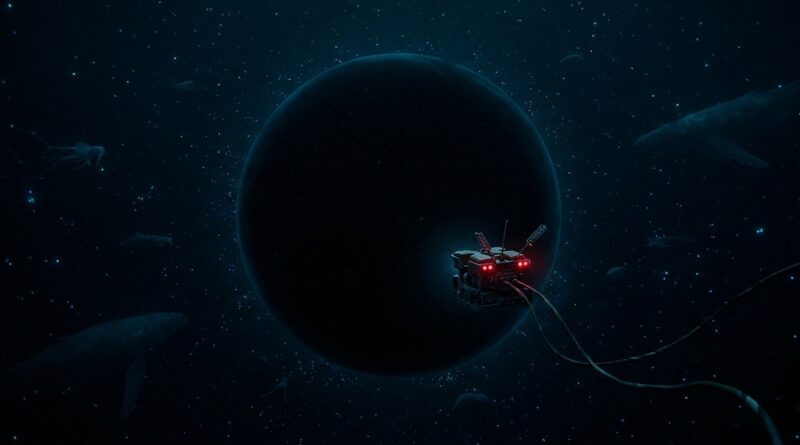
The Ocean’s ‘Blackout Zones’: Why New Deep-Sea Silence Patches Are Spooking Scientists
You can only watch the same shaky lights-in-the-sky clip so many times before your eyes glaze over. I get it. A lot of people who love mysteries feel stuck in a loop, rehashing old UFO footage while the biggest unknown on Earth sits right under us. The ocean is still badly under-watched, and now it is serving up something genuinely strange. Acoustic researchers and ocean-monitoring teams are reporting patches of water where the normal soundtrack of the deep seems to vanish. Not just fewer whale calls. Not just a quiet day. Whole areas where fish chatter, mammal clicks, and even the usual low rumble of the sea appear to drop out into what some observers are calling blackout zones. That does not automatically mean aliens, secret bases, or sea monsters. But it does mean something unusual may be happening in one of the least understood places on the planet, and this time the anomaly is happening in real time.
⚡ In a Hurry? Key Takeaways
- Scientists are paying attention to deep sea unexplained acoustic anomaly blackout zones because some underwater regions seem far quieter than normal for reasons that are not yet clear.
- You can follow hydrophone networks, ocean observatories, and citizen science audio projects to track unusual silence events instead of relying on recycled viral clips.
- Silence is not proof of anything supernatural. It could come from changing water layers, equipment limits, migration shifts, industry noise patterns, or something genuinely new that needs study.
What are these so-called blackout zones?
Think of the ocean like a giant, messy sound system. Even when nothing dramatic is happening, it is rarely silent. There are shrimp snaps, distant whale songs, ship noise, shifting sediment, storms, ice cracking in polar regions, and the constant low-level hiss of water in motion.
That is why reports of expanding ultra-silent patches are so weird. These are not just places with less animal activity than usual. The concern is that some monitoring systems are logging stretches where the expected sound mix appears sharply reduced or oddly absent.
To be clear, scientists do not all use the term “blackout zones.” It is more of a plain-English label for readers. Researchers would usually talk about anomalous acoustic attenuation, unexpected low-noise windows, propagation effects, ecological absence, or data gaps that cannot be explained right away.
Why scientists are uneasy, even if they are being careful
Good scientists are trained not to panic in public. They check the boring explanations first. That is exactly what makes this interesting. If careful people are quietly saying, “This is odd,” it is worth paying attention.
The deep ocean should not behave like a perfectly padded room. Sound travels extremely well underwater. In fact, that is one reason navies, marine biologists, and oceanographers depend so heavily on acoustics in the first place. If a patch of sea seems to go acoustically dead, there are only a few broad buckets to check.
1. The animals really left
This would still be a big deal. If whales, fish, and squid all avoid or leave a region, that points to changes in temperature, oxygen, prey supply, pollution, underwater construction, military activity, or seismic disturbance.
2. The sound is being bent, trapped, or scattered
Water is layered. Temperature, pressure, and salinity all change how sound moves. Sometimes sound can be funneled over huge distances. Other times it can be deflected away from a sensor. That means a “silent” zone may be more about physics than missing life.
3. The gear is missing part of the picture
Hydrophones are amazing, but they are not magic. Placement matters. Calibration matters. Signal processing matters. A software filter that removes what looks like noise can accidentally hide something important.
4. There is an environmental shift nobody expected
This is the category that gives people chills. Not because it means something paranormal, but because it could point to a real ocean change we do not yet understand.
Why the deep sea is the perfect place for a real mystery
Space gets the headlines. The ocean deserves more of them. We have mapped the surfaces of some planets better than large parts of our own seafloor. And unlike the sky, where millions of people can point a phone upward, the deep ocean needs expensive gear, patient monitoring, and a lot of interpretation.
That makes it easy for a strange pattern to stay niche for a long time. It also means early reports can get messy fast. One person hears “unexplained acoustic anomaly” and jumps to a hidden civilization. Another hears the same phrase and assumes broken equipment. Usually the truth is less dramatic than either extreme, but more interesting than both.
What could cause a deep sea unexplained acoustic anomaly blackout zones event?
Let’s keep both feet on the ground. Here are the most likely explanations researchers would check first.
Changing ocean layers
The ocean is not one uniform body of water. Different layers can act a bit like warped glass for sound. A hydrophone may suddenly stop “hearing” the usual background because the sound path has shifted.
Marine life migration or die-off
If the biological noisemakers leave, the sea gets quieter. That can happen due to warming water, low oxygen, food-web disruption, shipping lanes, sonar disturbance, or industrial activity.
Weather and seasonal cycles
Storm energy, currents, and seasonal breeding behavior all shape underwater sound. A local silence might be unusual without being mysterious.
Human interference
Noise cancellation in data cleanup, military secrecy around acoustic systems, or gaps in public datasets can all make a region look stranger than it is.
Geological activity
Subsea landslides, methane release, hydrothermal vent changes, and tectonic movement can alter both biology and sound transmission.
Something genuinely new
This is the honest answer nobody likes because it is not tidy. Sometimes anomalies are real, and the models are simply behind reality.
What this does not mean, at least not yet
It does not mean we have discovered an underwater Bermuda Triangle. It does not prove unknown craft are hiding in trenches. It does not prove a cover-up.
But it does justify curiosity. And right now, curiosity matters because stories harden fast online. Once a neat explanation takes hold, people stop looking. That would be a mistake here.
How regular people can follow this without getting lost in nonsense
You do not need a submarine or a PhD to keep tabs on this. You just need a better filter for information.
Follow primary sources when possible
Look for ocean observatories, passive acoustic monitoring projects, marine biology labs, and seismology networks. If a claim only exists on social media and nowhere else, slow down.
Learn what “normal” sounds like
Many public hydrophone archives and educational clips can help train your ear. Once you know the usual clicks, moans, rumbles, and static, an unusual silence becomes easier to spot.
Log what you hear
If you follow public streams or archived datasets, keep simple notes. Date. Time. Source. Region. Duration of silence. Any known storms or ship traffic. Patterns matter more than one spooky clip.
Join citizen science projects
Some marine programs welcome help with tagging whale calls, identifying ship noise, or sorting unusual acoustic events. This is one of the best ways to stay grounded while still contributing.
Why this story matters more than another old sky video
Because this one can still move. It is not locked inside a decades-old tape or a blurry military clip that has already been argued to death. A deep sea unexplained acoustic anomaly blackout zones story is alive. Data can still come in. Monitoring can improve. The public can still watch the puzzle form before the final narrative gets packaged for everyone.
That is rare. Most “mystery” communities spend years fighting over old evidence. Here, there is a chance to watch something underreported unfold in near real time.
At a Glance: Comparison
| Feature/Aspect | Details | Verdict |
|---|---|---|
| What is being observed | Patches of ocean where expected background sound and animal noise seem sharply reduced or absent. | Interesting and worth tracking, but not proof of anything exotic. |
| Most likely explanations | Sound propagation shifts, animal movement, sensor limits, weather cycles, or environmental stress. | Start with these before jumping to dramatic theories. |
| Best way for readers to engage | Follow hydrophone data, compare reports, log anomalies, and help with citizen science classification work. | Useful, grounded, and a lot more productive than replaying the same old footage. |
Conclusion
The ocean’s silent patches may turn out to have a clean scientific explanation. If so, great. We will have learned something real about how the deep sea works. But if these acoustic deserts keep showing up, shifting, or expanding, then we may be looking at one of the most underreported anomalies around. That is why this matters. It moves the mystery conversation away from endlessly dissecting the same sky videos and toward a fresh puzzle unfolding right now. Better yet, regular people can do more than just argue. You can follow the research, track hydrophone events, compare notes, and join citizen science efforts while the evidence is still taking shape. For a community hungry for something new, this is a far better place to start looking.