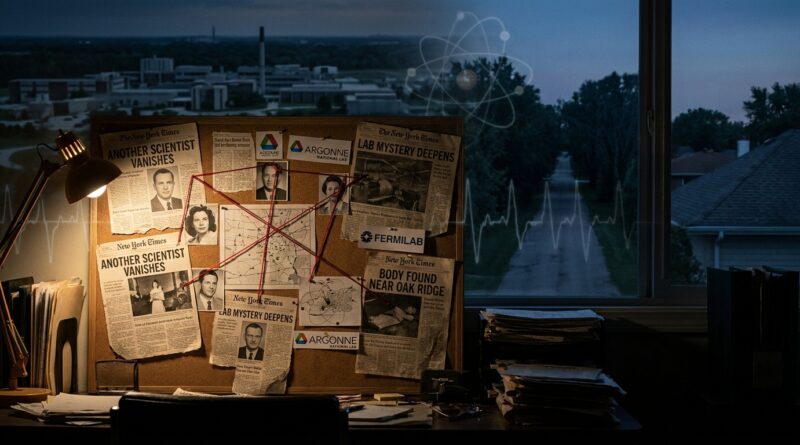
The ‘Missing Scientists’ Pattern: Why A String Of Strange Deaths Is Fueling A New High‑Strangeness Mystery
If you have been seeing headlines about scientists dying, disappearing, or turning up in deeply strange circumstances, the uneasy feeling is understandable. A lot of these stories sound like conspiracy bait on first read. Then you notice the same kinds of institutions keep showing up. National labs. Aerospace programs. Energy research. Advanced materials. That is when curiosity turns into real concern. The latest spike centers on reporting around Los Alamos staffer Melissa Casias, which is now being discussed alongside a broader White House level review of several unexplained or controversial scientist deaths and disappearances in the United States. That does not prove a hidden plot. It does mean this is no longer just internet message board fuel. The smart way to approach a story like this is simple. Start with what is confirmed. Separate patterns from coincidences. Then ask whether the pattern is strong enough to deserve deeper scrutiny, without sprinting straight into fantasy.
⚡ In a Hurry? Key Takeaways
- The current mysterious missing scientists deaths 2026 story is real as a pattern of concern, but the evidence does not yet prove a single coordinated cause.
- When you read new claims, check for three things first: named sources, official documents, and whether separate cases actually share more than a dramatic headline.
- The safest way to follow this story is to stay with documented facts, because unresolved deaths and disappearances attract rumor faster than almost any other kind of news.
Why this story is catching fire again
Some news cycles are built to spread. This is one of them.
You have tragic deaths. Missing people. Sensitive workplaces. Public distrust. And now, fresh reporting tied to a White House level review. That mix almost guarantees viral attention.
What makes this different from a normal true-crime spike is the setting. These are not random names pulled from nowhere. They are people connected, directly or loosely, to institutions that already carry an aura of secrecy. Los Alamos. Space-related work. Energy systems. Exotic materials. Once those labels appear, people start filling in blanks on their own.
That is exactly why this needs a calm read.
What we actually know so far
At the center of the current wave is renewed attention on the death of Melissa Casias, a Los Alamos staffer, and how that case is being discussed next to other scientist deaths and disappearances that remain disputed, unresolved, or publicly confusing.
Here is the important distinction. There are really three different buckets in play, and they often get mashed together online:
1. Confirmed deaths with disputed circumstances
These are cases where a death is real and documented, but the exact cause, motive, or surrounding facts are being challenged by family, media, or independent researchers.
2. Missing-person cases involving technical or research backgrounds
These cases tend to attract instant attention because a disappearance in a specialized field can look sinister even when the evidence is thin.
3. Retroactive pattern-building
This is when older deaths, accidents, suicides, and disappearances are gathered into one big narrative after the fact. Sometimes that helps reveal something meaningful. Sometimes it creates a pattern out of unrelated tragedies.
Right now, the honest answer is this: there is enough smoke to justify scrutiny, but not enough public evidence to claim one master explanation.
The pattern people think they see
The reason this story has legs is not just the body count, if that is the right phrase. It is the overlap in themes.
- Researchers tied to high-security or high-value institutions
- Fields with defense, energy, aerospace, or strategic importance
- Cases with public gaps, odd timelines, or conflicting reports
- Victims who seemed to be in the middle of ordinary lives, not obvious crisis points
That does not automatically equal foul play. But it does explain why people keep paying attention.
Humans are good at seeing patterns, sometimes too good. If five people connected to advanced materials die over several years, your brain wants to connect them. Sometimes it is onto something. Sometimes it is just trying to force order onto chaos.
Three possible explanations, from ordinary to extraordinary
Coincidence plus attention bias
This is the least exciting explanation, but it has to stay on the table. Large research ecosystems employ thousands of people. Over time, some will die unexpectedly, some will go missing, and some cases will be handled badly by institutions or police. Once the public starts watching this category, every similar case gets added to the pile.
Institutional failure, not conspiracy
This is often the middle-ground answer. Maybe there is no hidden assassin or covert campaign. Maybe what we are seeing is a mix of mental health crises, workplace pressure, security-related silence, poor communication with families, and clumsy investigations. That can still create a very dark and suspicious-looking trail.
Targeted interference or suppression
This is the explanation most people jump to, and it should not be dismissed out of hand just because it sounds dramatic. Scientists can work on things that matter financially, militarily, or politically. If even one case involved intimidation, espionage, or deliberate harm, that would change the frame of the whole story. The problem is that public proof remains limited.
Why national labs and space-linked research make this feel bigger
Put bluntly, these are places where regular people already assume not everything is public.
Los Alamos is not just another workplace. It sits inside American scientific mythology. The same goes for research connected to propulsion, energy storage, strategic materials, satellite systems, and defense-adjacent engineering. When a person linked to one of those worlds dies unexpectedly, the public does not read it the same way it would read an office-worker obituary.
That may be unfair in some cases. It is also reality.
The institution itself becomes part of the story. Silence looks suspicious. Bureaucratic caution looks like a cover-up. And every delayed statement creates more room for people to invent their own.
How to read these cases without getting played
If you want to follow mysterious missing scientists deaths 2026 without sinking into nonsense, use a simple filter.
Ask what is primary and what is recycled
A lot of viral reporting is just one article quoting another article quoting a social post. Try to locate the first real source. Police statement. Coroner report. Court filing. Family interview. Employer confirmation.
Separate “unexplained” from “suspicious”
Those words are not the same. A case can be unexplained because facts are missing. It becomes suspicious only when actual evidence points that way.
Watch for category inflation
People will often group suicides, accidents, unsolved disappearances, and confirmed homicides together as if they are one thing. That may make a stronger headline, but it weakens the analysis.
Be careful with timing claims
When someone says, “This is the fifth scientist in two years,” check the dates, occupations, and actual connections. Sometimes the “string” is much looser than advertised.
What makes the Melissa Casias angle important
The significance is not just the individual case. It is the way it is being folded into a wider federal review conversation.
Once a White House level review enters the discussion, even in an early or limited form, the story changes shape. It moves from fringe obsession to institutional concern. That still does not mean every theory is true. It means enough unease exists that people in power think the cluster of cases needs another look.
And that is a fair reason for public interest.
Accountable speculation. What should happen next?
If officials want to calm this story down, they need to do the opposite of what institutions usually do in tense moments. They need to say more, not less.
- Clarify which cases are under review
- Explain the scope of any federal involvement
- Release timelines where possible
- Correct false claims quickly
- Show families that their questions are being taken seriously
That will not satisfy hardcore conspiracy communities. But it will help everyone else.
Because right now, the vacuum is the story. When official information is thin, the internet rushes in to fill the gap.
At a Glance: Comparison
| Feature/Aspect | Details | Verdict |
|---|---|---|
| Documented pattern | There are multiple reported deaths and disappearances involving people tied to science and research institutions, with renewed focus in 2026. | Real enough to investigate seriously. |
| Proof of a coordinated cause | Public evidence does not yet show that these cases are all linked by one operation, motive, or actor. | Not established. |
| Best way for readers to respond | Follow original reporting, avoid viral claim-chains, and treat each case as its own file until hard links are shown. | Most reliable approach. |
Conclusion
The reason this story matters is not because every strange death must hide a dark secret. It matters because unresolved patterns around real scientists, real institutions, and real families deserve better than either blind dismissal or wild-eyed fantasy. With new reporting on Melissa Casias feeding into a wider White House level review, this is clearly a live story again. The smart move is to keep your curiosity switched on and your standards even higher. That is how you sort signal from noise. And for readers drawn to high-strangeness that brushes up against government labs, space research, advanced alloys, and people who seem to vanish out of the middle of ordinary life, that balance matters. You can take the weird seriously without turning your brain off. In fact, that is the only way this story is worth following at all.